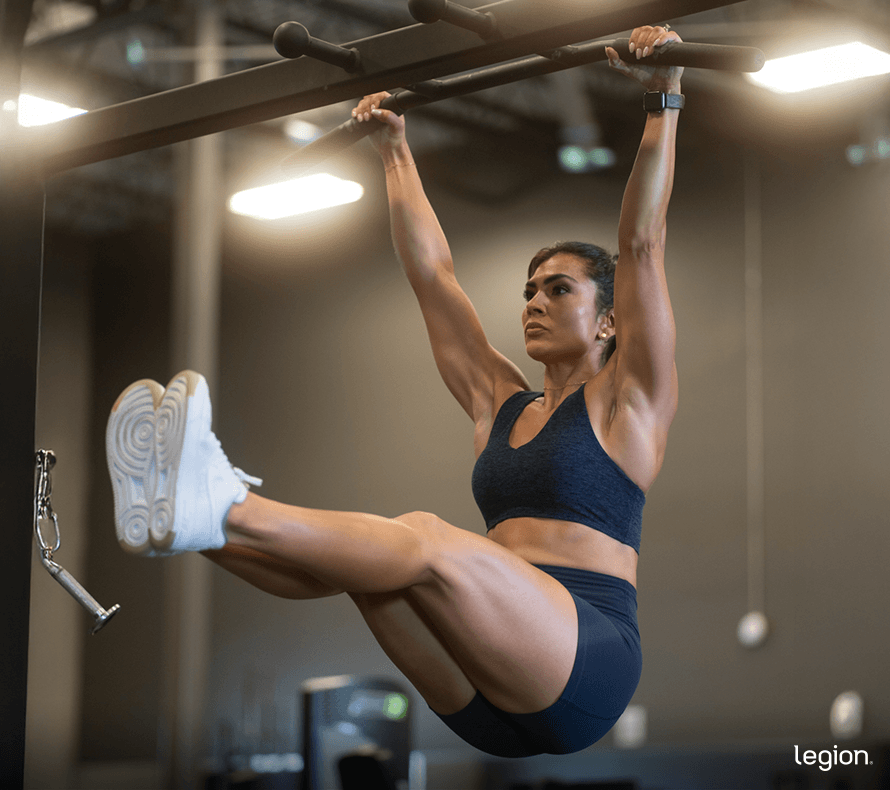
Your abs respond to strength training like any other muscle.
If you train them with effective exercises, focus on getting stronger (increasing the resistance), and get lean enough, they become “toned.”
This is the opposite of what most women do, though.
Instead, they do high-rep circuits and avoid weighted ab exercises, which is a great way to break a sweat but a poor way to develop your ab muscles.
Keep reading to learn why.
Key Takeaways
- The best ab workout for women includes exercises like the cable crunch, captain’s chair knee raise, and ab wheel rollout.
- Most women only need to train their abs 1-2 times per week to see results, and this usually only takes a few minutes at the end of your normal workouts.
- Ab workouts alone won’t give you a defined midsection—you also need to lower your overall body fat percentage. If you’re around 22% body fat or higher, you won’t have defined abs no matter how hard you train.
Table of Contents
+
The Best 10-Minute Ab Workout for Women
The best ab workout for women combines weighted and bodyweight exercises that train all the major muscles in your core and allows you to progressively increase the difficulty over time.
Here’s a simple, effective workout that does exactly that:
Legion AB Workout for Women
|
|
|

To finish this workout in 10 minutes or less, perform all three exercises back to back, resting only 10–15 seconds between exercises—just enough time to move from one station to the next. Once you’ve completed one round, rest 2–3 minutes and repeat until all your sets are finished.
The Ab Exercises in This Workout
The exercises in this workout cover your abs two main functions: bringing your chest and hips toward each other and keeping your torso stable.
Cable crunches bring your chest toward your hips, knee raises bring your hips toward your chest, and ab wheel rollouts train your core to stay tight as your body extends—giving you complete ab training in just a few movements.
Cable Crunch
Why: The cable crunch makes it easy to increase the weight you’re lifting over time, which makes it ideal for building strength and definition.
How to:
- Set the pulley to the highest position, attach a rope, and kneel facing the machine holding the rope at your forehead.
- Begin the movement by rounding your spine forward.
- Pull your elbows toward your thighs by contracting your abs while keeping your hips and arms fixed.
- Reverse the movement and return to the starting position.
Progression: Use a weight that allows you to do 10–20 reps per set. Once you can do 20 reps, add 5 pounds and build back up to 20 reps. Continue progressing in this way.
READ MORE: How to Do Cable Crunches: Form, Benefits & More
Captain’s Chair Knee Raise
Why: The captain’s chair knee raise trains the lower part of your abs, helping improve definition in the lower stomach.
How to:
- Set yourself on a captain’s chair with your back against the pad, forearms on the supports, and legs hanging straight down.
- Begin the movement by lifting your knees upward toward your chest.
- Raise your knees until your thighs are at least parallel to the floor while keeping your torso still.
- Reverse the movement and return to the starting position.
Progression: Start by doing 10–20 reps per set. As you get stronger, gradually straighten your legs to make the exercise harder. Once you can perform the movement with straight legs for 3 sets of 20 reps, progress to a more challenging variation like the hanging leg raise.
Ab Wheel Rollout
Why: The ab wheel rollout trains your entire core by forcing your abs to stay tight as your body extends, which helps build all-around core strength and stability.
How to:
- Kneel on the floor with an ab wheel in front of you and grab the handles with your arms straight.
- Brace your core and begin the movement by slowly rolling the wheel forward.
- Roll out as far as you can while keeping your back flat and your core tight.
- Reverse the movement and return to the starting position by pulling with your abs.
Progression: Start by performing the exercise from your knees for 10–20 reps per set. As you get stronger, cross your feet and lift them a few inches to increase the difficulty. When you can complete 3 sets of 20 controlled reps with your feet elevated, progress to a more advanced variation.
Why Ab Workouts Alone Won’t Give You Visible Abs
If your body fat percentage is already relatively low, training your abs will make a real difference in how defined your midsection looks. But if you have too much fat covering your abs, they won’t look defined no matter how many crunches you do.
To reveal them, you need to reduce your body fat percentage.
Unfortunately, training your abs won’t help with this. You can’t burn fat from one area by training the muscles underneath it. Instead, you have to lose fat overall.1 If you’re not sure how, check out this article:
How to Lose Weight Faster in 5 Simple Steps
That said, ignoring ab training while you’re losing fat is a mistake. Training your abs as you slim down improves how your midsection looks along the way and ensures that when you reach your goal, your abs already stand out.
In other words, don’t wait until you’re lean to start training your abs. Diet and train at the same time, and you’ll get better results both during the process and once you reach your goal.
Weighted vs. Bodyweight Ab Exercises for Women
Many women avoid weighted ab exercises because they think they’ll make their midsection look bulky or blocky. Instead, they stick to bodyweight exercises, believing these will create a more “toned” look.
This is a myth—bodyweight exercises don’t make your abs more toned than weighted ones.
If weighted ab exercises made your midsection bulky, you’d see it in the pictures below. These are women from Legion’s body transformation coaching program who regularly trained their abs with weight:
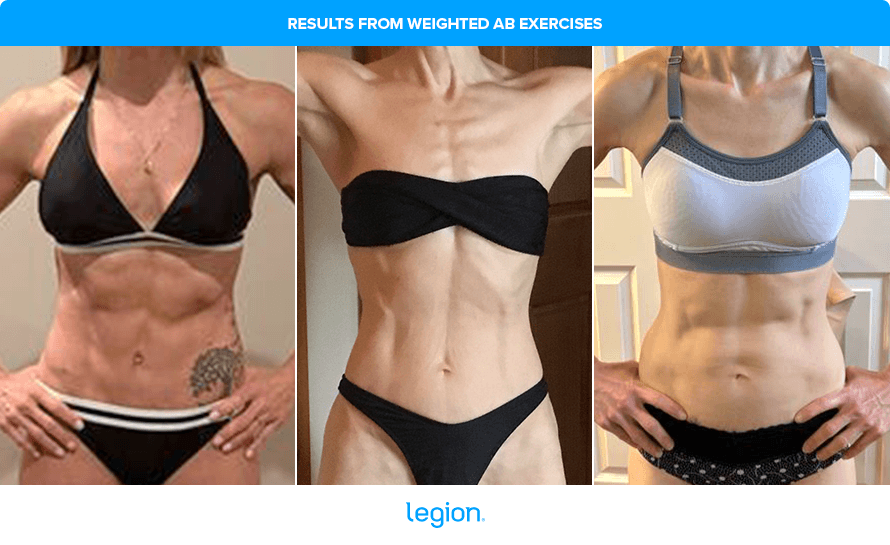
You can’t “tone” a muscle—you can only build it. And weighted exercises are often better for this because they make it easier to gradually increase resistance over time and train close to failure—both of which are essential for muscle growth.
That said, some bodyweight exercises also meet both of these criteria. The best ones—like knee raises and ab wheel rollouts—are challenging enough to let you train close to failure in a practical rep range, and they’re easy to make harder over time.
Start your ab workouts with a weighted exercise while you’re fresh and focus on increasing the load over time. Then follow it with challenging bodyweight exercises, which you can make harder as you get stronger.
Supplements to Support Your Ab Workouts
Women don’t need supplements to build strong, defined abs, but the right ones can help you get results faster. Here are three worth considering:
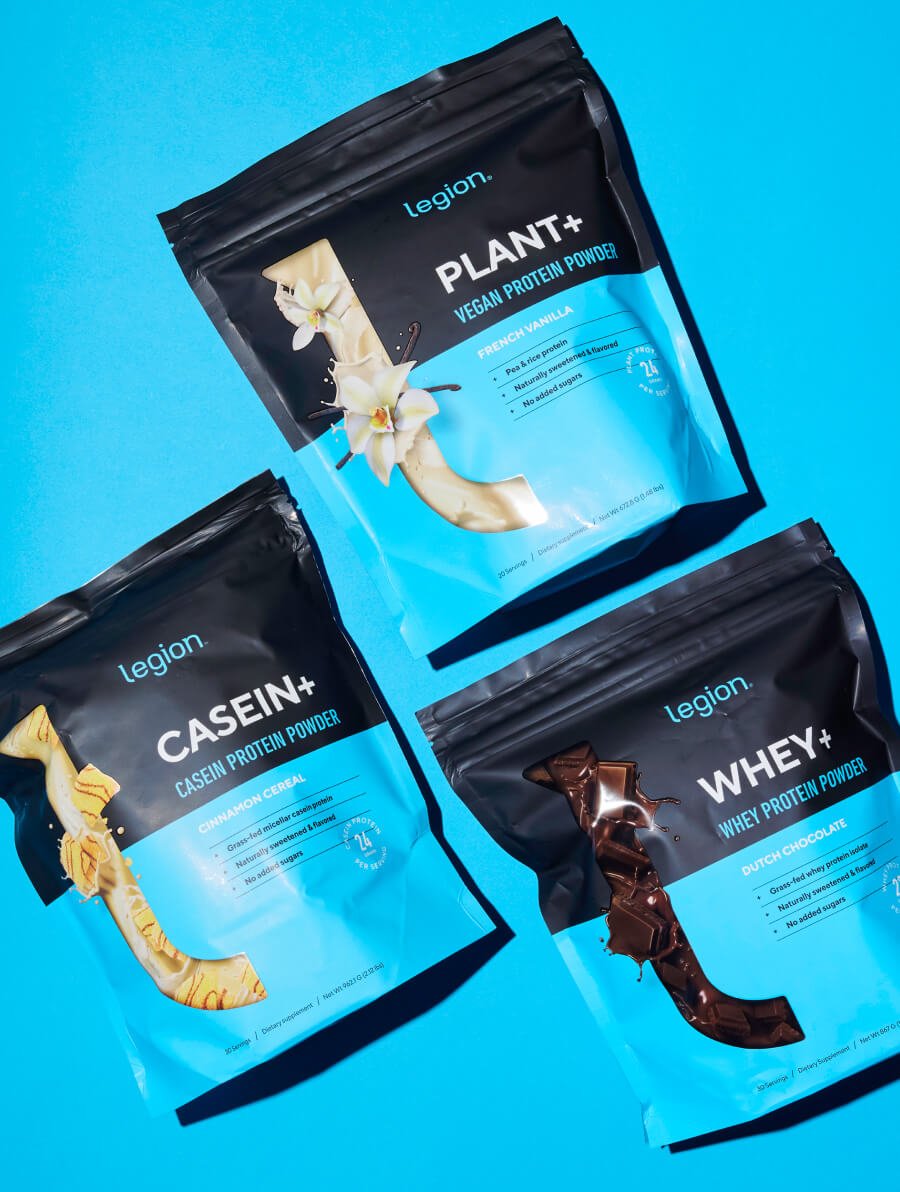
- Protein powder: Eating enough protein is essential for building and repairing muscle. Protein powders like Whey+, Casein+ and Egg+ make hitting your target easier.
- Creatine: Creatine boosts muscle and strength gain, improves anaerobic endurance, and reduces muscle damage and soreness.2 3 For a natural source of creatine, try Legion’s creatine monohydrate powder, creatine gummies, creatine capsules, or post-workout Recharge.
- Fat Burner: Effective fat burners contain ingredients that boost the number of calories you burn and reduce hunger and cravings, making weight loss more straightforward.
Want even more specific supplement advice? Take the Legion Supplement Finder Quiz to learn exactly what supplements are right for you.
How Often Should Women Train Abs?
If you follow a well-designed training program with plenty of compound weightlifting, you probably don’t need to train your abs as often as you think.
That’s because many compound exercises—like squats, deadlifts, rows, and presses—already heavily train your abdominals, obliques, and other core muscles.
For instance, a study conducted by scientists at Nord University measured the core muscle activity of twelve athletes during squats and weighted planks.4 The researchers found squats activated the abs and obliques just as effectively as planks, and the lower back muscles even more. Ab activation also increased with each rep of the squat, but not the plank.
If your program includes plenty of heavy compound lifting (which it should), you’re already training your abs hard each week. That’s why one focused ab workout per week is usually enough. I recommend you tack it onto the end of one of their regular workouts.
If your training contains fewer compound exercises or if you want to prioritize your abs, doing two ab workouts per week is a better approach. Just make sure to space them out (for example, Monday and Thursday) so your muscles have time to recover.
Ab Anatomy: What Muscles This Workout Trains
Your abs aren’t just one muscle—they’re a group of muscles that work together to move and stabilize your torso.
Here are the main muscles that make up your abs:

The main one is the rectus abdominis, which runs down the front of your stomach and creates the “six-pack” look. You train it when you bring your chest and hips toward each other, like in cable crunches and knee raises.
Your obliques sit along the sides of your midsection. You work them during all the exercises in this workout, especially when you have to stabilize your torso.
Finally, there are deeper core muscles, including the transverse abdominis, which help keep your spine stable. You don’t see these, but they’re heavily involved in exercises like ab wheel rollouts, where your abs have to stay tight as your body extends.
FAQ #1: What is the most effective ab workout for women?
The most effective ab workouts for women combine weighted and bodyweight exercises that train your entire core and allow you to progressively increase the difficulty over time. Focus on movements like cable crunches, leg raises, and ab wheel rollouts, and take your sets close to failure. For best results, pair your training with a diet that reduces your body fat percentage.
FAQ #2: Can you build abs with bodyweight exercises alone?
Yes, you can build your abs with bodyweight exercises alone—if you choose ones that are challenging enough. Exercises like knee raises, hanging leg raises, and ab wheel rollouts can build muscle when you take them close to failure and make them harder as you get stronger. Easier exercises done for 40+ reps per set won’t deliver the same results.
FAQ #3: Are weighted ab exercises better than bodyweight ab exercises?
Weighted ab exercises are often more effective because they make it easier to progressively overload your abs and train close to failure in a reasonable rep range. That said, challenging bodyweight exercises can work just as well.
For best results, use both—start your workouts with weighted movements, then follow with demanding bodyweight exercises.
Want More Content Like This?
Check out these articles:
- The Best Women’s Leg Workout for a Strong, Sculpted Lower Body
- The Best Arm Workout for Women to Build Toned, Defined Arms
- The Best Back and Biceps Workout for Women (45-Minute Routine)
Scientific References +
- ↩ KOSTEK, MATTHEW A., et al. “Subcutaneous Fat Alterations Resulting from an Upper-Body Resistance Training Program.” Medicine & Science in Sports & Exercise, vol. 39, no. 7, July 2007, pp. 1177–1185, https://doi.org/10.1249/mss.0b0138058a5cb. https://pubmed.ncbi.nlm.nih.gov/17596787/
- ↩ Eckerson, Joan M., et al. “Effect of Creatine Phosphate Supplementation on Anaerobic Working Capacity and Body Weight after Two and Six Days of Loading in Men and Women.” The Journal of Strength and Conditioning Research, vol. 19, no. 4, 2005, p. 756, https://doi.org/10.1519/r-16924.1. https://pubmed.ncbi.nlm.nih.gov/16287344/
- ↩ Bassit, Reinaldo Abunasser, et al. “Effect of Short-Term Creatine Supplementation on Markers of Skeletal Muscle Damage after Strenuous Contractile Activity.” European Journal of Applied Physiology, vol. 108, no. 5, 3 Dec. 2009, pp. 945–955, https://doi.org/10.1007/s00421-009-1305-1. https://pubmed.ncbi.nlm.nih.gov/19956970/
- ↩ van den Tillaar, Roland, and Atle Hole Saeterbakken. “Comparison of Core Muscle Activation between a Prone Bridge and 6-RM Back Squats.” Journal of Human Kinetics, vol. 62, no. 1, 13 June 2018, pp. 43–53, https://doi.org/10.1515/hukin-2017-0176. Accessed 31 Oct. 2019. https://pubmed.ncbi.nlm.nih.gov/29922376/