The best back and biceps workout for women includes deadlifts, one-arm dumbbell rows, lat pulldowns, and dumbbell curls. Do 3 sets of 8–10 reps per exercise, train 1–2 times per week, and gradually add weight or reps over time.
Most women don’t need a complicated routine to build a stronger, more defined back and biceps—they need a straightforward workout they can stick to and progress over time.
Training these muscles together is one of the most efficient ways to do that. Your biceps are involved in most back exercises, so you can train both muscle groups effectively in one session without spending hours in the gym.
In this article, you’ll learn a simple back and biceps workout for women that takes about 45 minutes, why the pairing works, and how to perform each exercise with proper form.
Key Takeaways
- Training back and biceps together is efficient because both muscles work during pulling exercises, so you can train them effectively in the same workout.
- A simple workout with deadlifts, rows, pulldowns, and curls trains your entire back and biceps in about 45 minutes.
- Most women should train back and biceps 1–2 times per week and aim for about 6–10 hard sets per muscle group per workout.
- For best results, focus on a few proven exercises, train close to failure, and aim to progress over time.
- You don’t need supplements to build your back and biceps, but a good pre-workout, creatine, and protein powder can help you train harder, recover better, and build muscle faster.
Table of Contents
+
The Best Back and Biceps Workout for Women
This workout is designed to help women build a stronger, more defined upper body without spending hours in the gym. It focuses on the exercises that give you the most return for your time, while also supporting the kind of balanced, athletic shape many women want:
- Deadlift: 3 sets | 8–10 reps | 3–5 min rest
- One-Arm Dumbbell Row: 3 sets | 8–10 reps | 3–5 min rest
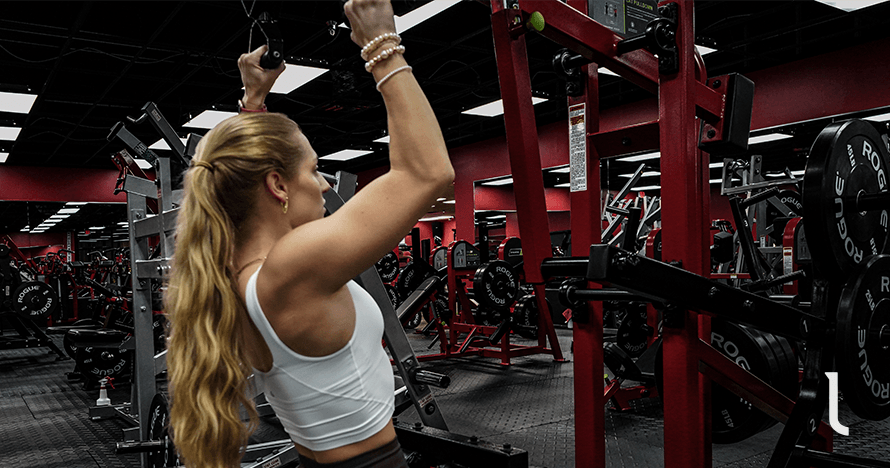
- Lat Pulldown: 3 sets | 8–10 reps | 2–3 min rest
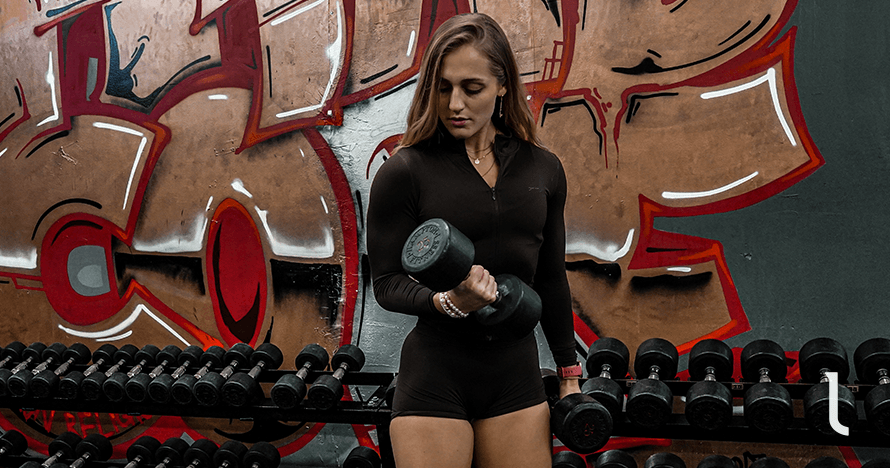
- Alternating Dumbbell Curl: 3 sets | 8–10 reps | 2–3 min rest
If you’re training at home, replace the deadlift with the dumbbell deadlift and the lat pulldown with a dumbbell pullover.
This workout is designed to train your entire back efficiently while keeping your sessions short and manageable—typically around 45 minutes.
In my experience coaching thousands of women through Thinner Leaner Stronger and Legion’s body transformation coaching, simpler workouts like this consistently produce better results than longer, more complicated routines.
And if you’d like proof, here are a few coaching clients who built noticeably stronger, more defined back and biceps muscle in just a few months using this approach:
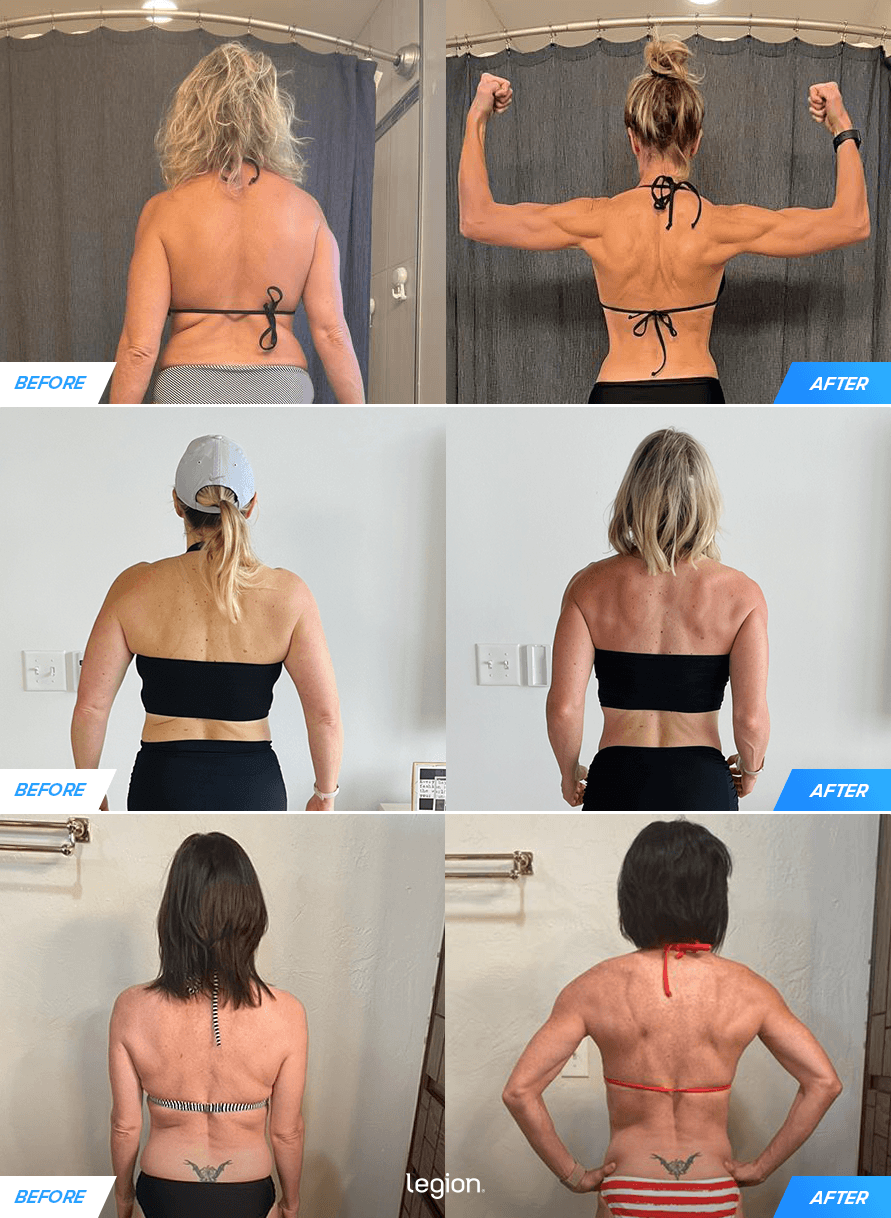
Now let’s look at why these exercises are so effective and how to perform them with proper form:
Deadlift
The deadlift lets you lift more weight than almost any other exercise, making it highly effective for building overall back strength and muscle. It also trains your glutes and hamstrings, helping you improve lower-body strength and shape at the same time.
How to:
- Stand with your feet shoulder-width apart and the bar over your midfoot.
- Grab the bar just outside your legs and flatten your back.
- Push through your heels and stand up with the weight.
- Reverse the movement and return to the starting position.
One-Arm Dumbbell Row
The one-arm dumbbell row trains your mid- and upper-back, helping you build a stronger, more defined upper body and improve posture.
How to:
- Hold a dumbbell in one hand and place the opposite hand and knee on a bench for support.
- Let the dumbbell hang straight down beneath your shoulder.
- Pull the dumbbell toward your torso while keeping your back flat.
- Reverse the movement and return to the starting position.
Lat Pulldown
The lat pulldown trains your lats, the muscles that give your upper body width. Building these muscles can make your waist look smaller and help create an “hourglass” shape. It’s also one of the best ways to build the strength needed to do pull-ups.
How to:
- Sit at a lat pulldown machine and secure your thighs under the pads.
- Grab the bar with a slightly wider-than-shoulder-width grip and sit upright.
- Pull the bar down toward your upper chest while keeping your torso mostly vertical.
- Reverse the movement and return to the starting position.
Alternating Dumbbell Curl
The alternating dumbbell curl trains your biceps, which help shape the front of your upper arms. Building your biceps makes your arms look more toned, defined, and athletic.
How to:
- Stand with your feet shoulder-width apart holding a dumbbell in each hand at your sides.
- Let your arms hang straight with your palms facing your thighs.
- Curl one dumbbell toward your shoulder while rotating your palm upward.
- Reverse the movement and return to the starting position, then repeat with the other arm.
Why a Back and Biceps Workout Works for Women
Training back and biceps together works well because it’s efficient—you can train both muscle groups in one session instead of splitting them across multiple days.
It’s also a natural pairing because your biceps are involved in most back exercises. When you do rows and pulldowns, your biceps help move the weight, so they’re already getting trained during your back workout.
Combining them also makes it easier to train more often. Most women should train back and biceps 1–2 times per week, and pairing them lets you do this efficiently while spreading your sets across the week and maintaining better performance in each workout.12
This keeps your workouts shorter and more manageable. Shorter workouts are easier to schedule, easier to recover from, and easier to stick to over time.
How to Structure a Back and Bicep Workout for Women
A well-structured arm and back workout for women starts with compound back exercises and finishes with a small amount of direct biceps work. This approach lets you lift the heaviest weights and train the most muscle when you’re freshest, which typically leads to better results than reversing this order.
In practice, that means you begin with deadlifts, rows, and pulldowns, and finish with curls.
Most women should also keep their workouts relatively simple.
You don’t need a long list of exercises to make progress. A few well-chosen movements, done with good form and effort, is usually enough.
Finally, your workout should match your setup.
If you’re training at home with dumbbells, your exercise selection will look different than if you’re training in a gym with machines and cables. The structure stays the same, but the tools you use can change.
How Long Should a Woman’s Back and Biceps Workout Be?
A back and biceps workout should usually last around 45 minutes. Evidence suggests muscle growth increases as you do more sets per workout, but peaks at around 6–10 sets per muscle group and may decline beyond that range:3
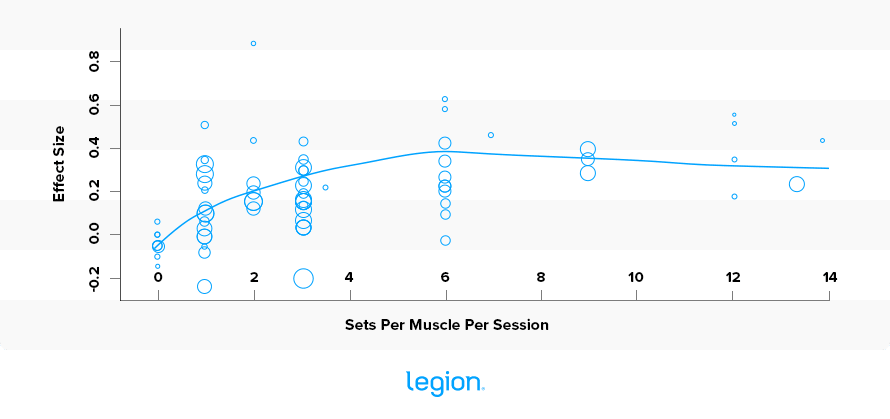
In other words, more isn’t always better. After a certain point, fatigue starts to outweigh the benefits, making your workouts less effective.
So the best approach is to do 6–10 sets for your back and 6–10 sets for your biceps, while accounting for overlap between exercises (since many back exercises also train your biceps). For example, if you do 3 sets of lat pulldowns, those sets count toward both muscle groups.
This is enough to stimulate growth without adding unnecessary fatigue.
If you structure your workouts this way, they’ll almost always take less than an hour—and short, focused workouts tend to produce better results than longer ones that push past the point of productive training.
Should You Use Supersets for Back and Biceps?
No, you shouldn’t use supersets for back and biceps workouts if your goal is to build strength and muscle. Supersetting these exercises fatigues your biceps too quickly, which makes your back training less effective.
The reason is simple: in a back-and-biceps superset, your biceps work in both exercises, but your back only works in one. This means your biceps accumulate more fatigue within each pairing and quickly become the weak link in your pulling movements.
As the workout goes on, your biceps give out first—and because your back relies on your biceps to help pull, your overall pulling strength drops even if your back still has plenty left in the tank.
The result is fewer reps with lighter weights, which reduces the quality of your training and can slow your progress over time.
A better approach is to keep your back and biceps exercises separate within the workout. Do your back exercises first using normal rest periods, then finish with your biceps work.
Supplements to Support Your Back and Biceps Workouts
You don’t need supplements to build your back and biceps, but the right ones can help you get results faster. Here are three worth considering:
- Protein powder: Eating enough protein is essential for building muscle. Protein powders like Whey+, Casein+ and Egg+ make hitting your target easier.
- Creatine: Creatine boosts muscle and strength gain, improves anaerobic endurance, and reduces muscle damage and soreness. For a natural source of creatine, try Legion’s creatine monohydrate powder, creatine gummies, creatine capsules, or post-workout Recharge.45
- Pre-workout: A quality pre-workout helps you train harder by boosting energy, focus, and athletic performance. Legion’s Pulse is available with or without caffeine.
Want even more specific supplement advice? Take the Legion Supplement Finder Quiz to learn exactly what supplements are right for you.
How to Progress a Back and Biceps Workout Over Time
Progress drives muscle growth—if you don’t gradually challenge your muscles more, your back and biceps won’t get stronger or grow.
To progress your workouts, focus on two things: training hard enough and gradually increasing the difficulty.
First, train close to failure.
Finish most sets 1–2 reps shy of failure—the point where you can’t complete another rep with good form.
A simple way to judge this is to ask yourself at the end of each set, “How many more reps could I have done?”
If the answer is more than two, increase the weight or reps on your next set to make it more challenging.
Second, increase the weight or reps over time.
For example, if your workout calls for 8–10 reps of the lat pulldown and you complete 10 reps in a set, increase the weight by 10 pounds for your next set.
If you do 7 reps or fewer in subsequent sets, reduce the load by 5 pounds to stay in the 8–10 rep range.
Apply this approach consistently, and your back and biceps will continue to get stronger and more defined over time.
The Bottom Line on Back and Biceps Workout for Women
Back and biceps workouts are simple, time-efficient, and effective. Training these muscles together lets you build strength, improve posture, and develop a more defined upper body without long workouts.
Focus on a few proven exercises, train close to failure, and aim to progress over time. Done consistently, this approach delivers results without unnecessary complexity.
FAQ #1: Can you train back and biceps together?
Yes, training back and biceps together is effective because both muscle groups are involved in pulling movements. Most back exercises also train your biceps, so combining them in one workout is efficient and avoids unnecessary overlap. This also makes it easier to train both muscles more than once per week.
FAQ #2: Can you do a back and bicep workout at home?
Yes, you can do a back and biceps workout at home using dumbbells. Exercises like dumbbell deadlifts, one-arm rows, pullovers, and curls can effectively train your back and biceps without machines. The structure stays the same—you just swap gym-based movements for dumbbell alternatives.
FAQ #3: What is the best back and bicep workout for women?
The best back and biceps workout for women includes a mix of compound and isolation exercises. A simple example is deadlifts, rows, lat pulldowns, and curls. This combination trains your entire back while also giving your biceps enough work to grow, without making the workout overly long or complicated.
FAQ #4: How often should women train back and biceps?
Most women should train back and biceps 1–2 times per week. Training twice per week usually produces better results because it allows you to spread your sets across multiple workouts while maintaining higher performance in each session.
Want More Content Like This?
Check out these articles:
- The Best Women’s Leg Workout for a Strong, Sculpted Lower Body
- The Best Arm Workout for Women to Build Toned, Defined Arms
- The Best Full Body Workout for Women (Gym or Home)