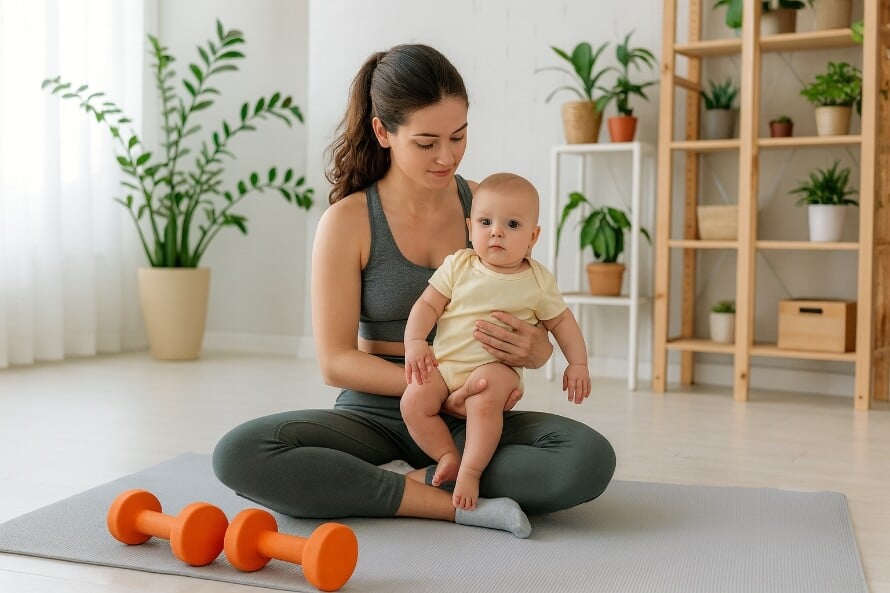
If you’re breastfeeding and trying to stay active, you’ve probably had this thought: “I’m exhausted. Can I just take my pre-workout again, or is that dangerous now?”
It’s a fair question—and one most new mothers never get a straight answer to.
Online advice swings from “absolutely not” to “just avoid caffeine,” but the science isn’t nearly that simple—or that confident.
This guide gives you the clear, evidence-based breakdown you’ve been looking for—so you can make a confident, personalized decision instead of guessing your way through it.
Key Takeaways
- Pre-workout isn’t automatically unsafe while breastfeeding, but most ingredients haven’t been studied in breastfeeding women or babies. Because of that, it’s smart to be cautious.
- Caffeine is the ingredient we know most about. It enters breast milk quickly, peaks in 1–2 hours, and newborns clear it very slowly.
- Artificial sweeteners also show up in breast milk and stay there for hours. We don’t know what long-term exposure means for babies, so many parents prefer naturally sweetened products.
- If you choose to use pre-workout, pick one with transparent labeling, low or no caffeine, and natural sweeteners, like stim-free Pulse.
- Pay attention to how your baby behaves. More fussiness, “wired” behavior, or trouble sleeping can be signs to cut back on caffeine or stop taking pre-workout while breastfeeding.
Table of Contents
+
Can You Take Pre-Workout While Breastfeeding?

Pre-workout isn’t necessarily off-limits while breastfeeding. But there’s enough uncertainty that you should be very cautious.
It helps to think of pre-workout ingredients in two broad buckets.
First, the “performance” ingredients like L-citrulline, beta-alanine, and betaine. These are there to increase pumps, delay fatigue, or boost power output.
They’re also the ingredients we know the least about in this context—we simply don’t have studies examining their safety in breastfeeding mothers or their babies.
There’s no obvious reason to think normal doses would be dangerous, but “no obvious reason to worry” is not the same as “proven safe.” For many parents, if something isn’t essential and hasn’t been properly studied, it’s reasonable to skip it while breastfeeding.
Second, the stimulants—mainly caffeine.
Caffeine is the ingredient we understand best (though still not particularly well):
- It gets into breast milk fairly quickly.
- Newborns (especially preterm babies) clear it much more slowly than adults.
- Very high intakes can make some babies fussy, jittery, and wide awake, while moderate intakes don’t consistently cause obvious problems in older, healthy infants.
So what does this mean for you?
- If the lack of data on most pre-workout ingredients feels like a red flag, avoiding pre-workout is a perfectly valid choice.
- If you’re comfortable using it, your decision should center on how much caffeine you’re consuming and whether that seems appropriate for your baby’s age and health.
How Pre-Workout Ingredients Affect Breastfeeding and Your Baby
Since caffeine is the only performance-enhancing ingredient we actually have breastfeeding research on, it’s the only one we can confidently comment on.
That said, many formulas also contain artificial sweeteners that can appear in breast milk, so they’re worth considering, too.
With that in mind, here’s how these ingredients behave in your body—and your baby’s.
Caffeine
Mothers close to giving birth clear caffeine much more slowly than non-pregnant women. Once you give birth, however, that changes quickly—your body starts handling caffeine the way it did before pregnancy.
From there, caffeine behaves pretty predictably: you absorb it quickly, levels peak after about an hour, and then taper off over the next six hours or so.
Your baby is a different story. Newborns (especially preterm babies) break down caffeine much more slowly than adults, which means even small amounts can hang around in their system. By around 3–5 months, their ability to clear caffeine looks more like yours.
In practical terms, that means:
- If you have caffeine, your breast milk reflects that fairly quickly.
- The caffeine doesn’t vanish after one feed—it lingers and fades over time.
- The younger and smaller your baby is, the less capable they are of dealing with even those small amounts.
That’s why dose, timing, and your baby’s age all matter when you’re deciding whether pre-workout caffeine fits into breastfeeding for you.
Artificial Sweeteners
Many pre-workouts use artificial sweeteners like acesulfame-K, saccharin, sucralose, or cyclamate that show up in your system—and your baby’s.
In one study on breastfeeding women, all of these sweeteners appeared in both blood and breast milk after a single dose. Levels in breast milk didn’t just spike and vanish, either—they tended to peak several hours after intake (often later than in blood) and then linger for a while.
Some, like acesulfame-K, showed much higher transfer into milk than others, meaning more of what you consume reaches your baby.
Other research has found various artificial sweeteners in both amniotic fluid and breast milk, and yet another study found newborns exposed to artificial sweeteners through breastmilk tended to vomit more—though it wasn’t able to show that the sweeteners were to blame.
While studies suggest regular consumption of these chemicals may indeed be harmful to our health, we don’t yet know what exposure means for a developing child. Because of that uncertainty, many parents prefer to limit how often they rely on sweetener-heavy products while breastfeeding.
How Much Caffeine Is Safe While Breastfeeding, and How Long Should You Wait to Breastfeed After Pre-Workout?
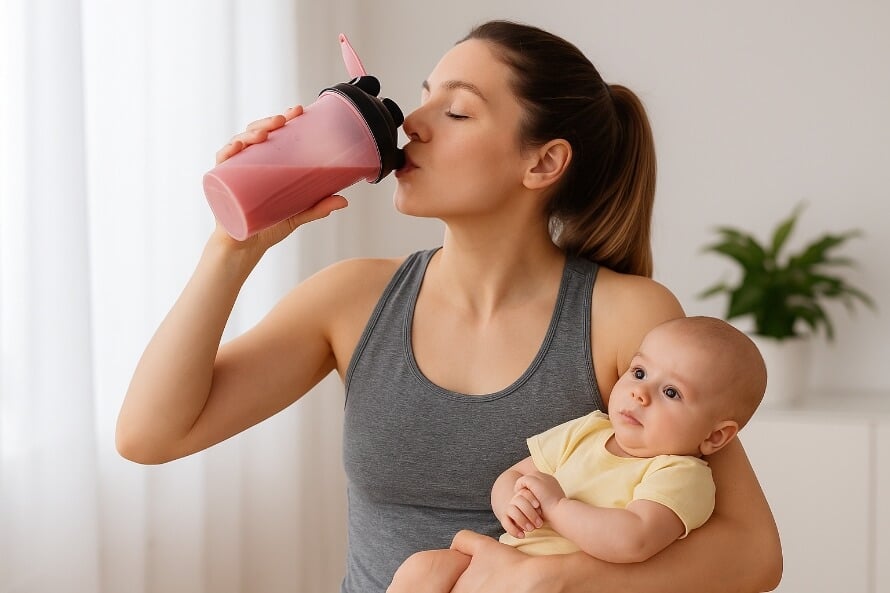
Most guidelines land somewhere in the 200–300 mg per day range as a conservative caffeine limit while breastfeeding. Some evidence suggests up to 300–500 mg may be fine for certain mothers, but the research is limited, so staying cautious is wise.
Remember, that’s total caffeine: coffee, tea, soda, energy drinks, chocolate, and your pre-workout all count.
As for timing, caffeine appears in breast milk quickly, peaks around 1–2 hours after you take it, and then declines gradually. That means there’s no magic waiting period where your milk suddenly goes from “full of caffeine” to “totally clear.” It’s more of a gradual slope down.
Taking your pre-workout right after a feeding can reduce how much caffeine your baby gets at the next feed, but it won’t eliminate it entirely. Your total daily intake, how often you nurse, and your baby’s age (especially if they were preterm) all matter more than any simple “wait X hours” rule.
Should You Use Pre-Workout or Stim-Free Pre-Workout While Breastfeeding?
A lot of breastfeeding moms look at pre-workout labels, see the caffeine, and think, “Okay, I’ll just use a stim-free version instead.”
Unfortunately, it’s not quite that simple.
Stim-free formulas skip caffeine, which helps, but they often still contain artificial sweeteners. As you’ve already seen, these sweeteners do transfer into breast milk, and while we don’t yet know what long-term exposure means for a developing baby, some research suggests that frequent intake of certain sweeteners may have negative health effects in general.
Because of that uncertainty, many health-conscious parents choose to avoid stim-free pre-workouts altogether or look for naturally sweetened options instead.
How to Choose a Safer Pre-Workout for Breastfeeding Moms

If you’ve talked with your healthcare provider and feel comfortable using a pre-workout, there are a few smart ways to lower the potential risks:
Caffeine
If you enjoy a morning coffee but don’t want to blow past your daily caffeine limit, look for a low-caffeine pre-workout.
If you can’t find a low-caffeine option that works for you, certain energy drinks can actually be a better fit—they often contain less caffeine than traditional pre-workouts while still offering ingredients that support focus and alertness.
And if you’d rather avoid caffeine altogether, a stim-free pre-workout is the next logical option.
Sweeteners
Since artificial sweeteners appear in breast milk, and some transfer more than others, it’s worth looking at which ones your product uses. Products that use natural ones like stevia or monk fruit are often preferred by breastfeeding mothers.
Transparent Labels
Avoid formulas that hide behind “proprietary blends,” “matrixes,” or “complexes.” Choose products that clearly list every ingredient and dose.
It’s also wise to choose brands that use independent, third-party testing to verify ingredient purity and dosing accuracy.
Supplements without this testing are more likely to contain undeclared ingredients or incorrect amounts, and inaccurate labels make dosing far harder to control—especially when you’re breastfeeding.
What to Watch For in Your Baby If You Use Pre-Workout
Even if you stay within conservative caffeine limits, it’s still worth keeping an eye on how your baby responds. Most of the concerning symptoms in the research come from very high maternal caffeine intakes—far beyond what you’d get from a typical pre-workout. But the patterns are still useful to know.
For instance, some research describes babies becoming fussy, jittery, restless, or unusually wakeful when their mothers consume extremely large amounts of caffeine (the equivalent of 5–10+ cups of coffee per day). In rare situations involving high caffeine intake, some infants have shown shaking or convulsive-like episodes, which resolved once the mother stopped consuming caffeine.
In practical terms, if you use pre-workout—or just drink a lot of caffeine in general—watch for:
- More frequent night waking
- Increased fussiness or “wired” behavior
- Trouble settling or obvious sleep disruption
- Any unusual or extreme symptoms (which always warrant prompt medical attention)
If you start noticing these patterns and your caffeine intake is on the higher side, it’s a good sign to stop drinking caffeine and talk with your pediatrician or another healthcare provider.
The Bottom Line on Taking Pre-Workout While Breastfeeding
Pre-workout isn’t automatically off-limits while breastfeeding, but it’s also not something to take lightly. We simply don’t have good research on most of the ingredients in these products, and even caffeine—the one ingredient we understand best—can affect babies differently depending on their age and sensitivity.
If you decide to use pre-workout, keep your total daily caffeine in a conservative range, choose products with transparent labels, and pay attention to how your baby responds. If they become unusually fussy, wired, or restless, it’s worth cutting back or stopping altogether.
And if the lack of data feels like too big of a question mark, skipping pre-workout or using a naturally sweetened stim-free option is always a perfectly valid choice.
FAQ #1: Is pre-workout ever really safe to take while breastfeeding?
There’s no research proving that pre-workout is fully safe while breastfeeding, but there’s also no evidence showing typical amounts are automatically harmful. The real issue is the uncertainty: most ingredients simply haven’t been studied in breastfeeding women or infants.
FAQ #2: How much caffeine from all sources (coffee, soda, pre-workout) is too much while breastfeeding?
Most guidelines suggest staying around 200–300 mg per day from all sources combined—coffee, tea, soda, chocolate, energy drinks, and pre-workout. Some evidence suggests higher intakes may be fine for certain mothers, but the research is limited, so staying conservative is the safest approach.
If you’re regularly going over that range or notice your baby getting fussy or wired, it’s a sign to cut back.
FAQ #3: Are stimulant-free pre-workouts safe to use while breastfeeding?
Stim-free pre-workouts avoid caffeine, which is helpful, but they often rely on artificial sweeteners and performance ingredients that haven’t been studied in breastfeeding. These sweeteners do show up in breast milk, and we don’t know what long-term exposure means for infants.
If you decide you want to use a stim-free product, a naturally sweetened option is generally the more conservative choice compared to formulas that use several artificial sweeteners.
FAQ #4: Can I “pump and dump” after taking pre-workout to make breastfeeding safer?
Pumping and dumping doesn’t reliably remove caffeine or sweeteners from your milk because these ingredients decline gradually, not all at once. Caffeine, for example, peaks 1–2 hours after you take it and then tapers off over several hours. Pumping won’t speed that up.
A better approach is to keep your total caffeine low, take pre-workout right after a feeding, and monitor your baby’s response to the next feed.
FAQ #5: What’s a safer way to boost workout energy while breastfeeding without using pre-workout?
If you’d rather skip pre-workout, a small cup of coffee or tea can give you a mild energy bump without the large caffeine load of many pre-workouts. A good playlist can also make a surprisingly big difference in workout energy.
Want More Content Like This?
Check out these articles:
- Creatine vs. Pre-Workout: Key Differences & Which to Take
- Is Pre-Workout Bad for Your Heart? What Science Really Says
- Dry Scooping Pre-Workout: What It Is and Why People Do It
Scientific References +
- “Caffeine.” PubMed, National Library of Medicine (US), 2006, www.ncbi.nlm.nih.gov/books/NBK501467/.
- McCreedy, Aimee, et al. “Effects of Maternal Caffeine Consumption on the Breastfed Child: A Systematic Review.” Swiss Medical Weekly, 28 Sept. 2018, https://doi.org/10.4414/smw.2018.14665. Accessed 10 Nov. 2020.
- Knutti, R., et al. “Effect of Pregnancy on the Pharmacokinetics of Caffeine.” European Journal of Clinical Pharmacology, vol. 21, no. 2, 1981, pp. 121–126, https://doi.org/10.1007/bf00637512. Accessed 9 Sept. 2021.
- Berlin, C. M., et al. “Disposition of Dietary Caffeine in Milk, Saliva, and Plasma of Lactating Women.” Pediatrics, vol. 73, no. 1, 1 Jan. 1984, pp. 59–63, pubmed.ncbi.nlm.nih.gov/6691042/. Accessed 9 Mar. 2024.
- Stavchansky, S., et al. “Pharmacokinetics of Caffeine in Breast Milk and Plasma after Single Oral Administration of Caffeine to Lactating Mothers.” Biopharmaceutics & Drug Disposition, vol. 9, no. 3, May 1988, pp. 285–299, https://doi.org/10.1002/bod.2510090307. Accessed 15 Nov. 2021.
- McNamara, Patrick J., and Maggie Abbassi. “Neonatal Exposure to Drugs in Breast Milk.” Pharmaceutical Research, vol. 21, no. 4, Apr. 2004, pp. 555–566, https://doi.org/10.1023/b:pham.0000022401.14710.c5. Accessed 21 Apr. 2022.
- Stampe, Sofie, et al. “Artificial Sweeteners in Breast Milk: A Clinical Investigation with a Kinetic Perspective.” Nutrients, vol. 14, no. 13, 1 Jan. 2022, p. 2635, www.mdpi.com/2072-6643/14/13/2635, https://doi.org/10.3390/nu14132635. Accessed 30 Mar. 2023.
- Concha, Francisca, et al. “Maternal Consumption and Perinatal Exposure to Non-Nutritive Sweeteners: Should We Be Concerned?” Frontiers in Pediatrics, vol. 11, 12 June 2023, https://doi.org/10.3389/fped.2023.1200990.
- Huang, Qiushi, et al. “Diet Beverage Intake during Lactation and Associations with Infant Outcomes in the Infant Feeding Practices Study II.” Nutrients, vol. 13, no. 9, 10 Sept. 2021, p. 3154, https://doi.org/10.3390/nu13093154. Accessed 27 Oct. 2021.
- Basson, Abigail Raffner, et al. “Artificial Sweeteners: History and New Concepts on Inflammation.” Frontiers in Nutrition, vol. 8, no. 8, 24 Sept. 2021, https://doi.org/10.3389/fnut.2021.746247.
- Suez, Jotham, et al. “Non-Caloric Artificial Sweeteners and the Microbiome: Findings and Challenges.” Gut Microbes, vol. 6, no. 2, 4 Mar. 2015, pp. 149–155, https://doi.org/10.1080/19490976.2015.1017700. Accessed 18 Aug. 2019.
- Qin, Xiaofa. “What Made Canada Become a Country with the Highest Incidence of Inflammatory Bowel Disease: Could Sucralose Be the Culprit?” Canadian Journal of Gastroenterology, vol. 25, no. 9, 2011, pp. 511–511, https://doi.org/10.1155/2011/451036.
- Laforest-Lapointe, Isabelle, et al. “Maternal Consumption of Artificially Sweetened Beverages during Pregnancy Is Associated with Infant Gut Microbiota and Metabolic Modifications and Increased Infant Body Mass Index.” Gut Microbes, vol. 13, no. 1, 31 Dec. 2020, p. 1857513, https://doi.org/10.1080/19490976.2020.1857513. Accessed 18 Sept. 2021.
- “Can Consuming Caffeine While Breastfeeding Harm Your Baby? An Interview with Ruth Lawrence, PhD.” Journal of Caffeine Research, vol. 1, no. 4, Dec. 2011, pp. 192–194, https://doi.org/10.1089/jcr.2011.1212.
- European Food Safety Authority. “Scientific Opinion on the Safety of Caffeine.” EFSA Journal, vol. 13, no. 5, May 2015, https://doi.org/10.2903/j.efsa.2015.4102.
- Ryu, Jacqueline. “Effect of Maternal Caffeine Consumption on Heart Rate and Sleep Time of Breast-Fed Infants.” Developmental Pharmacology and Therapeutics, vol. 8, no. 6, 1985, pp. 355–363, https://doi.org/10.1159/000457060. Accessed 20 Aug. 2020.
- Harty, Patrick S., et al. “Multi-Ingredient Pre-Workout Supplements, Safety Implications, and Performance Outcomes: A Brief Review.” Journal of the International Society of Sports Nutrition, vol. 15, no. 1, 8 Aug. 2018, jissn.biomedcentral.com/articles/10.1186/s12970-018-0247-6, https://doi.org/10.1186/s12970-018-0247-6.
- Rivera-calimlim, L. “Drugs in Breast Milk.” Drug Therapy, vol. 7, no. 12, Dec. 1977, pp. 59–63, pubmed.ncbi.nlm.nih.gov/12336945/.
- Bailey, D N, et al. “A Study of Salicylate and Caffeine Excretion in the Breast Milk of Two Nursing Mothers.” Journal of Analytical Toxicology, vol. 6, no. 2, 1982, pp. 64–8, pubmed.ncbi.nlm.nih.gov/7098450/, https://doi.org/10.1093/jat/6.2.64.
- Murphy, M, et al. Caffeine and Babies. July 1989, https://doi.org/10.1136/bmj.299.6691.121-a?.
- Martín, Itziar, et al. “Neonatal Withdrawal Syndrome after Chronic Maternal Drinking of Mate.” Therapeutic Drug Monitoring, vol. 29, no. 1, Feb. 2007, pp. 127–129, https://doi.org/10.1097/ftd.0b013e31803257ed. Accessed 24 Nov. 2022.