Instructions
- Hold a dumbbell in each hand with your palms facing your thighs and your arms hanging straight down.
- Stand with your feet a little narrower than shoulder-width, toes pointed slightly out, and a soft bend in your knees. Stand tall with your chest up, take a deep breath into your stomach, and brace your abs.
- With a flat back, push your hips backward and let the dumbbells travel down the front of your legs in a straight line, keeping them close to your body the whole way. Don’t bend your knees any further as you descend—leave them in that same slightly bent position from start to finish, which keeps the tension on your hamstrings.
- Lower until you feel a good stretch in your hamstrings, which is usually when the dumbbells reach just below your knees (your wrists end up roughly in front of your kneecaps). Stop before your lower back starts to round.
- Drive your hips forward to stand back up, keeping your arms straight, your core tight, and your lower back slightly arched until you return to the starting position.
Expert Tips
- If you struggle to feel your hamstrings and glutes working during the dumbbell Romanian deadlift, focus on keeping your back straight and your hips high, holding the dumbbells just in front of your shins, and lowering them just to the point you feel a deep stretch in your hamstrings, but no further.
- A good cue to keep your back straight and upper body stable is to imagine “crushing oranges in your armpits.”
- If your grip strength gives out before your hamstrings, glutes, and back, use weightlifting straps. While this makes the exercise “easier” on your forearms, it allows you to use heavier weights, which makes it harder for all of the other muscles.
- Place the dumbbells on a plyo box, bench, or the upper rack of the dumbbell rack between sets, rather than on the floor. This prevents you from having to pick the dumbbells up from the floor, saving energy for the set.
- Keep a slight bend in your knees throughout each rep. This allows you to go a little deeper and is more comfortable for most people.
Mike’s Take
The dumbbell Romanian deadlift (RDL) is a good exercise for training your hamstrings, glutes, and spinal erectors, but I almost never use it.
Why?
Because the barbell Romanian deadlift is better in almost every way: It’s easier to set up and get into position, it requires less coordination and stability (which makes it easier to learn and progress), and most importantly—it allows you to use much heavier weights. Most gyms don’t have dumbbells that go over 100 lb., and if they do, they often go up in 10 lb. increments (e.g. 130 lb., 140 lb., etc). The dumbbell Romanian deadlift also has no real advantages over the barbell version, so I recommend the latter to basically everyone, including beginners.
That said, the dumbbell RDL is a perfectly good option if you don’t have access to a barbell (such as when traveling or training at home) or simply prefer training with dumbbells. That said, if you do have access to a barbell, I recommend you use it for your Romanian deadlifting.
Regardless of whether you use a dumbbell or barbell, I like to do Romanian deadlifts on my leg or lower body days, usually for 3 sets of 6–8 or 8–10 reps with 2–3 minutes rest between sets, and I usually take each set 2–3 reps from failure.
Muscles Worked by the Dumbbell Romanian Deadlift
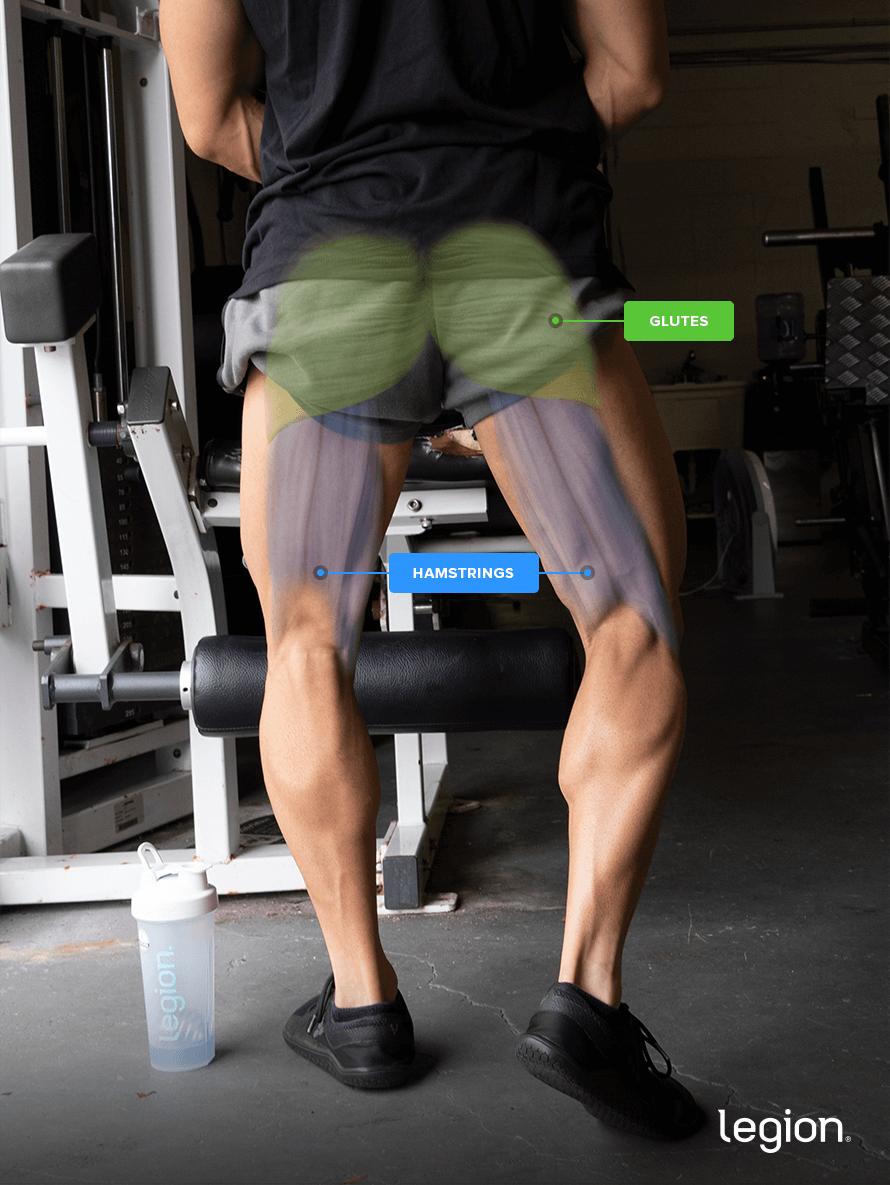
The dumbbell RDL primarily trains your hamstrings, glutes, and spinal erectors (back muscles), and also trains your adductors (inner thighs), quads, and forearms to a lesser degree.
Now, if you struggle to feel your hamstrings and glutes working during this exercise, here are the most common causes and solutions:
- You’re trying to lower the dumbbells too much, which forces you to bend your knees and round your lower back. This takes tension off your hamstrings and glutes and shifts more of the load to your quads and lower back. Instead, lower the dumbbells just until you feel a deep stretch in your hamstrings and no more, usually when they’re right under your kneecaps.
- You simply don’t have enough experience with the exercise yet. It often takes at least a few weeks to months of practicing a new exercise before you really “feel” the target muscles. Keep at it.
- You’re distracted. Take your headphones off, put the phone away, stop thinking about what you’ll eat for your post-workout meal, and really focus on the exercise. Nine times out of ten, this is all you need to do to feel the target muscles.
If you’re doing all of that and you still don’t feel your hamstrings or glutes working, don’t fret. Just because you can’t feel these muscles contracting doesn’t mean they aren’t being effectively trained by the exercise. The reality is that whether or not you feel a muscle working often has little correlation with how much it will grow.
Another question people often have is whether or not the dumbbell RDL is effective for building their hamstrings and butt. While it’s a good exercise for training both of these muscle groups, you’ll generally want to include a few accessory exercises in your workout routine to fully develop them.
Your hamstrings do two jobs: they extend your hips (which is what the RDL trains) and they flex your knees (which the RDL doesn’t train). What’s more, three of your four hamstring muscles cross both the hip and the knee, but one of them—the short head of the biceps femoris—only crosses the knee. That means it barely participates in hip-hinging exercises like the RDL.
This isn’t just anatomical trivia. Research shows that hip-hinge exercises like the RDL and knee-flexion exercises like the leg curl preferentially grow different parts of the hamstrings—hip hinges tend to develop the semimembranosus, while leg curls and Nordic curls do more for the semitendinosus and that stubborn biceps femoris short head.1
The practical upshot: to fully develop your hamstrings, pair your RDLs with a knee-flexion exercise. If you train in a gym, use a leg curl. If you train at home, do Nordic curls. Do that, and you’ll effectively train all portions of your hammies.
When it comes to the glutes, most people find that they need to include a few glute isolation exercises in their workout routines to fully develop these muscles. My favorites are the squat (which is an outstanding glute builder) and the hip thrust machine, which is one of the few exercises that allows you to isolate the glutes effectively and keep training them when your quads and hamstrings are cooked.23
4 Dumbbell RDL Workouts
Here are four sample workouts that incorporate the dumbbell RDL the way I’d program them if you were my coaching client.
Leg Workout with Dumbbell RDLs
Goblet Squat: 3 sets of 8–12 reps
Dumbbell Romanian Deadlift: 3 sets of 8–12 reps
Leg Press: 3 sets of 8–12 reps
Seated Leg Curl: 3 sets of 8–12 reps
Hamstring-Focused Workout with Dumbbell RDLs
Dumbbell Romanian Deadlift: 3 sets of 8–12 reps
Dumbbell Bulgarian Split Squat: 3 sets of 8–12 reps
Lying Leg Curl: 3 sets of 8–12 reps
Standing Calf Raise: 3 sets of 8–12 reps
Glute-Focused Workout with Dumbbell RDLs
Hip Thrust or Hip Thrust Machine: 3 sets of 8–12 reps
Dumbbell Romanian Deadlift: 3 sets of 8–12 reps
Dumbbell Bulgarian Split Squat: 3 sets of 8–12 reps
Lying Leg Curl: 3 sets of 8–12 reps
Home & Travel Leg Workout with Dumbbell RDLs
Dumbbell Goblet Squat: 3 sets of 8–12 reps
Dumbbell Romanian Deadlift: 3 sets of 8–12 reps
Dumbbell Bulgarian Split Squat: 3 sets of 8–12 reps
Nordic Curl: 3 sets to failure
The most common way to program the dumbbell RDL is early in a leg or lower-body workout, either as your main hip-hinge movement or right after a squat. Since it uses so many different muscles, it’s best to do it when you’re fresh.
For most people, 2–3 sets of 8–12 reps works well.
To progress, add reps until you hit the top of your rep range, then add weight (this is known as double progression).
If the dumbbells in your gym move up in large increments—e.g. 10 lb., 20 lb. etc.—then it will be more difficult to progress the weight regularly. Instead, it’s often best to work in a higher and wider rep range, such as 10–15 reps. This is another reason I favor the barbell RDL over the dumbbell version—it’s easier to progress the weight in small increments, which is the best way to build muscle over time.
You’ll also notice that to round out your hamstring training, I’ve included some kind of knee-flexion exercise like the leg curl or Nordic curl in every workout.
Here are a couple more workouts that include variations of the Romanian deadlift:
- Leg Day Workout Routine for Hypertrophy & Building Mass
- The 8 Best Hamstring Exercises for Leg Size & Strength
- The 3 Best Glute Workouts and Exercises for Women
Dumbbell RDL vs. Barbell RDL: Which Should You Use?
In theory, both the dumbbell RDL and the barbell RDL are equally effective for training all of the relevant muscle groups. After all, they’re basically the same exercise, and your hamstrings, glutes, and back muscles don’t care whether they’re being taxed by dumbbells or barbells.
That said, in practice there are some important differences that give first place to the barbell variation:
- It makes it easier to incrementally add weight over time, which is the best way to build muscle and strength. Most gyms carry plates of around 1.25–2.5 lb, which makes it easy to add just 2.5–5 lb. to a barbell. Many gyms have dumbbells that progress in 5-lb. jumps, which means you have to add 10 lb. whenever you want to move up in weight.
- You can keep loading a barbell with hundreds of pounds, whereas the heaviest dumbbells most gyms have are around 100 lb.
- It’s much easier to get into position by hoisting a barbell off of a squat rack than it is to yank dumbbells off the ground, off a dumbbell rack, or even off a bench.
And compared to all of that, dumbbells have no real advantage over a barbell. Thus, if you have a barbell, I always recommend you use that instead of dumbbells for Romanian deadlifts.
That said, if you’re new to weightlifting or don’t have access to a barbell, dumbbells will work, too. At least until the heaviest dumbbells you have access to are no longer challenging. Then you need to get your hands on a barbell.
More Glute and Hamstring Exercises
- How to Do the Barbell Hip Thrust: Form, Mistakes & Alternatives
- How to Do the Glute Ham Raise for Strong Hamstrings
- How to Do the Glute Bridge: Form, Benefits, and Variations
Scientific References +
- ↩ Morin T, Caillet AH, Nordez A, et al. Robustness of hamstring muscle activation strategies following selective hypertrophy induced by Nordic hamstring curl and stiff-leg deadlift exercises. J Appl Physiol (1985). 2025;139(1):296-307.
- ↩ Plotkin DL, Rodas MA, Vigotsky AD, et al. Hip thrust and back squat training elicit similar gluteus muscle hypertrophy and transfer similarly to the deadlift. Front Physiol. 2023;14:1279170.
- ↩ Kassiano W, Kunevaliki G, Costa B, et al. Addition of the barbell hip thrust elicits greater increases in gluteus maximus muscle thickness in untrained young women. Int J Strength Cond. 2024;4(1):1-9.