The best exercises for building your forearms are ones that rely on grip strength to hold or pull a heavy weight—deadlifts, Romanian deadlifts, pull-ups, shrugs, and all heavy rows.
And most of the time, these classic strength training exercises are all you need to build a pair of proportionate, strong, muscular forearms.
Nine times out of ten, when someone claims their forearms are “undersized,” the culprit is a lack of heavy pulling, not a lack of dedicated forearm exercises.
That said, if you feel your forearms are lagging despite your heavy pulling, there are two things you can do about it:
- Use weightlifting straps sparingly.
Weightlifting straps make it easier to hold heavy weights, especially on deadlifts, rows, and lat pulldowns.
This prevents your grip strength from becoming a limiting factor in your sets, but it also reduces how hard your forearms have to work.
I recommend you use straps sparingly to get the best of both worlds.
Specifically, I recommend using straps only on your heaviest pulling exercises like deadlifts or heavy dumbbell rows (especially if doing higher reps), and generally trying to do your first 1–2 sets without straps while your forearms are still fresh.
- Do dedicated forearm training.
If you’ve found heavy pulling insufficient for developing your forearms, the next step is to include some dedicated forearm workouts in your weekly routine.
That said, you only need to do a few sets of a few exercises per week. You absolutely do not need to overhaul your existing workouts to focus on forearms (by doing exercises like towel pull-ups, for instance). You also don’t need to start squeezing a grip trainer at your desk all day until your forearms are so sore and cramped you can’t type.
All you need is a handful of dumbbell exercises that train your forearms’ main functions through a full range of motion and make it easy to incrementally add resistance over time.
The Best Forearm Workouts with Dumbbells
Below is the best dumbbell workout routine for gaining forearm size fast.
Do each workout—A and B—once a week. Add them to the end of two of your existing training sessions on nonconsecutive days that don’t already include much grip work (no deadlifts, rows, pull-ups, etc.).
For example, say you follow the PPL split training push on Monday, pull on Wednesday, and legs on Friday. Add Forearm Workout A to the end of Monday’s push workout and Forearm Workout B to the end of Friday’s legs workout.
Dumbbell Forearm Workout A
Legion Dumbbell Forearm Workout A
|
|

Dumbbell Forearm Workout B
Legion Dumbbell Forearm Workout B
|
|
Notes on the Workouts
You might be wondering whether two sets of two exercises is enough to make real forearm gains. The simple answer is yes.
Remember, you’re already getting plenty of forearm work from your heavy pulling. These workouts only need to train the functions of the forearms not covered elsewhere:
- Wrist flexion (moving your palm toward your wrist)
- Wrist extension (moving your knuckles toward your wrist)
- Elbow flexion (bringing your hand to your shoulder)
A couple of sets of well-chosen exercises is enough to cover all three.
Two more points to get the most out of these workouts:
- Intensity: Finish each set 1–2 reps shy of failure—the point where you couldn’t do another rep with good form. To gauge whether you’re reaching this point, ask yourself at the end of each set: “How many more reps could I have done?” If the answer is more than two, add weight or reps in the next set.
- Progression: Use double progression. If your workout calls for 10–15 reps of the wrist curl and you complete 15 reps in a set, increase the weight by 5 pounds for your next set. If the new weight is so challenging that you can’t complete at least 10 reps in subsequent sets, reduce the load by 2.5 pounds.
The 5 Best Dumbbell Forearm Exercises
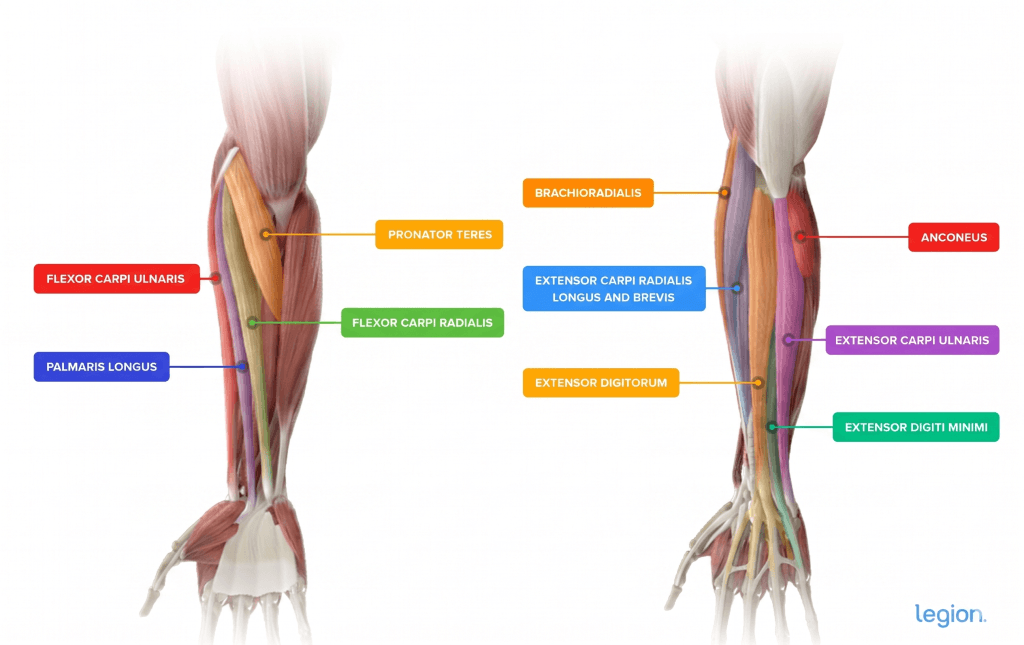
To understand why I chose these exercises, it’s worth grokking forearm anatomy.
The diagrams above show the muscles on the inside (left) and outside (right) of your forearm. Wrist flexion exercises (curling your palm toward your elbow) train the inside; wrist extension exercises (pulling the back of your hand toward your elbow) train the outside.
The one muscle worth singling out is the brachioradialis—the muscle near your elbow that runs in line with your thumb. It contributes a meaningful amount to overall forearm size, but unlike the other forearm muscles, it isn’t trained well by wrist curl variations.
It’s best trained by biceps curls, which is why the biceps curl, reverse curl, and hammer curl are all in this list.
1. Wrist Curl
Why: The wrist curl trains your wrist flexors through a full range of motion and allows you to progressively increase the load in small increments over time. These attributes make it the single best dumbbell exercise for the muscles on the inside of your forearm—and one of the biggest drivers of overall forearm mass.
How to:
- Sit on a bench with a dumbbell in your right hand.
- Rest your right forearm on your right thigh with your palm facing upward, then move your arm forward until your wrist hangs just past your knee.
- Curl the dumbbell up by flexing your wrist as high as it will go.
- Reverse the movement and return to the starting position.
Expert Tip: At the bottom of each rep, let the dumbbell roll into your fingertips before curling it back up. This increases the range of motion and trains your forearm flexors while more deeply stretched, which may help them grow.1
2. Reverse Wrist Curl
Why: The reverse wrist curl has all the same benefits as the wrist curl. The only difference is that it trains the muscles on the opposite side of your forearm: the wrist extensors. These muscles are smaller and weaker than the wrist flexors, but they’re also more visible when your arms hang at your sides. And that’s why developing the wrist extensors is essential if you want aesthetic forearms.
How to:
- Sit on a bench with a dumbbell in your right hand.
- Rest your right forearm on your right thigh with your palm facing downward, then move your arm forward until your wrist hangs just past your knee.
- Lift the dumbbell up by extending your wrist as high as it will go.
- Reverse the movement and return to the starting position.
Expert Tip: Perform the reverse wrist curl with a thumbless grip (your thumb on the same side as your fingers, not wrapped around the handle). For most people, this feels more stable and comfortable.
3. Reverse Curl
Why: The reverse curl emphasizes the wrist extensors and brachioradialis. It works because of how the biceps function during a curl. In a regular curl, your palms face up—a strong position for the biceps, so they handle most of the load. In a reverse curl, your palms face down, which weakens the biceps and shifts more of the work to the brachioradialis.2 The wrist and finger extensors also work isometrically throughout to prevent the weight from bending your wrist.
How to:
- Stand holding a dumbbell in each hand with your arms at your sides and your palms facing backward.
- Curl both dumbbells up toward your shoulders.
- Reverse the movement and return to the starting position.
Expert Tip: Don’t try to keep the dumbbells perfectly horizontal at the bottom of the rep. It’s more comfortable for most people to let them angle in slightly toward each other. Forcing them flat doesn’t make the exercise better—it just puts your wrists in an awkward position.
4. Biceps Curl
Why: The biceps curl is mainly a biceps exercise, but research shows it also recruits the brachioradialis more than any other curl variation.3 It also trains your wrist flexors isometrically—they have to work throughout the rep to keep the weight from folding your wrist backward. That’s enough forearm work to earn the biceps curl a spot in a dumbbell forearm routine.
How to:
- Stand holding a dumbbell in each hand with your arms at your sides and your palms facing forward.
- Curl your right hand up to your right shoulder.
- Reverse the movement and return to the starting position, then repeat on your left side.
Expert Tip: Squeeze the dumbbells hard throughout each rep. The harder you grip, the more your wrist flexors and brachioradialis have to work, which is what turns the biceps curl into a meaningful forearm exercise.
READ MORE: How to Do the Dumbbell Curl: Form, Benefits, and Variations
5. Hammer Curl
Why: The hammer curl is mainly a biceps exercise, but it also effectively trains the brachioradialis.4 And it lets you handle heavier weights than most dedicated forearm exercises, which is generally good for gaining muscle and strength.
How to:
- Stand holding a dumbbell in each hand with your arms at your sides and your palms facing your thighs.
- Curl your right hand up to your right shoulder.
- Reverse the movement and return to the starting position, then repeat on your left side.
Expert Tip: Hammer curls feel easier than other biceps curl variations because the neutral grip puts you in a mechanically advantageous position that lets you lift heavier weights. Don’t take this as an invitation to load up the dumbbells beyond what you can handle. If you can’t curl the weight up without swinging your body or curling it across your body, it’s too heavy. Drop the weight to something you can curl with proper form.
READ MORE: How to Do Hammer Curls for Biceps and Forearm Size
Want More Content Like This?
Check out these articles:
- The Best Forearm Workouts to Increase Grip Strength
- The Ultimate Guide to the Best Grip Strengtheners (2026)
- The Ultimate Guide on How to Work Your Forearms
Scientific References +
- ↩ Lanhers C, Pereira B, Naughton G, et al. Relationship Between Core Stability and Athletic Performance in Athletes: A Systematic Review. Sports (Basel). 2024;9(1):9.
- ↩ Kleiber T, Kunz L, Disselhorst-Klug C. Muscular coordination of biceps brachii and brachioradialis in elbow flexion with respect to hand position. Front Physiol. 2015;6:215.
- ↩ Coratella G, Tornatore G, Longo S, et al. Biceps Brachii and Brachioradialis Excitation in Biceps Curl Exercise: Different Handgrips, Different Synergy. Sports (Basel). 2023;11(3):64.
- ↩ Coratella G, Tornatore G, Longo S, et al. Biceps Brachii and Brachioradialis Excitation in Biceps Curl Exercise: Different Handgrips, Different Synergy. Sports (Basel). 2023;11(3):64.