
Taking a greens supplement instead of eating green foods is like electro-shocking your muscles instead of training.
It doesn’t work like that.
Still, greens gummies are booming. They promise all the benefits of a healthy diet—more energy, better digestion, stronger immunity, and sharper focus—in a chewable, candy-like treat.
It’s an appealing shortcut. But like most shortcuts, there are tradeoffs—and in this case, major ones.
So before you swap your fruit and veggies for greens gummies, it’s worth looking at what’s actually inside them, how they’re made, and whether they can realistically do what they claim.
Key Takeaways
- Greens gummies are mostly candy—50–80% of their weight is sweeteners, gelling agents, and flavorings, leaving little room for active ingredients.
- To fit dozens of ingredients into the tiny remaining space, brands use doses that are far below what research shows is effective.
- Many formulas hide behind proprietary blends, which let companies list impressive ingredients without including meaningful amounts.
- Even when ingredients are present in meaningful amounts, they can degrade during production and storage, so what’s on the label may not be what you actually get.
- For a greens supplement containing clinically effective doses of spirulina, Astragalus membranaceus, matcha tea, and maca, try Genesis.
Table of Contents
+
What Are Greens Gummies?

A greens supplement is a product designed to boost your nutrient intake, usually by combining concentrated plant ingredients like leafy greens, vegetables, and algae.
Greens gummies are simply a greens supplement in chewable, candy form.
Many greens gummies also include vitamins, minerals, and extras like probiotics, adaptogens, or fiber, and are marketed as a tastier, more convenient alternative to traditional greens powders.
The Promise of Greens Gummies
People who want to “cover their bases” nutritionally often end up taking a long list of supplements: a multivitamin, a greens powder, a prebiotic, a probiotic, an adaptogen blend, a mushroom extract, and so on.
Buying all of these separately gets expensive, and keeping track of what you’ve taken becomes a hassle. Many also taste terrible, require preparation, and leave you with bottles, blenders, and countertops to clean.
Greens gummies promise to solve that.
According to the brands that sell them, greens gummies provide virtually everything you need nutritionally in a single product. They also require no prep and taste like candy, which makes taking them feel more like a treat than a chore.
For example, Grüns claims that their gummies offer “comprehensive nutrition” that “replaces handfuls of health products at a fraction of the cost.”
Convenience isn’t their only selling point.
Brands also claim greens gummies can transform your health by boosting energy, improving digestion, strengthening immunity, enhancing focus, and more.
The value proposition is basically “eat candy, get healthy.”
What’s not to like?
If only it were true. Science shows there are two key problems with greens gummies:
- Dosages
- Stability
Let’s examine each.
Why All Greens Gummies Are Under-Dosed
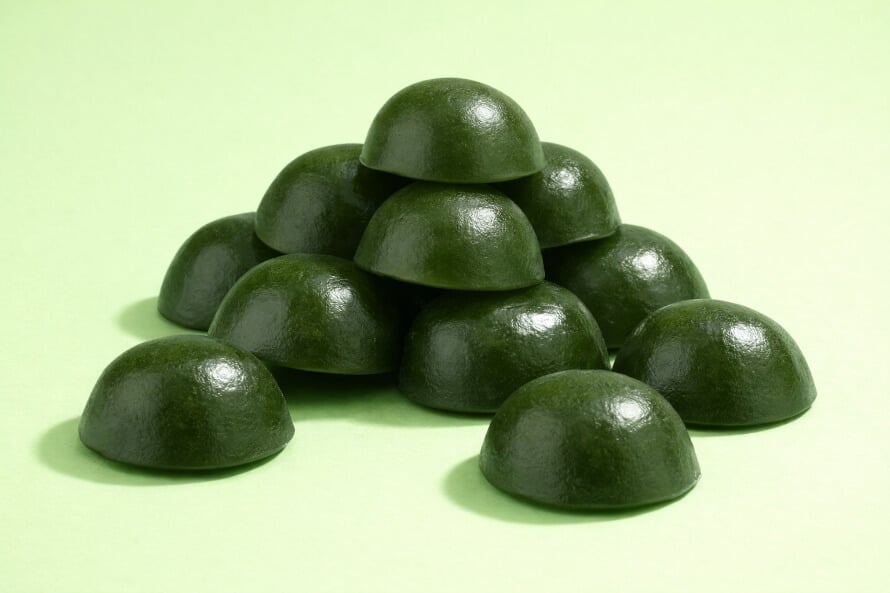
The biggest problem with greens gummies is the format itself.
Gummies have to be chewy, sweet, and shelf-stable. To make that possible, manufacturers use ingredients like gelling agents, sweeteners, and flavorings.
These ingredients generally take up about 50 to 80% of a gummy by weight, so for every 5 grams of gummies you eat, only 1 to ~2.5 grams are active ingredients—the rest is basically candy. Once the percentage of active ingredients goes above about 50%, the product becomes hard and unpalatable—it stops being a gummy.
Despite this, many brands squeeze anywhere from 20 to 60 ingredients into each serving, about 2 to 8 gummies in most cases.
Let’s do some math:
Let’s say a large dose of gummies is 20 grams. At most, that means the product can contain about 10 grams of active ingredients.
Divide 10 grams by 20 to 60 active ingredients, and you’re getting ~160 to 500 mg of each active ingredient on average. And that’s assuming the gummies contain the maximum amount of active ingredients. In reality, most greens gummies contain less than half this amount.
For most ingredients, that’s not anywhere close to the dose proven in scientific studies to offer health benefits.
The amounts are just too small to matter.
Take vitamin D.
Grüns, Lemme, and Bloom all provide 20 mcg (800 IU)—enough to meet the basic daily recommendation, but well short of the intake associated with meaningful benefits, which is closer to 50 mcg (2,000 IU) per day.123
Another example:
Goli highlights artichoke leaf extract as their star ingredient, and it’s listed first in their “Supergreens & Probiotics Blend.” On paper, that positioning makes sense: artichoke leaf extract has been shown to benefit cardiovascular, liver, and digestive health in human studies.
The problem is that those studies typically used 500–1,800 mg per day, though some showed benefits using doses as high as 6,000 mg per day. 4567
Goli’s entire Supergreens & Probiotics Blend weighs just 510 mg per serving and contains 12 ingredients.
Even if we generously assume half that blend is artichoke leaf extract—which is unlikely—that’s only 255 mg. You’d need two servings just to reach the lowest effective dose, and closer to seven to approach the upper end of the commonly studied range.
To match the highest doses used in research, you’d need around 24 servings—roughly 96 gummies per day.
Finally, MaryRuth’s “Veggie Blend” contains just 60 mg across 8 ingredients and uses a proprietary line of powdered plant-based extracts designed—according to the blend’s manufacturer—for “low-dose” applications like gummies.
Once you look at the numbers like this, it’s hard not to see how thin the formulas really are—and why the marketing looks the way it does.
Why Greens Gummies Have “Proprietary Blends”
Every leading greens gummy brand—including Grüns, Lemme, Bloom, MaryRuth’s, Goli, and 8Greens—hides their headline ingredients behind a proprietary blend (often called a “complex” or “matrix”).
That’s where brands list ingredients and a single combined weight without telling you how much of each ingredient you’re actually getting.
They claim this protects their formulas from copycats.
In practice, it lets companies flaunt a long lineup of impressive ingredients on the label without adding meaningful amounts of them to the product. They can make up the bulk of the blend with cheap, commonplace ingredients and sprinkle in token amounts of the more exotic, higher-profile ones.
Take Grüns as an example. They tuck their gummies’ showpiece ingredients—including kale leaf and stalk powder, alfalfa powder, and spirulina—into a proprietary “Core Nutrients Blend”.
By law, manufacturers must list ingredients in a blend from most to least abundant. The first two ingredients in Grüns’s Core Nutrients Blend are tapioca fiber and inulin—two concentrated forms of fiber.
Each serving of Grüns gummies contains 8.7 grams of the blend and 6 grams of fiber.
Since tapioca fiber and inulin are the only major fiber sources in the entire formula, it’s reasonable to assume they account for basically all of that 6 grams, which leaves about 2.7 grams for everything else.
And “everything else” is a long list—29 more ingredients, to be exact. If those ingredients were split evenly across the remaining 2.7 grams, that would work out to about 0.09 grams each—less than a tenth of a gram per ingredient.
In reality, blends aren’t divided evenly like this, which likely means a few ingredients take up most of the remaining space and the rest are present in trace amounts.
Bloom’s Supergreens Gummies pull the same trick.
Each serving contains 5.7 grams of their “Greens, Fruits, and Veggies Blend” and 5 grams of fiber.
Again, the only notable sources of fiber in the entire product are the blend’s top two ingredients: tapioca fiber and chicory root inulin. If those account for essentially all of the fiber in each serving, that leaves just 0.7 grams for the other 17 ingredients combined—roughly 0.04 grams each.
How Greens Gummies Compare to Real Foods

One of the ways gummy brands strengthen their pitch is by comparing gummies to real foods.
For example, Goli boasts their gummies contain “more zinc than 26 cups of kale,” while Lemme claims their gummies provide “as much vitamin B7 as 60 cups of raw baby spinach”
That sounds impressive because foods like kale and spinach have a reputation as nutritional powerhouses. So if a gummy beats them by that much, the dose must be huge, right?
Wrong.
Kale isn’t a meaningful source of zinc, and spinach is a poor source of vitamin B7. That makes these comparisons easy to “win,” because the bar is set comically low.
What they don’t tell you is whether the gummy contains enough of these nutrients to benefit your health. They only tell you it contains more than a food that has low levels in the first place.
Another bold claim is that greens gummies improve digestion—something they often attribute to their probiotic content. The problem is that many leave out the one number that actually matters: CFUs (colony-forming units).
CFUs tell you how many live bacteria you get per serving—the number that determines whether a probiotic can realistically affect gut health. Yet some gummies list probiotics only in milligrams or hide them inside blends.
For example, Lemme lists Bacillus coagulans in mg but provides no CFU count, and Goli includes Bacillus subtilis in a blend without disclosing either CFUs or a standalone dose.
This trick lets brands print authoritative-sounding strain names on the label—often long Latin ones that feel scientific—without revealing whether the amount in the product is actually meaningful.
In other words, you’re shown something that looks precise, technical, and science-backed—but not the number you’d need to judge whether it can work.
Why Greens Gummies Lose Potency Over Time
Yet another major problem with gummies is stability.
Many nutrients—like vitamins C and D—break down when exposed to heat, moisture, oxygen, or acid. Unfortunately, those are exactly the conditions you need to make gummies.89
To create their chewy texture, manufacturers melt gelling agents such as pectin or gelatin and then let them set. That process requires heat, moisture, and carefully controlled acidity—conditions that help the gummy form, but that can also degrade sensitive nutrients during production.
The risk doesn’t end once the gummies are sealed in a bottle, either.
Each gummy still contains moisture and acid that keep degrading certain nutrients over time—so even if the label was accurate on day one, it may not be months later.
Brands could clear this up by publishing results from third-party stability tests showing their gummies still contain what the label claims long after production (which is what we do for our creatine gummies).
Most don’t, however, which means you have to trust that what’s on the label is actually what’s in the gummy—something experience tells us is unwise.
Faced with limitations like these, brands have to work hard to make their products sound credible. One of the most effective ways they do that is by leaning on something even more persuasive than marketing: science.
The “Science” Behind Greens Gummies
Many greens gummy brands claim their products are “clinically studied”—but this wording is misleading.
It’s true that vitamins, minerals, plant extracts, and probiotics have all been studied extensively in humans and have often been shown to provide health benefits.
But those studies weren’t on greens gummies. They often used different doses (usually much higher) and almost always studied different forms (typically pills, capsules, or powders).
This would be like Twinkies claiming their products contain ingredients “clinically proven” to boost muscle growth because they contain trace amounts of whey protein.
Technically true, but wildly misleading.
A prime example of this is Grüns.
They have a dedicated science section on their website, reference clinical testing in ads, and frequently use charts and statistics as proof their gummies “work.”
Their case rests on three things: a clinical study, third-party testing, and a customer survey.
Let’s look at each in detail, starting with the clinical study.
On the Grüns “Study”
As of this writing, Grüns gummies have been studied just once.
According to Grüns, a 12-week double-blind, placebo-controlled trial found that people taking the gummies increased their vitamin C and folate levels more than people taking a placebo.
The problem is the study hasn’t been published, so there’s no way to verify the results or judge their quality.
For instance, we don’t know how many participants there were, how they were recruited, what their diets looked like, whether they started out deficient, what the researchers controlled for, what the statistical analysis looked like . . . or anything else.
Without those details, this study is little better than “trust me, bro.”
For example, if participants’ diets weren’t controlled, the Grüns group could simply have eaten more vitamin C- and folate-rich foods during the study, resulting in their higher levels at the end.
Or it could simply be baseline differences.
If the Grüns group started out deficient while the placebo group didn’t, the Grüns group’s levels would naturally rise more once they began consuming those nutrients daily.
Even if you take Grüns’s summary at face value, the takeaway is modest: if you take a supplement containing vitamin C and folate, your vitamin C and folate levels can increase.
Hardly groundbreaking stuff.
More importantly, it tells us nothing about the claims we care about.
Did the gummies increase levels of vitamins and minerals across the board? We don’t know.
Did the greens, mushrooms, adaptogens, or prebiotics have any effect? We don’t know.
Did the gummies improve energy, digestion, focus, or immunity—or any of the benefits Grüns actually promises? We don’t know.
In other words, the study answers a question nobody asked while ignoring the ones that matter.
On the Grüns Third-Party Testing
Grüns also emphasizes that its gummies are third-party tested by Eurofins. The implication is that, unlike many gummies that struggle with instability and manufacturing challenges, Grüns’s product contains what the label claims.
And this is partly true.
Eurofins testing shows that the listed vitamins and minerals are present at roughly the stated amounts, the product is free from major contaminants, and that the results hold for a limited period (about seven months) after production.
As far as gummy supplements go, that’s a step in the right direction.
But, Eurofins testing doesn’t verify the doses of other ingredients—the amount of greens, mushrooms, adaptogens, and prebiotics. That distinction matters because when a product claims to be “third-party tested,” most people assume the entire formula has been independently checked. In reality, only part of it has.
This applies to all supplements, so this problem isn’t unique to Grüns, but it’s worth noting.
Furthermore, Eurofins testing doesn’t verify that the amounts of various nutrients are clinically effective—it doesn’t tell you whether those doses are high enough to do anything meaningful for your health. The underdosing issue raised earlier remains.
On the Grüns Customer Survey
Grüns also points to a survey of roughly 3,000 customers who reported their experiences after taking the gummies for about three months. The results showed that . . .
- 96% took Grüns regularly
- 70% reported improved wellbeing
- 67% reported better digestion
- 56% reported more energy
- 44% reported better focus
At first glance, these numbers look convincing.
The problem is this isn’t a scientific study. It’s a customer survey.
There’s no placebo group, no blinding, no baseline measurements, and no objective outcomes. It relies entirely on self-reported feelings, which are notoriously unreliable.1011
And the design itself stacks the deck.
Only people who bought the product—and kept taking it for months—were surveyed. That introduces selection bias (it excluded those who tried it, didn’t like it, and gave up taking it).12
Add confirmation bias (people want to believe what they paid for works) and the placebo effect (especially strong for subjective outcomes like energy or digestion), and you have a setup almost guaranteed to produce positive responses.13
What’s more, the survey has no way of accounting for other changes these people may have made at the same time.
When people start taking a supplement like this, it’s often part of a broader effort to improve their health—so they may also start eating better, exercising, or sleeping more. If that’s the case here, there’s no way to know whether the gummies deserve the credit or whether those other changes produced the results.
Even the headline numbers don’t mean what they seem. A figure like “96%” sounds impressive until you see what it refers to: the percentage of customers who take the product regularly. That doesn’t show effectiveness. It shows adherence.
The other results are hardly more compelling. Fewer than half reported improved focus, yet that’s still framed as a win.
At bottom, surveys like this can be useful for measuring customer satisfaction, but they can’t tell you whether it works.
Do Greens Gummies Actually Work?
No, greens gummies won’t work for most people.
If you’re slightly deficient in certain vitamins or minerals, the trace amounts contained in greens gummies might help—although you’d be much better off taking a well-formulated multi-vitamin.
Beyond that narrow use case, they’re unlikely to do much—and they certainly won’t deliver the sweeping health benefits their marketing promises.
A Better Alternative to Greens Gummies
If you want the benefits of eating more greens, the most reliable solution is to eat more greens.
That’s especially true of most “basic” greens supplements (including gummies), which are largely made from fruit and vegetable powders that are nutritionally inferior to their food counterparts.
Where things can differ is with well-formulated greens supplements.
The best ones don’t only contain powdered versions of common fruits and veggies. Instead, they include ingredients that are difficult to get in meaningful amounts from food alone—and include them at doses shown by research to confer benefits.
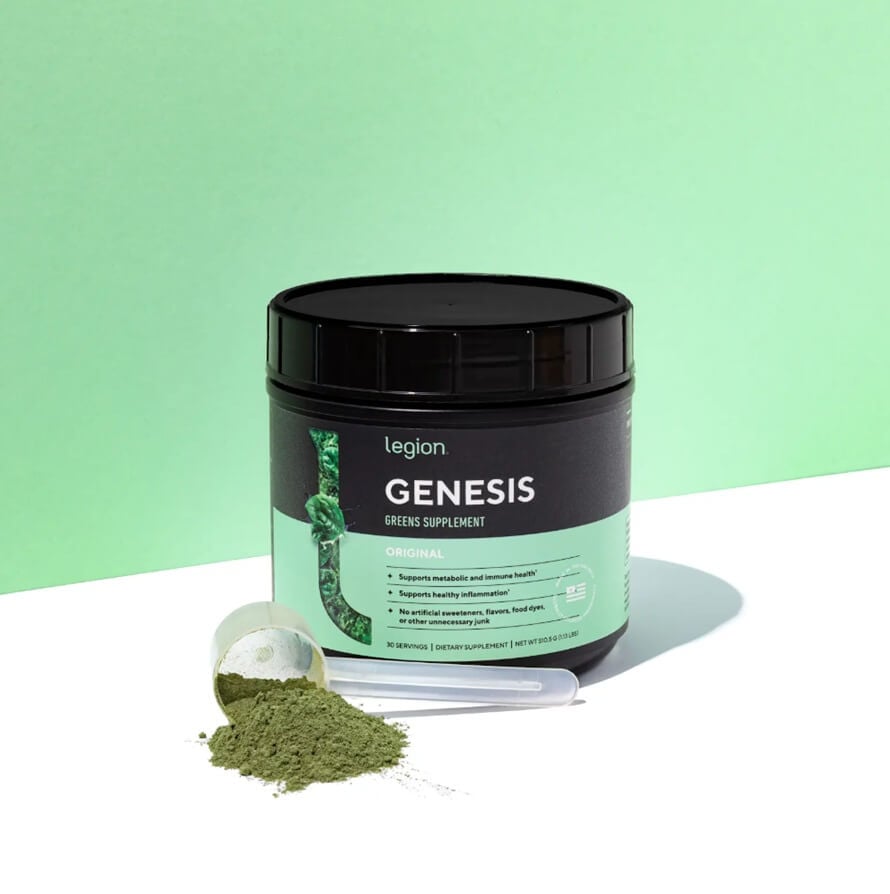
For example, Genesis is green because it contains a clinically effective dose of spirulina (alongside Astragalus membranaceus, matcha tea, and maca)—an ingredient most people rarely eat, and almost never at clinically studied levels.
If you’re going to take a greens supplement, that’s the kind worth taking.
Otherwise, just eat vegetables.
The Bottom Line on Greens Gummies
Greens gummies are essentially candy wearing vegetables like a skinsuit.
Due to the nature of gummies, they can only hold limited amounts of active ingredients—and far less than the amount of greens that’s been shown to meaningfully improve health.
What’s more, many of these ingredients degrade quickly in gummy form, so the doses will likely be even lower by the time you actually eat them.
While gummies can work well for certain supplements, especially single-ingredient supplements like creatine, magnesium, and vitamin C, they don’t work as greens supplements.
If you want the benefits associated with eating greens, the most reliable solution is to eat more fruits and vegetables.
And if you’re going to supplement, choose a product that’s fully transparent (no proprietary blends) and contains clinically effective doses of ingredients you can’t easily get from food alone—like Genesis.
FAQ #1: Are gummy greens good for you?
Most greens gummies don’t contain large enough doses of active ingredients to meaningfully improve your health. They’re not inherently harmful for most people. They’re just usually underdosed and oversold.
FAQ #2: Are 8Greens gummies legit?
Like basically all greens gummies, 8Greens don’t contain enough active ingredients to meaningfully improve your health.
FAQ #3: Are Supergreens Gummies better than powder?
If it’s a well-formulated greens powder, no.
Powders have far more room for active ingredients and aren’t constrained by the stability issues that affect gummies. As discussed above, many greens gummies (including Bloom’s Supergreens Gummies) are composed largely of fiber, with only small amounts of other ingredients.
In general, a reputable greens powder is far more likely to deliver clinically effective doses. The same usually can’t be said about gummies.
Want More Content Like This?
Check out these articles:
- What Is Creatine HMB? Is it Better than Creatine Monohydrate?
- The Protein Content Scam Hiding in Plain Sight on Supplement Labels (And It’s Not Just Amino Spiking)
- The Creatine Gummy Scandal: What You Need to Know
- Is Grass-Fed Whey Protein Powder a Scam?
Scientific References +
- https://pubmed.ncbi.nlm.nih.gov/38337676/ ↩
- https://pubmed.ncbi.nlm.nih.gov/30872787/ ↩
- https://pubmed.ncbi.nlm.nih.gov/36983963/ ↩
- https://www.sciencedirect.com/science/article/abs/pii/S0944711308000305?via%3Dihub ↩
- https://onlinelibrary.wiley.com/doi/10.1002/ptr.7247 ↩
- https://onlinelibrary.wiley.com/doi/10.1155/2019/2069701 ↩
- https://www.sciencedirect.com/science/article/abs/pii/S1043661818312672?via%3Dihub ↩
- https://www.sciencedirect.com/science/article/abs/pii/S0268005X20313886?via%3Dihub ↩
- https://pubmed.ncbi.nlm.nih.gov/35621548/ ↩
- https://mentalhealth.bmj.com/content/5/1/15 ↩
- https://www.sciencedirect.com/science/article/abs/pii/S1087079222001332 ↩
- https://pmc.ncbi.nlm.nih.gov/articles/PMC9908043/ ↩
- https://pmc.ncbi.nlm.nih.gov/articles/PMC4090078/ ↩