Many people organize their workouts by muscle group—chest day, back day, leg day, and so on.
But some muscle groups work especially well together. One of the best pairings is chest and back.
Chest exercises involve pushing weight away from your body, while back exercises involve pulling weight toward you. Because these movements train mostly different muscles, you can train them in the same workout without one exercise interfering much with the next.
This also makes chest and back workouts ideal for supersets, where you perform two exercises back-to-back before resting. The result is a workout that’s both efficient and highly effective for building muscle.
In this article, you’ll learn how to structure a chest and back workout, whether supersets or straight sets work best, and the best chest and back workout for gaining strength and size.
Key Takeaways
- Chest and back exercises train mostly different muscles, which means you can train them in the same workout without one exercise hurting your performance on the next.
- Pairing chest and back exercises in supersets lets you maintain a high quality of work while significantly reducing how long your workouts take.
- The best chest and back workouts combine heavy compound lifts with isolation exercises and include a mix of pressing angles and pulling movements.
- Most people get the best results training their chest and back twice per week and focusing on gradually lifting heavier weights or doing more reps over time.
- You don’t need supplements to build chest and back muscle, but protein powder, creatine, and pre-workout can help you get there faster.
Table of Contents
+
Can You Train Chest and Back Together?
Yes—and for many people, it’s one of the most efficient ways to organize an upper-body workout.
Chest exercises train the muscles you use to push things away from your body—mainly your pecs, triceps, and front delts.
Back exercises train the muscles you use to pull things toward you—mainly your lats, traps, rhomboids, biceps, and rear delts.
In other words, these exercises train mostly different muscles. Because of this, doing one usually doesn’t hurt your performance on the other. While your chest muscles rest, you can train your back, and vice versa.
This makes chest and back exercises a natural pairing in the same workout.
It also allows you to organize your training efficiently—for example, by pairing chest and back exercises in supersets.
How to Structure a Chest and Back Workout
Once you understand why chest and back exercises work well together, the next step is deciding how to organize the workout.
There are two common ways to do this: straight sets and supersets.
Supersets vs. Straight Sets
With straight sets, you perform a set of an exercise, rest for a couple of minutes, and repeat until you’ve completed all your sets before moving on to the next exercise.
With supersets, you pair two exercises and perform them back-to-back before resting. In a chest and back workout, that usually means doing a chest exercise followed immediately by a back exercise, then resting.
The main advantage of supersets is efficiency.
Research shows they can reduce training time by nearly 40% without harming long-term results like muscle growth or strength gain.
That said, straight sets still work perfectly well. Some people prefer them because they feel less rushed and find it easier to focus on lifting heavier weights. If that’s the case for you, they’re still a perfectly viable way to organize your workouts.
How to Choose the Right Chest and Back Exercises
A good chest and back workout usually includes a mix of compound exercises and isolation exercises.
Compound exercises should make up the lion’s share of your workouts because they train many muscles at once and allow you to lift heavier weights safely, which makes them highly effective for gaining muscle and strength.
Isolation exercises train one muscle group at a time. Use them later in your workouts when doing more compound exercises would be impractical but you still want to work your chest and back more.
Another useful guideline is to include a mix of “movement patterns.”
For your back, that usually means including both horizontal pulls (like rows) and vertical pulls (like pull-ups or pulldowns).
For your chest, it means doing exercises that involve pressing at different angles, such as flat presses, incline presses, and dips.
Research suggests using a mix of movements like this leads to more complete and balanced muscle growth than relying on less variety.
The Best Chest and Back Superset Workout
Now that you understand how to structure a chest and back workout, here’s a simple routine built around compound lifts, complementary movement patterns, and supersets.
Perform the exercises labeled A and B back-to-back before resting. After completing both exercises, rest using this protocol:
- Rest 3–5 minutes after supersets 1 and 2
- Rest 2–3 minutes after supersets 3 and 4
This structure lets you train your chest and back efficiently without one exercise interfering with the next.
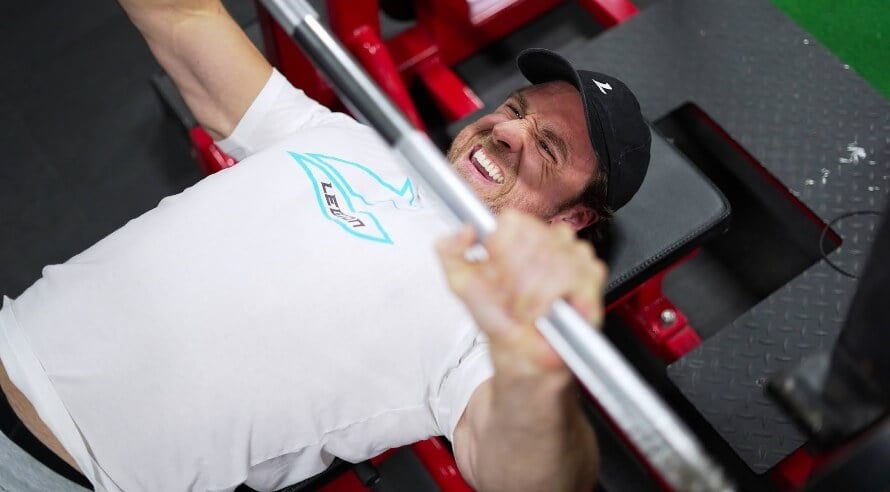
1A. Flat Barbell Bench Press
The barbell bench press is one of the best exercises for building chest size and strength because it trains the pecs through a large range of motion and allows you to lift heavy weights.
It’s the first exercise in this workout because heavy compound presses require the most strength and energy.
How to:
- Lie on a flat bench with your feet flat on the floor and grip the bar slightly wider than shoulder-width.
- Unrack the bar and hold it above your chest with your arms straight.
- Lower the bar to your chest while keeping your elbows tucked slightly toward your sides.
- Reverse the movement and return to the starting position.
Sets & Reps: 3 sets | 4–6 reps
READ MORE: The Definitive Guide to Proper Bench Press Form
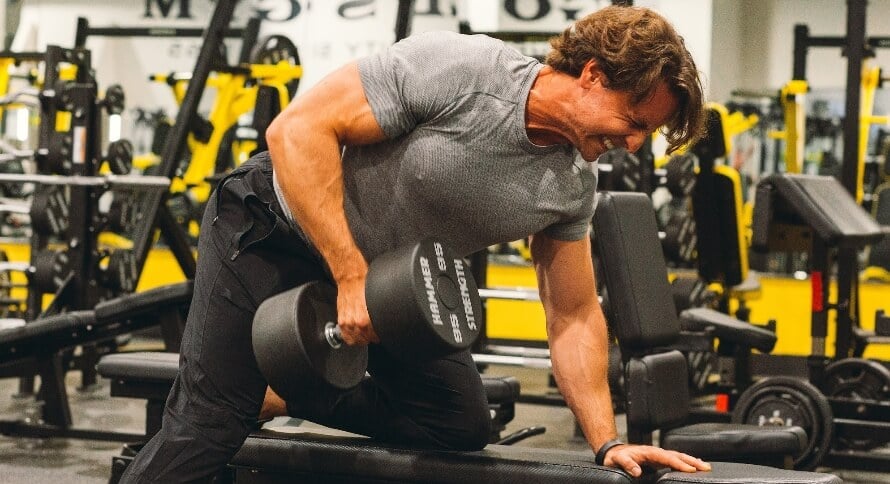
1B. One-Arm Dumbbell Row
The one-arm dumbbell row pairs well with the bench press because it trains your upper back while your chest rests. Training each side independently can also help ensure both sides of your back grow evenly.
How to:
- Hold a dumbbell in one hand and place the opposite hand and knee on a bench for support.
- Let the dumbbell hang straight down beneath your shoulder.
- Pull the dumbbell toward your torso while keeping your back flat.
- Reverse the movement and return to the starting position.
Sets & Reps: 3 sets | 6–8 reps
READ MORE: How to Do the Bent-Over Dumbbell Row
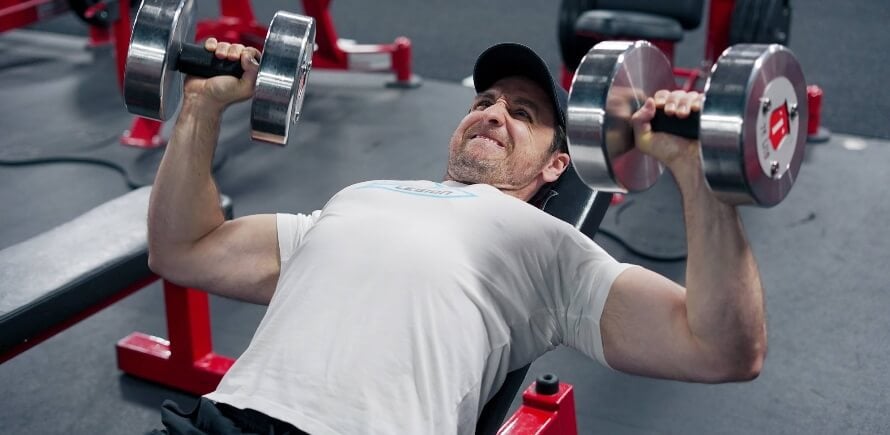
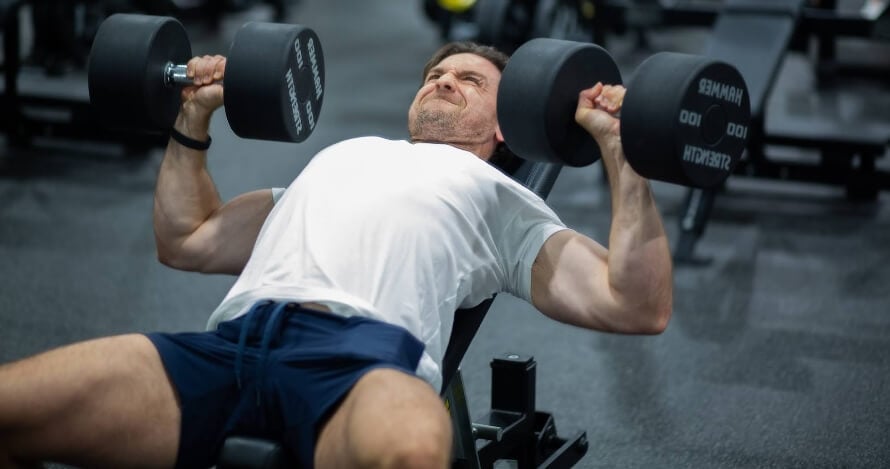
2A. Incline Dumbbell Bench Press
The incline dumbbell bench press emphasizes the upper portion of your chest and trains each side of your body independently. Using dumbbells also allows a slightly longer range of motion than barbell presses, which can help stimulate additional muscle growth.
How to:
- Sit on an incline bench holding a dumbbell in each hand resting on your thighs.
- Lie back and bring the dumbbells to either side of your chest.
- Press the dumbbells upward until your arms are straight.
- Reverse the movement and return to the starting position.
Sets & Reps: 3 sets | 4–6 reps
READ MORE: How to Dumbbell Bench Press: Form, Benefits, and Variations
2B. Pull-up
The pull-up is one of the most effective exercises for building your lats, which help create the wide “V-taper” many people want. It pairs well with the incline press because it trains the opposite pulling movement pattern.
How to:
- Grab a pull-up bar slightly wider than shoulder-width with your palms facing away from you.
- Hang with your arms straight and your body stable.
- Pull your body upward until your chin passes the bar.
- Reverse the movement and return to the starting position.
Sets & Reps: 3 sets | 6–8 reps
READ MORE: How to Do Your First Pull-up with Proper Form
3A. Dip
The dip trains your chest through a large range of motion and emphasizes the lower portion of the pecs, which is important for rounding out pec development.
How to:
- Grab the handles of a dip station and support your body with your arms straight.
- Lean slightly forward and lift your feet off the ground.
- Lower your body by bending your elbows until your upper arms are roughly parallel to the floor.
- Reverse the movement and return to the starting position.
Sets & Reps: 2 sets | 4–6 reps
READ MORE: The Ultimate Guide to Chest Dips for Building Your Chest
3B. Chest-Supported Row
The chest-supported row is an excellent upper-back exercise because the bench support prevents you from using momentum. This forces your upper back muscles to do most of the work.
How to:
- Set an incline bench to roughly a 30-degree angle and lie face down holding a dumbbell in each hand.
- Let your arms hang straight toward the floor.
- Pull the dumbbells upward until they reach your sides.
- Reverse the movement and return to the starting position.
Sets & Reps: 2 sets | 6–8 reps
READ MORE: Chest-Supported Row: Alternatives, Muscles Worked, and Form
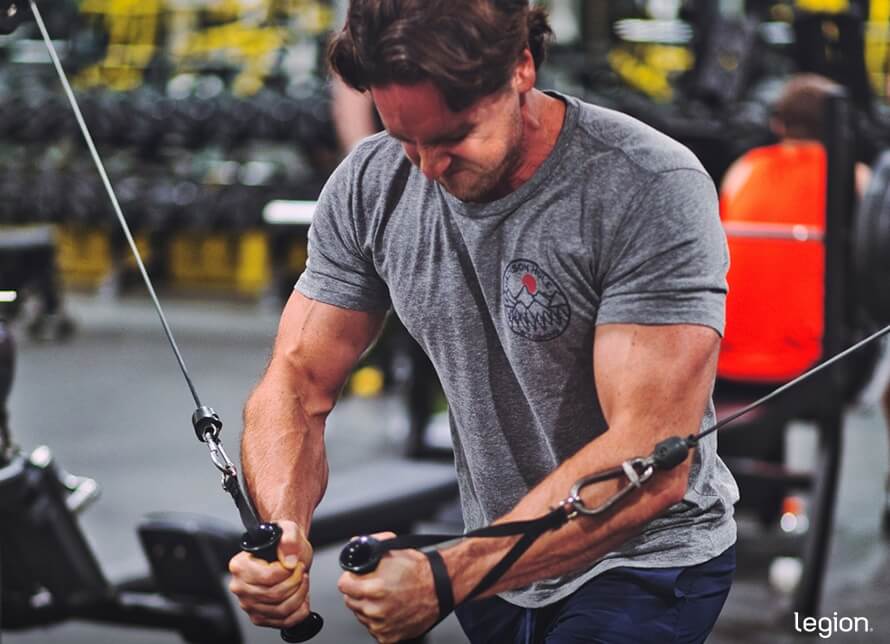
4A. Cable Fly
The cable fly allows you to train your chest with higher reps after the heavier compound exercises are finished. Because other muscles are less involved, it’s useful for adding extra chest work at the end of the workout.
How to:
- Set the pulleys on a cable machine to shoulder height and grab one handle in each hand.
- Step forward so your arms extend slightly behind your torso.
- Bring your hands together in an arc while keeping a slight bend in your elbows.
- Reverse the movement and return to the starting position.
Sets & Reps: 2 sets | 8–10 reps
READ MORE: The Best Cable Pec Exercises for a Full Chest Workout
4B. Cable Pullover
The cable pullover trains your lats through a long range of motion and places them under tension in the stretched position, which makes it ideal for gaining lat size.
- Attach a rope handle to a high cable pulley and grab one end of the rope in each hand.
- Step back and lean forward slightly with your arms extended overhead.
- Pull the rope downward in an arc until your hands reach your thighs.
- Reverse the movement and return to the starting position.
Sets & Reps: 2 sets | 8–10 reps
READ MORE: How to Do the Cable Pullover: Muscles Worked, Form, and Alternatives
Supplements to Support Your Chest and Back Workouts
You don’t need supplements to build chest and back muscle. That said, the right ones can make the process easier. Here are three worth considering:
- Protein powder: Eating enough protein is essential for building muscle. Protein powders like Whey+, Casein+ and Egg+ make hitting your target easier.
- Creatine: Creatine boosts muscle and strength gain, improves anaerobic endurance, and reduces muscle damage and soreness. For a natural source of creatine, try Legion’s creatine monohydrate powder, creatine gummies, creatine capsules, or post-workout Recharge.
- Pre-workout: A quality pre-workout helps you train harder by boosting energy, focus, and athletic performance. Legion’s Pulse is available with or without caffeine.
Want even more specific supplement advice? Take the Legion Supplement Finder Quiz to learn exactly what supplements are right for you.
How Often Should You Do a Chest and Back Day?
Most people get the best results training each major muscle group twice per week, including the chest and back.
This frequency works well because it gives your muscles enough stimulus to grow while still allowing time to recover between workouts.
For example, you might perform the chest and back workout above early in the week and then do a variation of the routine later in the week.
The Bottom Line on the Chest and Back Workout
Chest and back exercises work well together because they train mostly different muscles. This lets you pair them in supersets without hurting your performance and finish your workouts faster.
To get the best results, train your chest and back twice per week, include a mix of compound and isolation exercises, and focus on gradually getting stronger over time.
FAQ #1: Can I train chest and back together?
Yes. Chest and back exercises train mostly different muscles—pushing muscles for the chest and pulling muscles for the back—so doing them in the same workout works well. This also makes them ideal for supersets, allowing you to train efficiently while maintaining high-quality work throughout the workout.
FAQ #2: Is a chest and back day good for building muscle?
Yes. A chest and back day can be very effective for building muscle because it lets you train two large upper-body muscle groups in one workout. When programmed properly, it can provide plenty of stimulus for both strength and muscle growth.
FAQ #3: What’s the difference between a chest and back dumbbell workout and a gym workout?
The main difference is the equipment available. In a gym, you usually have access to barbells, machines, and cables, which allows you to train your chest and back with a wider variety of exercises.
That said, you can still build muscle and strength with only dumbbells. For example, here’s a simple chest and back dumbbell workout using supersets:
- 1A: Flat dumbbell bench press: 4 sets | 4–6 reps
- 1B: One-arm dumbbell row: 4 sets | 6–8 reps
- 2A: Incline dumbbell bench press: 3 sets | 4–6 reps
- 2B: Chest-supported dumbbell row: 3 sets | 6–8 reps
- 3A: Dumbbell fly: 3 sets | 8–10 reps
- 3B Dumbbell pullover: 3 sets | 8–10 reps
Want More Content Like This?
Check out these articles:
- The Best Back and Shoulder Workouts for Upper-Body Width and Mass
- The Best Chest and Shoulder Workout Routine for Mass
- The Best Chest and Triceps Workout for Building Muscle
Scientific References +
- Zhang, Xing, et al. “Superset versus Traditional Resistance Training Prescriptions: A Systematic Review and Meta-Analysis Exploring Acute and Chronic Effects on Mechanical, Metabolic, and Perceptual Variables.” Sports Medicine, vol. 55, 4 Feb. 2025, https://doi.org/10.1007/s40279-025-02176-8.
- Burke, R., et al. “Less Time, Same Gains: Comparison of Superset vs. Traditional Set Training on Muscular Adaptations.” Science & Sports, Aug. 2025, https://doi.org/10.1016/j.scispo.2025.07.011. Accessed 6 Oct. 2025.
- Barakat, Christopher, et al. “The Effects of Varying Glenohumeral Joint Angle on Acute Volume Load, Muscle Activation, Swelling, and Echo-Intensity on the Biceps Brachii in Resistance-Trained Individuals.” Sports, vol. 7, no. 9, 4 Sept. 2019, p. 204, https://doi.org/10.3390/sports7090204.
- Burke, Ryan, et al. “Exercise Selection Differentially Influences Lower Body Regional Muscle Development.” Journal of Science in Sport and Exercise, 12 July 2024, https://doi.org/10.1007/s42978-024-00299-4.
- Park, Se-yeon, and Won-gyu Yoo. “Differential Activation of Parts of the Latissimus Dorsi with Various Isometric Shoulder Exercises.” Journal of Electromyography and Kinesiology, vol. 24, no. 2, Apr. 2014, pp. 253–257, https://doi.org/10.1016/j.jelekin.2013.12.004.
- Eckerson, Joan M., et al. “Effect of Creatine Phosphate Supplementation on Anaerobic Working Capacity and Body Weight after Two and Six Days of Loading in Men and Women.” The Journal of Strength and Conditioning Research, vol. 19, no. 4, 2005, p. 756, https://doi.org/10.1519/r-16924.1.
- Bassit, Reinaldo Abunasser, et al. “Effect of Short-Term Creatine Supplementation on Markers of Skeletal Muscle Damage after Strenuous Contractile Activity.” European Journal of Applied Physiology, vol. 108, no. 5, 3 Dec. 2009, pp. 945–955, https://doi.org/10.1007/s00421-009-1305-1.