Both bulking and cutting have pros and cons.
If you’re trying to decide which you should do, the answer depends mainly on your body fat, training experience, and goals.
Bulking adds both lean mass (yay) and body fat (boo), and cutting unveils your abs (hooray) but stunts muscle growth (hiss).
And it’s this dilemma that makes for a fitness purgatory of sorts where you don’t really commit to one strategy or another and thus stagnate in terms of progress.
In this article, you’ll learn exactly when you should bulk, when you should cut, and when neither is the right choice.
Key Takeaways
- Whether you should bulk or cut depends mainly on your body fat, training experience, and primary goal (build muscle vs. lose fat).
- Bulk if you’re relatively lean and want to maximize muscle and strength gain; cut if you’re carrying more body fat and want to get leaner.
- If you’re new to weightlifting, you can often build muscle and lose fat at the same time by eating at maintenance or in a small calorie deficit.
- If you’re in the middle (not very lean, not very high body fat), either approach works—so choose the one you’re most motivated to stick with.
- You don’t always need to bulk or cut—maintenance is a valid option when you want to hold your progress and take a break from dieting.
Table of Contents
+
Should You Bulk or Cut?
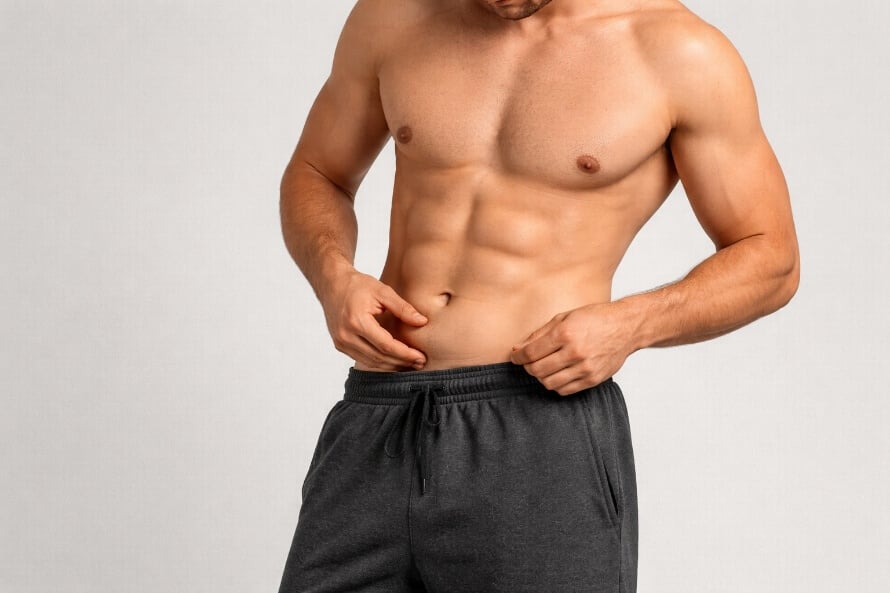
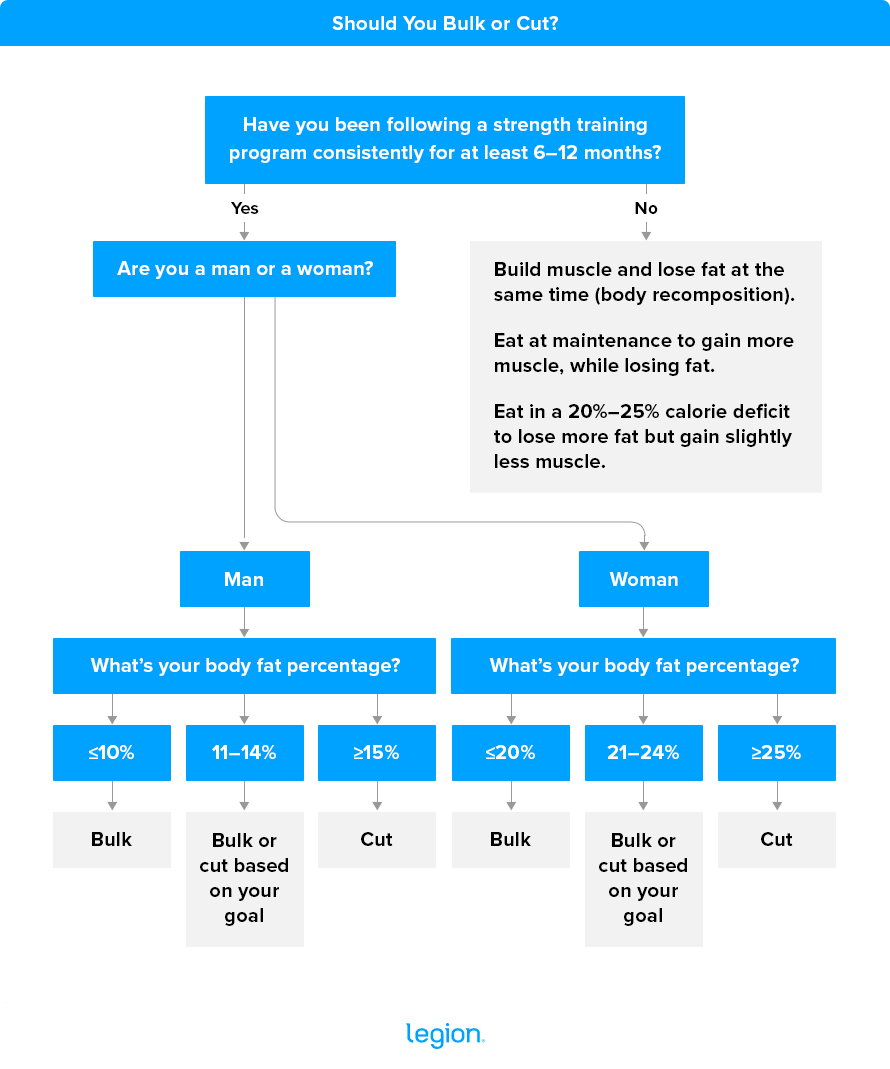
If you want to gain muscle and strength as quickly as possible, and are at or below 10% body fat (men) or 20% (women), you should bulk.
If you want to lose fat as quickly as possible, and are at or above 15% body fat (men) or 25% (women), you should cut.
If you fall between these ranges, either approach can work. In this case, do the one that motivates you most: if you’re more excited to build muscle, bulk; if you’re more motivated to get leaner, cut.
The only exception is if you’ve been training for less than 6–12 months. In that case, you can usually build muscle and lose fat at the same time, often referred to as body recomposition or “recomping.” You can do this by eating at maintenance or in a calorie deficit.
If you eat at maintenance, you’ll usually gain more muscle while still losing fat. If you eat in a calorie deficit, you’ll usually gain slightly less muscle but lose slightly more fat.
If you want to be walked through this step by step, here’s a flowchart to help:
Can You Recomp Instead of Bulking or Cutting?
Yes—but only in certain situations. If you’re new to weightlifting or returning after a long layoff, your body is so sensitive to strength training that you can build muscle and lose fat at the same time. This is known as body recomposition.
You can do this by eating at maintenance to maximize muscle gain while still losing fat, or by eating in a 20–25% calorie deficit if fat loss is your top priority (though this will reduce how much muscle you gain).
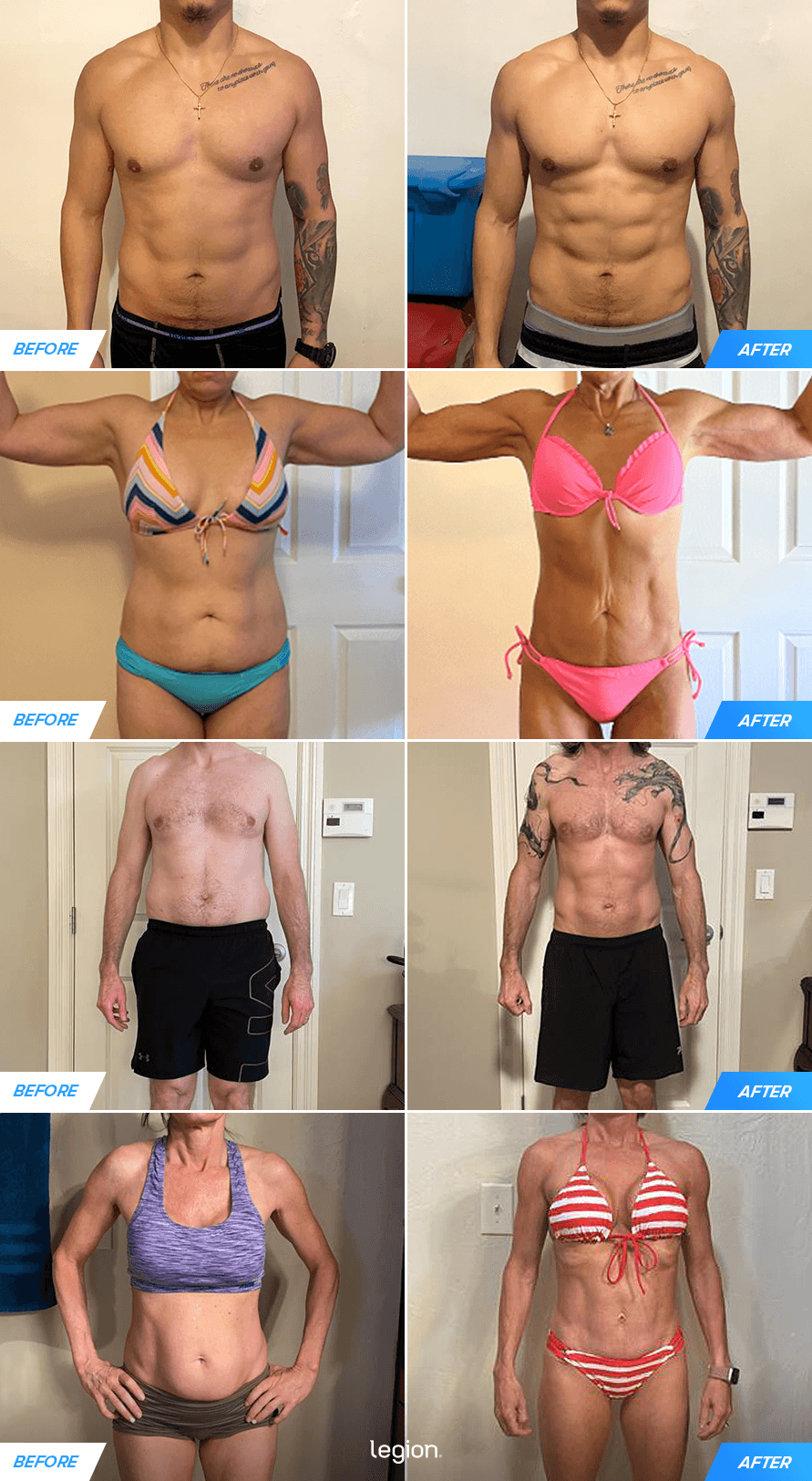
With the right training and nutrition plan, this approach can produce dramatic changes in body composition—even without a dedicated bulk or cut. For example, here are results from people who used this approach with Legion’s body transformation coaching program:
On the other hand, if you’ve been training consistently for more than 6–12 months, you’ll make better progress by choosing a dedicated phase—either bulking or cutting.
To learn more about exactly how to successfully “recomp,” check out this article:
The Secret to Body Recomposition: Lose Fat & Gain Muscle
Should You Bulk or Cut if You’re Skinny Fat?
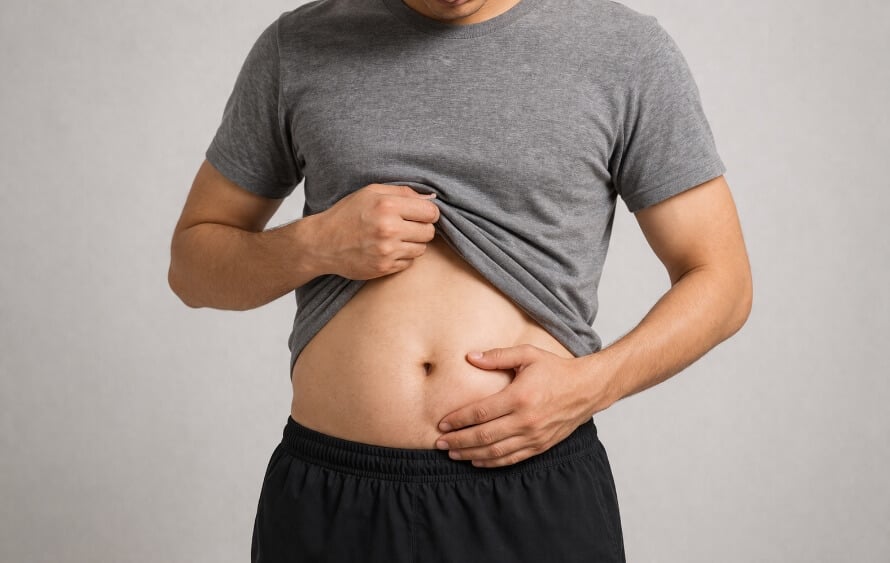
If you’re “skinny fat” (relatively high body fat and low muscle mass), what you should do depends mainly on your training experience.
If you’re new to weightlifting, you can usually build muscle and lose fat at the same time. In this case, eat in a 20–25% calorie deficit to accelerate fat loss while still gaining muscle.
If you’re more experienced, you’ll make better progress by focusing on one goal at a time. Most people in this position are better off starting with a small calorie surplus (around 10%) to build a solid base of muscle, then cutting later to reduce body fat.
If you want a more detailed, step-by-step plan, see our full guide to getting rid of the “skinny fat” look:
Skinny Fat: What It Is, What Causes It, and How to Fix It
How Long Should a Bulk or Cut Last?
How long you spend bulking and cutting depends on the following:
- How much weight you want to gain or lose: If you want to gain a lot of muscle, you’ll need to stay in a surplus for longer than someone who only wants to add a few pounds of muscle to their frame.
Likewise, if you have a lot of fat to lose, you’ll need to stay in a deficit longer than someone who’s only looking to drop one or two body fat percentage points.
- How many years you’ve been training: The more experienced you are, the longer it takes to build muscle, and thus the longer you have to spend in a surplus to gain lean mass.
That said, a good rule of thumb is to spend at least 8–12 weeks bulking and use a bulking–cutting ratio of 3:1 (unless you’re very overweight, in which case you may need to spend considerably more time cutting than bulking until you reach a more healthy weight).
For example, if you spend 12 weeks bulking, you should spend the following 4 weeks cutting.
Keep in mind, though, that none of these figures are etched in stone and will likely change as you become more experienced with bulking and cutting.
Once you’re good at controlling your calorie intake and can easily maintain a healthy body fat percentage, you may prefer to shorten your cycles of cutting and bulking using mini cuts and bulks.
When Should You Switch From Bulking to Cutting?
You should switch from bulking to cutting when you’ve gained as much muscle as you want for now or your body fat has risen to the point where you’re no longer comfortable with how you look.
For most people, this means ending a bulk around 15% body fat (men) or 25% (women), then cutting until you’re lean again.
Starting your bulks lean allows you to spend more time in a calorie surplus, which means more time gaining muscle. It also keeps your cuts shorter and easier, since you have less fat to lose to return to your preferred level of leanness.
If you’re unsure where you stand, use the flowchart above to decide whether it’s time to switch phases.
Do You Always Need to Be Bulking or Cutting?
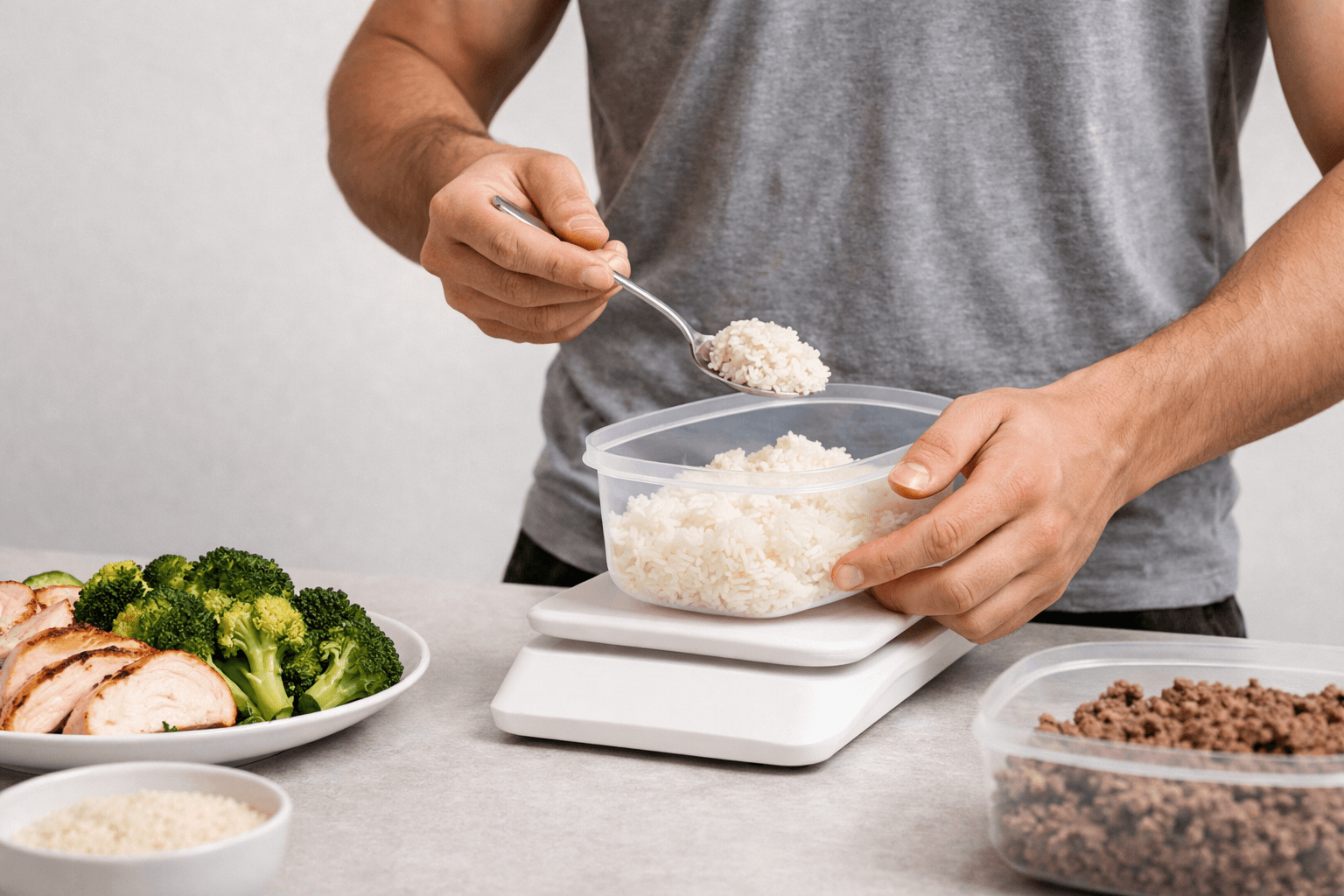
No. You don’t always need to be in a calorie surplus or deficit. In many cases, maintaining your weight is the best option—especially if you’re happy with your current body composition, want a break from dieting, or prefer a simpler, lower-effort approach to eating.
At maintenance, you won’t gain significant muscle or lose significant fat. Instead, you’ll mostly hold your progress until you decide to commit to your next bulk or cut.
READ MORE: What Is Maingaining? Does It Work for Building Muscle?
The Bottom Line on Bulk vs. Cut
Whether you should bulk or cut depends mainly on your body fat, training experience, and goals.
If you’re lean and want to build muscle as quickly as possible, bulk. If you’re carrying more body fat and want to get leaner, cut. If you’re new to training, you can often build muscle and lose fat at the same time, but this becomes much harder as you gain experience.
If you fall somewhere in the middle, either approach can work—so choose the one that keeps you motivated and consistent.
And remember: you don’t always need to be bulking or cutting. Maintenance is a valid option when you want to hold your progress and take a break before committing to your next phase.
FAQ #1: How do you cut without losing muscle?
To cut without losing muscle, you need to use a moderate calorie deficit, eat enough protein, and continue lifting heavy weights.
1. Use an aggressive calorie deficit.
Set your calorie deficit at 20–25% (eat 20–25% fewer calories than you burn every day). This is enough to lose fat lickety-split without losing muscle or wrestling with excessive hunger, lethargy, and the other hobgoblins of low-calorie dieting.
(And if you’d like even more specific advice about how many calories, how much of each macronutrient, and which foods you should eat to reach your goals, take the Legion Diet Quiz.)
READ MORE: How Many Calories Should I Eat?
2. Eat a high-protein diet.
To lose fat as quickly as possible, aim to eat 1–1.2 grams of protein per pound of body weight daily.
And if you’re very overweight (25%+ body fat in men and 30%+ in women), this can be reduced to around 40% of your total daily calories.
READ MORE: How Much Protein Do I Need? The Definitive (and Science-Based) Answer
3. Do a lot of heavy compound weightlifting.
Lifting weights helps you maintain muscle and lose fat. To maximize these benefits, do the following:
- Lift weights 3–5 times weekly.
- Prioritize compound exercises such as the squat, deadlift, bench press, and overhead press.1
- Train with 75–85% of your one-rep max (weights that you can do 4–10 reps with before failing).2
- Strive to add weight or reps to every exercise in every workout (also known as progressive overload).
4. Do a moderate amount of cardio.
The best way to include cardio in a weight loss regimen is to do as little as needed to reach your desired rate of weight loss and stay fit and happy, and no more.
Here’s what typically works best:
- Do at least two low- to moderate-intensity cardio workouts per week of 20–60 minutes each.
- Do one HIIT workout weekly if you enjoy it.
- Limit total cardio to 2–3 hours weekly.
- Do your cardio and weightlifting on separate days if possible, and if you have to do them on the same day, lift weights first and try to separate the two workouts by at least 6 hours.
5. Take the right supplements.
You don’t need supplements to lose fat, but the right ones can make the process faster and more comfortable:
- Caffeine: 3–6 mg of caffeine per kilogram of body weight per day increases metabolic rate and helps you train harder while dieting.
- Yohimbine: 0.1–0.2 milligrams of yohimbine per kilogram of body weight before fasted training enhances fat loss.
- Fat Burner: Effective fat burners contain ingredients that boost the number of calories you burn and reduce hunger and cravings, making weight loss more straightforward.
And if you’d like to know exactly what other supplements you should take to reach any and all of your fitness goals, take the Legion Supplement Finder Quiz.
FAQ #2: How do you gain muscle without getting fat?
To gain muscle without getting fat, eat a small calorie surplus, prioritize protein, and focus on progressive strength training.
1. Eat slightly more calories than you burn.
Research shows that the sweet spot for maximizing muscle gain while minimizing fat gain is somewhere around 105–110% of your total daily energy expenditure (TDEE). Eating more than this won’t help you build muscle faster, it’ll only cause you to gain more fat.34
2. Eat the right balance of macros.
Here’s what works for most people:
- Protein: Eating 0.8–1 gram of protein per pound of body weight per day is enough to maximize muscle growth. That said, eating more (1.5–2 grams per pound) may help minimize fat gain. This usually works out to around 20–30% of calories for most people.56
- Fat: Getting 20–% of your calories from fat is enough to optimize health and add flavor to your meals while leaving plenty of room for protein and carbs.
- Carbs: Get the rest of your calories (~40–60%) from carbs.
(Again, if you feel confused about how many calories, how much of each macronutrient, and which foods you should eat to reach your goals, take the Legion Diet Quiz to learn exactly what diet is right for you.)
3. Don’t eat too much.
Gorging a couple of days per week will help you bulk up fast, but you’ll gain fat at double or even triple the normal rate.
Don’t do this. Instead, learn how to “cheat” intelligently and control your calories while bulking the same way you would while cutting.
4. Emphasize compound weightlifting and progressive overload.
To maximize the muscle- and strength-building effects of weightlifting, do the following:
- Lift weights 3–5 times weekly
- Prioritize compound exercises
- Train with 75–85% of your one-rep max
- Focus on progressive overload
5. Take the right supplements.
The best supplements for supporting muscle growth are:
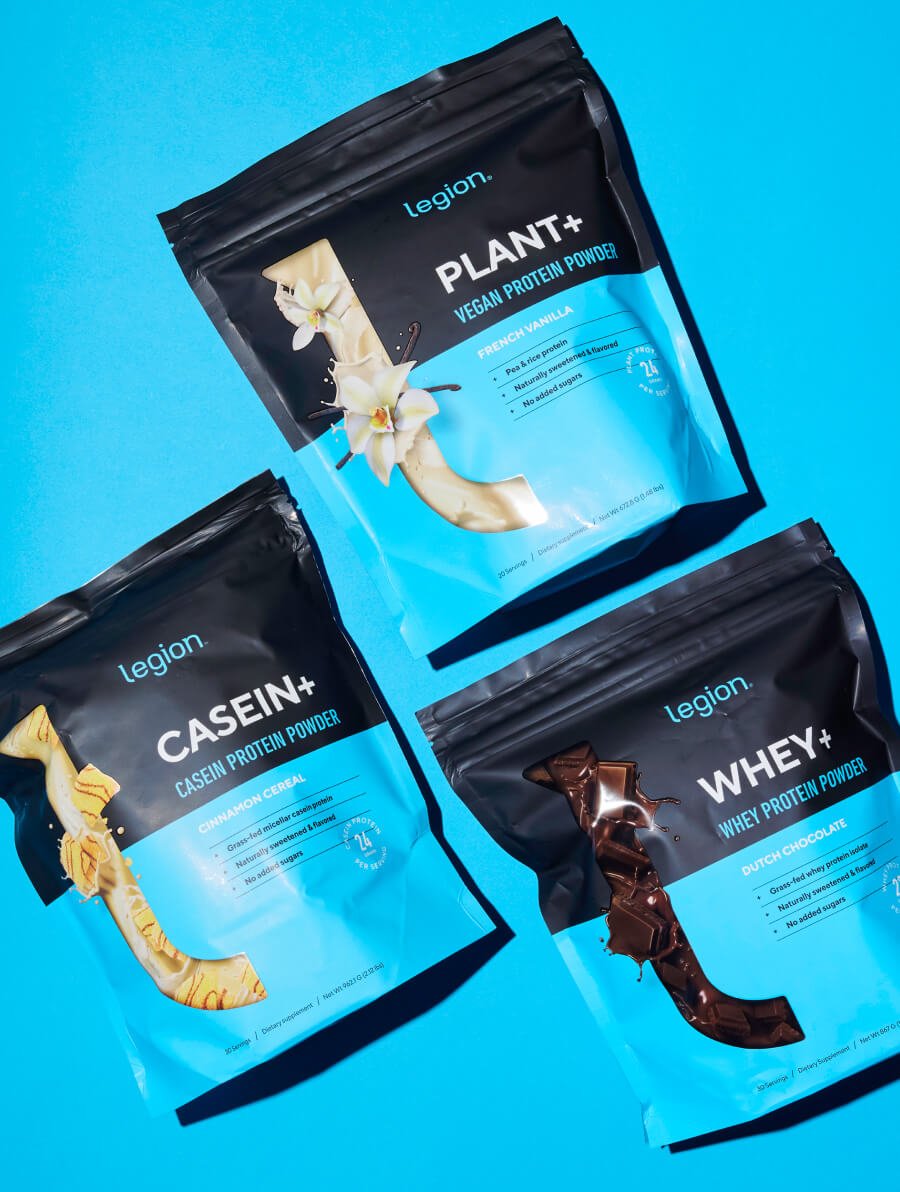
- Protein powder: Eating enough protein is essential for building muscle. Protein powders like Whey+, Casein+, and Egg+ make hitting your target easier.
- Creatine: Creatine boosts muscle and strength gain, improves endurance, and reduces muscle damage and soreness. For a natural source of creatine, try Legion’s creatine monohydrate powder, creatine gummies, creatine capsules, or post-workout Recharge.78
- Pre-workout: A quality pre-workout helps you train harder by boosting energy, focus, and athletic performance. Legion’s Pulse is available with or without caffeine.
FAQ #3: Can I cut and bulk at the same time?
No. Physiologically speaking, fat loss and muscle growth have “irreconcilable differences.” Their mutual incompatibility stems from their relationship to the body’s energy balance.
That said, it is possible to build muscle and lose fat simultaneously—or achieve body recomposition—when you’re new to weightlifting.
In your first year of weightlifting alone you can expect to gain anywhere from 15–25 pounds of muscle as a guy and about half that as a woman, a phenomenon known as “newbie gains.”
And in most cases, you can pull this off while gaining very little body fat or even losing fat—thus achieving “recomp.”
Once the honeymoon phase is over, though, your goal will be to lose fat and not muscle while in a calorie deficit and to gain muscle with minimal fat while in a calorie surplus.
FAQ #4: How do I transition from a cut to a bulk?
To transition from a cut to a bulk, increase your calories to a maintenance level for a few weeks before moving into a surplus.
This isn’t to fix “metabolic damage” caused by dieting—dieting doesn’t harm your metabolism. While your metabolism can slow while dieting, this is normal and quickly reverses once you start eating more.
The real reason for a maintenance period between cutting and lean bulking is to avoid overeating, which can lead to unwanted fat gain. After dieting and losing body fat, hunger and cravings can increase, especially if you’re very lean. This, combined with a sudden increase in food intake, can lead to overeating.
By transitioning from cutting to maintenance for a few weeks before lean gaining, you can control your appetite better and maintain your new body composition, setting yourself up for a successful muscle-building phase.
FAQ #5: When should I stop bulking?
Stop bulking when you’ve gained enough muscle or you’re no longer happy with your body fat percentage (because it’s too high). While these points are different for everyone, men typically stop bulking when they exceed 15% body fat, and women might do so when they reach 25% body fat.
FAQ #6: Should I bulk or cut first?
It depends on how much body fat you have and your training experience, but most people should cut if they’re relatively high in body fat and bulk if they’re already lean.
If you’ve been training for more than 6 to 12 months, a good rule of thumb is to bulk if you’re at or below about 10% body fat (men) or 20% (women), and cut if you’re at or above about 15% (men) or 25% (women).
If you’re new to weightlifting, you can often build muscle and lose fat at the same time, so you may not need to choose between bulking and cutting right away.
FAQ #7: How long should a 20-pound bulk take?
For most people, gaining 20 pounds during a bulk takes several months to a year, depending on your training experience and how quickly you gain weight.
A good rule of thumb is to gain about 1–2% of your body weight per month if you’re a beginner, and about 0.5–1% per month if you’re more experienced.
For example, a 170-pound person who has been training for a couple of years should aim to gain about 0.8–1.7 pounds per month, which means gaining 20 pounds would likely take around 12–24 months.
Gaining weight faster than this usually leads to more fat gain, whereas staying within these ranges helps ensure that most of the weight you gain is muscle.
Want More Content Like This?
Check out these articles:
- How to Properly Bulk To Gain Muscle Without Gaining Fat
- How Long Should You Bulk For? A Comprehensive Guide
- Dirty Bulk vs. Clean Bulk: What’s Best for Building Muscle?
Scientific References +
- http://www.ncbi.nlm.nih.gov/pubmed/21993043 ↩
- https://pubmed.ncbi.nlm.nih.gov/11283441/ ↩
- https://www.ncbi.nlm.nih.gov/pmc/articles/PMC6680710/ ↩
- https://pubmed.ncbi.nlm.nih.gov/3479191/ ↩
- https://jissn.biomedcentral.com/articles/10.1186/1550-2783-11-19 ↩
- https://jissn.biomedcentral.com/articles/10.1186/s12970-015-0100-0 ↩
- https://pubmed.ncbi.nlm.nih.gov/16287344/ ↩
- https://pubmed.ncbi.nlm.nih.gov/19956970/ ↩