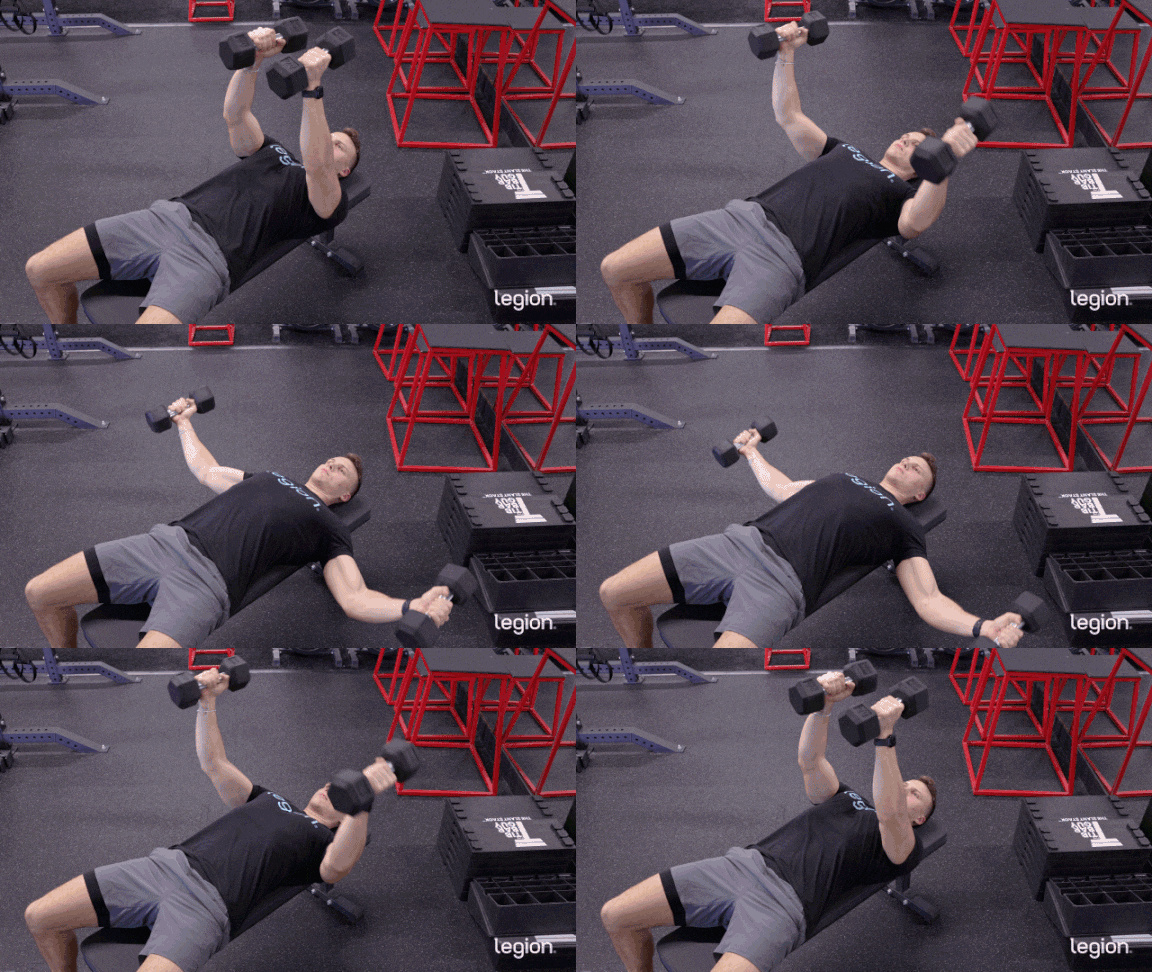
The dumbbell fly is a pec isolation exercise performed lying on a bench. You hold a dumbbell in each hand above your chest, lower them out to your sides in a wide arc, then reverse the movement to bring the weights back together.
It’s a staple in bodybuilding chest workouts because it lets you train your pecs even when your shoulders and triceps are tired from pressing. It also trains them through a longer range of motion than most presses, with a deeper stretch on the chest—something research suggests is important for muscle growth.1
Table of Contents
+
Instructions
- Sit on the edge of the bench with the dumbbells standing on end on your thighs, then lean back and gently push your thighs (and the dumbbells) toward your chest. Continue to roll back onto the bench until you’re lying flat and holding the dumbbells at either side of your chest.
- Press the dumbbells straight up over your chest until your arms are extended, with your palms facing each other and a slight bend in your elbows.
- Lower the dumbbells out to the sides in a wide arc, keeping that same slight bend in your elbows the whole way.
- Keep lowering until you feel a deep stretch across your chest.
- Reverse the movement, bringing the dumbbells back up until they’re about 6–12 inches apart.
- When you’re finished with your set, you can either lower the dumbbells to your chest and drop them to the floor, or bring your legs up, push the dumbbells back onto your thighs, and swing your legs down and your torso up to rise into a sitting position. I prefer the latter—it’s more work, but it ensures I don’t damage the equipment or make a ruckus in the gym.
Expert Tips
- Pinch your shoulder blades together and pull them toward your butt throughout each set. It can help to imagine you’re holding a pencil between your shoulder blades and tucking it into your back pocket.
- Don’t clash the dumbbells together at the top of each rep. Keep the dumbbells 6–12 inches apart to keep tension on your pecs throughout each rep.
- Lower your arms until you feel a deep stretch in your pecs. If you feel any shoulder discomfort (pain, pressure, pinching), go as low as you comfortably can and no further—bending your elbows slightly can also help.
- Don’t bounce or jerk the weights at the bottom of each rep. Lower them under control, pause in the stretch for a beat, then reverse the movement just as smoothly.
- Keep your feet and butt planted throughout each rep—no tapping, hopping, or lifting.
A Dumbbell Chest Fly Workout to Grow Your Pecs
Do your dumbbell fly after your main compound pressing (bench press, incline press, etc.) on any day you train your chest—a chest and back, chest and triceps, or chest and shoulders workout, a push day, an upper body day, or a simple chest day.
For most people, 2–3 sets of 8–12 reps works well. If you want to go slightly heavier, sets of 8–10 can also be effective. I wouldn’t go heavier than that, though.
Here’s a sample upper-body workout incorporating the dumbbell chest fly:
Barbell Bench Press: 3 sets of 4–6 reps
Dumbbell Chest Fly: 3 sets of 8–12 reps
Cable Triceps Extension: 3 sets of 8–12 reps
Cable EZ-Bar Curl: 3 sets of 8–12 reps
Cable Lateral Raise: 3 sets of 8–12 reps
Trying to lift too much increases your risk of tweaking your pecs, shoulders, or biceps. It also makes it harder to maintain proper form. And once your form gets loose, tension tends to shift away from your pecs and onto other muscles, making the exercise less effective for your chest.
Who Should Do the Dumbbell Chest Fly?
In your first year or so of training, your number one goal should be to build a foundation of whole-body strength and muscle—and the best way to do that is to focus on heavy compound lifting. For chest, that means prioritizing heavy presses like the bench press, incline press, and dumbbell press.
At this stage, there’s little reason to bother with isolation work like the dumbbell fly. The small extra growth it may provide isn’t worth the added time in the gym or the extra recovery demands.
Once you reach the intermediate stage—usually after around 12 months of consistent training—the dumbbell fly starts to make more sense.
That’s because the more experienced you become, the more stimulus your muscles need to keep growing, and compound pressing alone isn’t always enough to provide that.2
When you do any pressing exercise, you train your pecs along with smaller muscles like your triceps and front delts. Your pecs are bigger and stronger, so they tend to fatigue more slowly than those supporting muscles, which usually tire first.
That means after several sets of heavy pressing, your shoulders and triceps might be smoked, but your pecs may still need a few more sets to be fully stimulated.
The dumbbell fly is a solid solution in this scenario. It lets you keep training your pecs when it’s no longer practical to do so with heavy presses—ensuring they get the volume (sets) they need to grow, without your other pushing muscles becoming the limiting factor.
How to Feel Your Chest When Doing Dumbbell Flyes
If you struggle to feel your pecs working during dumbbell flys—and you’re already using proper form—here’s a drill that can help. I do this myself at the beginning of every chest workout and recommend it to anyone who has this issue:
- Stand with your left hand on your right pec, and extend your right arm straight out to the side.
- With a slight bend in your elbow, slowly pull your right arm across your body in a wide arc—as if you were doing a standing fly without weight.
- Feel your pec contract under your hand as it pulls your upper arm across your body.
- Repeat for 10–15 reps, then switch sides.
Next, lie down on a bench, pinch your shoulder blades together and pull them toward your butt, then perform the dumbbell fly with very light weights. Try to replicate the same sensation as when you were standing: your pecs pulling your upper arms toward your midline.
Do 8–10 reps, then add a little weight and do another 8–10. If you lose the sensation, repeat the standing drill, then go back to light flys. After a few workouts, you should be able to feel your pecs pulling your arms across your body without needing the drill.
Why “Squeeze Your Pecs at the Top” Is Bad Advice
The standard advice on the dumbbell fly is to squeeze your pecs together as hard as you can when the dumbbells meet at the top of the rep. The idea is that this is the “peak contraction,” where your chest muscles are working hardest.
That’s intuitive—but the squeeze doesn’t actually do much.
At the top of the rep, your arms point almost straight up and the dumbbells sit stacked over your shoulders. Gravity pulls the weights straight down into your arm bones, so your skeleton supports the load—not your pecs.
In other words, your pecs aren’t working against any resistance—this is the part of the rep that’s easiest—the opposite of “peak contraction.”
As you lower the weights, however, tension greatly increases on your pecs as they have to fight against the weight to control and reverse the movement. And that’s why the focus of each rep should be controlling the weight as you lower it and feeling a deep stretch at the bottom, not squeezing at the top.
Instead, stop each rep when your hands are 6–12 inches apart. That keeps some tension on your pecs throughout the entirety of each rep.
Dumbbell Chest Fly vs. Other Fly Variations
Many lifters wonder whether the dumbbell fly is as effective as other fly variations like the cable fly or pec deck. The answer is no, and I actually prefer both the cable fly and pec deck over the dumbbell fly, but that doesn’t make it a “bad” exercise.
The main downside of the dumbbell fly is that it puts lots of tension on your chest at the bottom of each rep but almost none at the top. The cable fly and pec deck, on the other hand, keep tension on your chest through the full range of motion, which is generally better for muscle growth.
That said, the dumbbell fly still loads your pecs in the most productive part of the rep—the stretch at the bottom—so it’s still a productive exercise. What’s more, most exercises have the same issue, and we don’t think of them as “bad” exercises. For example, the squat also places little tension on your quads at the top of each rep, but no one thinks of it as a subpar leg builder.
So if your gym doesn’t have a cable station or pec deck, those machines are always busy, you just prefer the feel of dumbbells, or you’re bored to tears with the cable fly and pec deck, the dumbbell fly is a perfectly solid choice.
Cable and pec deck flys also have their own drawbacks.
People often move their body far more than they realize on the cable fly, which makes the exercise easier on the pecs (and less effective). And the fixed range of motion on the pec deck can feel awkward—or even too short for flexible people.
Another common question about dumbbell fly variations is which bench angle is best.
Flat is most people’s default because it trains the entire pec well. If you’d rather emphasize your upper pecs, setting the bench to a 30- to 45-degree angle is a good option—just don’t go higher than that, or your front delts will steal some of the work from your pecs.
Both flat and incline are fine choices to include in your program—pick whichever you prefer, or rotate between them every few months to develop your whole chest and keep your training fresh. Skip decline flys, though. The setup is awkward and doesn’t offer any advantages over the flat or incline variations.
Want More Content Like This?
Check out these articles:
- How to Do the Cable Crossover for Chest Size and Symmetry
- The Best Chest Workouts at Home for Pec Size & Strength
- How Many Chest Exercises Should You Do Per Workout?
Scientific References +
- ↩ Androulakis Korakakis P, Wolf M, Coleman M, et al. Optimizing resistance training technique to maximize muscle hypertrophy: a narrative review. J Funct Morphol Kinesiol. 2024;9(1):9.
- ↩ McHugh MP. Recent advances in the understanding of the repeated bout effect: the protective effect against muscle damage from a single bout of eccentric exercise. Scand J Med Sci Sports. 2003;13(2):88-97.