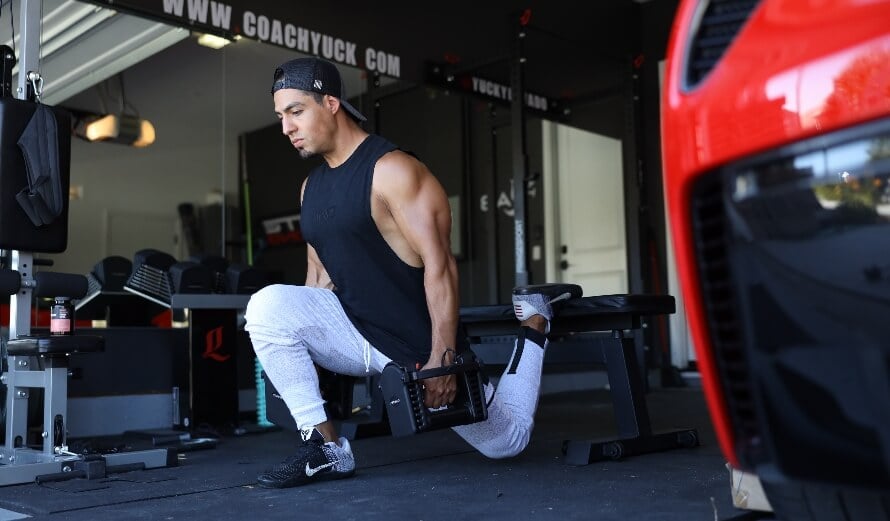
Many people think dumbbell leg workouts are a downgrade.
If they don’t have a barbell, a leg press, and piles of plates, they can’t see the point.
That’s a mistake.
Dumbbell leg workouts are more than enough to build lower-body size and strength—if you do them right.
In this article, you’ll learn why leg workouts with dumbbells work so well, the best dumbbell leg exercises for home or gym workouts, and the few simple rules that make them produce faster gains.
Key Takeaways
- You can train your entire lower body with a pair of dumbbells and a few feet of floor space.
- Dumbbell leg workouts work best when you focus on a short list of proven exercises rather than dozens of variations.
- Exercises like Bulgarian split squats, Romanian deadlifts, squats, lunges, and step-ups let you train your quads, glutes, and hamstrings hard even without heavy weights.
- To get the most out of your lower-body dumbbell workouts, train close to failure and strive to add weight or reps over time.
- You don’t need supplements to build your lower body with dumbbells, but protein powder, creatine, and pre-workout can help you get there faster.
Table of Contents
+
Benefits of Dumbbell Leg Workouts
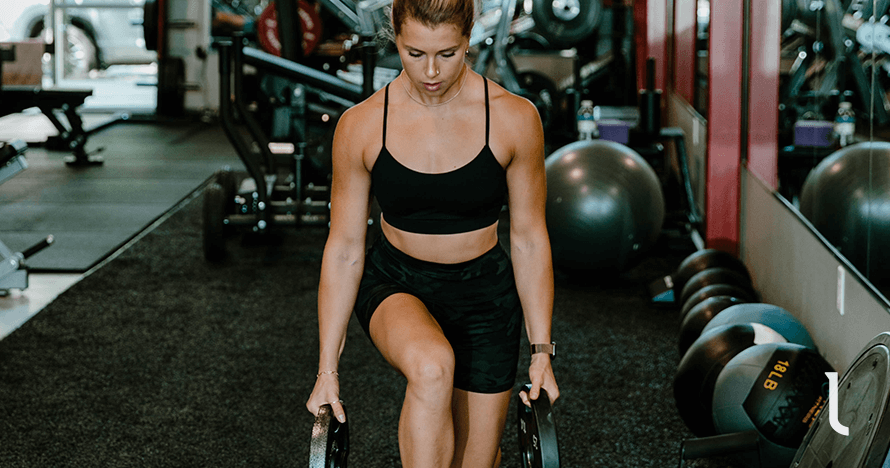
- Minimal equipment: With a pair of dumbbells and minimal floor space, you can train the big lower-body muscle groups without needing a rack, a bar, or machines.
- Big stimulus with lighter weights: Moves like split squats, lunges, and step-ups let you push one leg hard at a time, which makes moderate dumbbells feel heavy and keeps the workout challenging even if you don’t have heavy weights.
- Fast setup: You don’t have to haul out a barbell, load plates, adjust safeties, or claim a station—just grab the weights and go, which reduces friction to train and makes it easier to stay consistent.
- More natural movement: Because dumbbells move freely, you can usually tweak stance, foot angle, and torso position more easily, which helps you train hard without fighting restrictive equipment.
- Time-efficient: Dumbbell training transitions quickly from exercise to exercise and doesn’t require much setup, which makes it a great fit when you’ve only got 30–40 minutes and still want a “real” leg day.
Dumbbell Leg Exercises for Home or Gym Workouts
If you want to build strong, muscular legs with dumbbells, you don’t need a long list of fancy moves.
You need a handful of exercises that train all the main lower-body muscles, and that you can do safely, load progressively, and repeat consistently.
That’s what you’ll find here: dumbbell leg exercises that work in a gym or at home, require little setup, and train your quads, glutes, and hamstrings hard.
Bulgarian Split Squat
Why: Lets you train each leg hard with lighter dumbbells by putting almost all the weight on one leg.
How to:
- Hold a dumbbell in each hand and stand 2–3 feet in front of a bench.
- Place the top of your left foot on the bench behind you and keep your right heel planted.
- Lower your hips by bending your right knee until it’s at about 90 degrees.
- Reverse the movement and return to the starting position.
- Complete all reps on one side, then switch legs.
Sets, Reps, and Rest Guidelines: 3 sets | 6–8 reps | 3–5 minutes rest
READ MORE: How to Perform Bulgarian Split Squats for Glutes, Hamstrings & Quad Growth
Dumbbell Romanian Deadlift
Why: The easiest way to train your hamstrings and glutes hard with dumbbells.
How to:
- Stand upright holding a dumbbell in each hand, palms facing your thighs.
- Push your hips backward and arch your lower back slightly.
- When you feel a stretch in your hamstrings, bend your knees slightly, and keep lowering the dumbbells until your back begins to round.
- Reverse the movement and return to the starting position.
Sets, Reps, and Rest Guidelines: 3 sets | 6–8 reps | 3–5 minutes rest
READ MORE: How to Do the Romanian Deadlift: Form, Benefits, and Variations
Dumbbell Front Squat
Why: It’s your main “heavy” squat exercise that you can perform with dumbbells.
How to:
- Hold a dumbbell at each shoulder and stand with your feet about shoulder-width apart.
- Keep your chest up, brace your core, and point your elbows slightly forward.
- Sit straight down, pushing your knees out in line with your toes.
- Stand up and return to the starting position.
Sets, Reps, and Rest Guidelines: 3 sets | 8–10 reps | 3–5 minutes rest
READ MORE: How to Do Dumbbell Front Squats for Leg Mass & Strength
Goblet Squat
Why: The easiest squat setup with a dumbbell—great when you’re training at home or short on equipment.
How to:
- Hold a dumbbell in front of your chest with both hands.
- Place your feet a little wider than shoulder-width apart, point your toes slightly outward, and raise your chest.
- Keeping your back straight, sit down and push your knees out in the same direction as your toes.
- Stand up and return to the starting position.
Sets, Reps, and Rest Guidelines: 3 sets | 8–10 reps | 2–3 minutes rest
READ MORE: Goblet Squat: Form, Form, Muscles Worked, & Common Mistakes
Dumbbell Lunge
Why: A simple single-leg exercise that needs only dumbbells and a few feet of space.
How to:
- Holding a dumbbell in each hand, stand with your feet hip-width apart.
- Step forward 2–3 feet with your left leg.
- Lower your body by bending both knees until your right knee touches the floor.
- Reverse the movement and return to the starting position.
- Repeat the movement on your right side.
Sets, Reps, and Rest Guidelines: 3 sets | 6–8 reps | 2–3 minutes rest
READ MORE: How to Lunge: Form, Benefits, and Variations
Dumbbell Reverse Lunge
Why: A simple lunge that may emphasize the glutes more than forward lunging.
How to:
- Holding a dumbbell in each hand, stand with both feet about hip-width apart.
- Step back 2–3 feet with your left leg.
- Lower your body by bending both knees until your left knee touches the floor.
- Reverse the movement and return to the starting position.
- Repeat the movement on your left side.
Sets, Reps, and Rest Guidelines: 3 sets | 6–8 reps | 2–3 minutes rest
READ MORE: Dumbbell Reverse Lunge: Muscles Worked, Form & Variations
Dumbbell Step-up
Why: Trains the glutes through a large range of motion and doesn’t require much weight to be effective, so it’s usually a little gentler on your joints.
How to:
- Holding a dumbbell in each hand, place your right foot on a box, bench, or other surface about knee-height off the floor.
- Keeping your weight on your right foot, fully straighten your right leg.
- Lower your left foot toward the floor, and return to the starting position.
Sets, Reps, and Rest Guidelines: 3 sets | 6–8 reps | 2–3 minutes rest
READ MORE: Weighted Step-Ups Guide: How to Do Dumbbell Step-Ups
3 Tips for More Productive Leg Workouts with Dumbbells
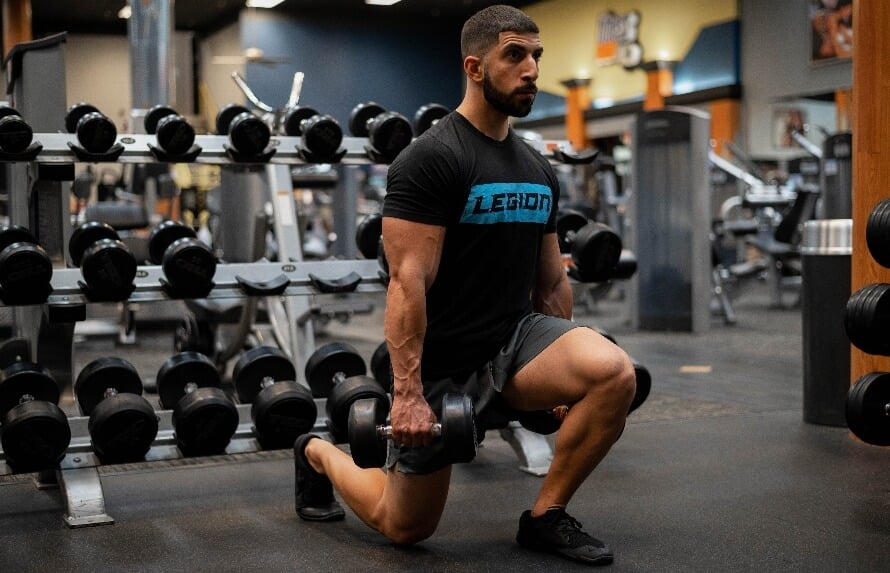
Here are three simple rules that will make your dumbbell leg workouts significantly more effective.
Intensity
To make your dumbbell leg day workouts as effective as possible, take most of your sets to within 1–2 reps of failure—the point where you can’t perform another rep with proper form.
To gauge whether you’re reaching this point, ask yourself at the end of each set: “If I had to, how many more reps could I have done with good form?”
If the answer is more than two, increase the weight or reps on your next set to make it more challenging.
Progressive Overload
To keep building muscle and getting stronger, you also need to focus on progressive overload—gradually lifting heavier weights over time.
Here’s how to do it:
If your workout calls for 6–8 reps of the Bulgarian split squat and you complete 8 reps in a set, increase the weight by 10 pounds (total) for your next set. If you do 5 reps or fewer in subsequent sets, reduce the load by 5 pounds to stay in the 6–8 rep range.
Apply this approach to every exercise in your dumbbell leg workouts, aiming to add either weight or reps every session.
Supplements
You don’t need supplements to build big legs, but the right ones can help you get there faster. Here are three worth considering:
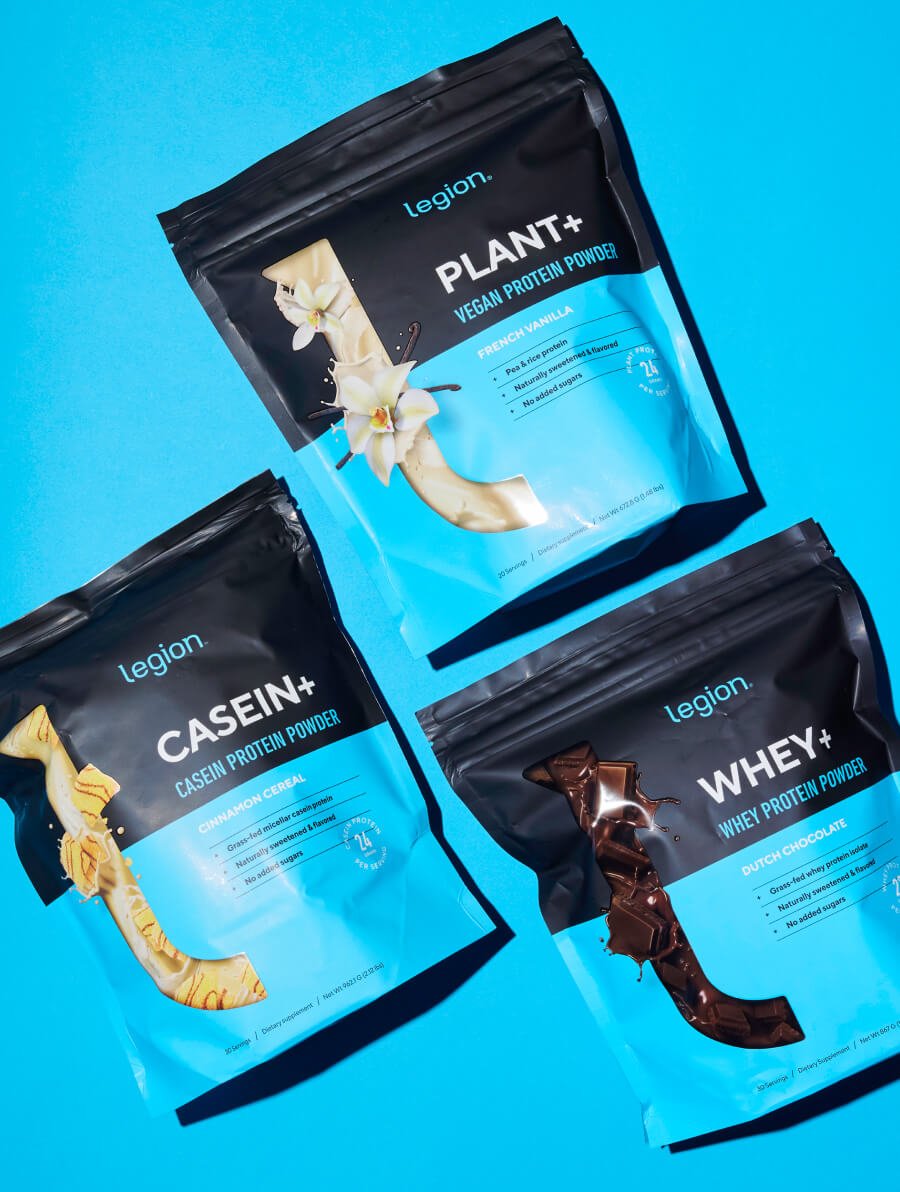
- Protein powder: Eating enough protein is essential for building and repairing muscle. Protein powders like Whey+, Casein+ and Egg+ make hitting your target easier.
- Creatine: Creatine boosts muscle and strength gain, improves anaerobic endurance, and reduces muscle damage and soreness. For a natural source of creatine, try Legion’s creatine monohydrate powder, creatine gummies, creatine capsules, or post-workout Recharge.
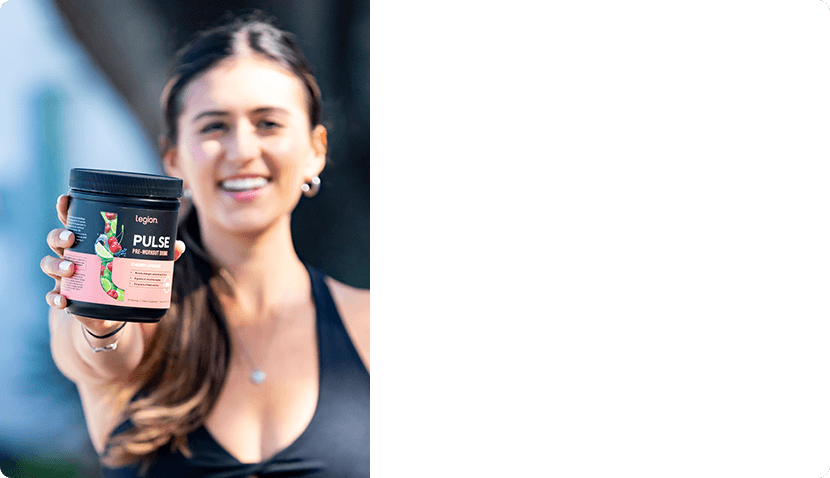
- Pre-workout: A quality pre-workout helps you train harder by boosting energy, focus, and athletic performance. Legion’s Pulse is available with or without caffeine.
Want even more specific supplement advice? Take the Legion Supplement Finder Quiz to learn exactly what supplements are right for you.
The Bottom Line on Dumbbell Leg Workouts
Dumbbells are more than enough to build strong, muscular legs—at home or in the gym. Use the exercises in this guide to train the squat, hinge, lunge, and step patterns, take most sets close to failure, and focus on adding reps or weight over time.
Do that consistently, and your quads, glutes, and hamstrings will grow.
FAQ #1: Can you build legs with just dumbbells?
Yes. If you train hard and progress over time, dumbbells are more than enough to build strong, muscular legs.
The key is choosing exercises that train all your lower-body muscle groups, taking most sets close to failure, and gradually adding reps or weight. If your dumbbells are light, use more single-leg work so each set is still hard enough to drive muscle growth.
FAQ #2: What is a good dumbbell leg workout routine?
Here’s a simple, effective dumbbell leg workout you can do at home or in the gym:
- Bulgarian Split Squat: 3 sets | 6–8 reps | 3–5 minutes rest
- Dumbbell Romanian Deadlift: 3 sets | 6–8 reps | 3–5 minutes rest
- Dumbbell Step-up: 3 sets | 6–8 reps | 2–3 minutes rest
Do it 1–2 times per week, focus on good form, and aim to add reps or weight over time.
FAQ #3: Is 20 minutes enough for leg day?
It’s probably not ideal. To get everything done in 20 minutes, you usually have to do fewer sets, rest less, or both—and any combination of that can make it harder to train with enough volume and intensity for long-term muscle growth.
A better option—if you can spare it—is to take 30–40 minutes and do more high-quality work with heavier weights and better performance set to set.
FAQ #4: How heavy should dumbbells be for leg workouts?
Heavy enough that your working sets land close to failure in the rep range you’re using. As a rule, if you finish a set and feel like you could’ve done more than 2 extra reps with good form, the weight is probably too light (or you need more reps).
FAQ #5: Are dumbbell squats as effective as barbell squats?
Dumbbell squats are highly effective for building muscle—at least up to a point. The problem is they become impractical and awkward once the weights get heavy enough, because getting the dumbbells into position and holding them can become the limiting factor.
When that happens, barbell squats are usually the better option because they’re easier to load heavy and progress consistently.
Want More Content Like This?
Check out these articles:
- The Best Dumbbell Chest Workouts for Pec Growth & Strength
- The Best Dumbbell Shoulder Exercises & Workouts for Mass
- 28 Dumbbell Exercises and Workouts for Your Whole Body
Scientific References +
- Park, Sanghoon, et al. “Comparative Analysis of Lunge Techniques: Forward, Reverse, Walking Lunge.” ISBS - Conference Proceedings Archive, 6 Nov. 2016, ojs.ub.uni-konstanz.de/cpa/article/view/6941.
- Park, Samho, et al. “Comparative Study of the Biomechanical Factors in Range of Motion, Muscle Activity, and Vertical Ground Reaction Force between a Forward Lunge and Backward Lunge.” Physical Therapy Rehabilitation Science, vol. 10, no. 2, 30 June 2021, pp. 98–105, https://doi.org/10.14474/ptrs.2021.10.2.98.
- Eckerson, Joan M., et al. “Effect of Creatine Phosphate Supplementation on Anaerobic Working Capacity and Body Weight after Two and Six Days of Loading in Men and Women.” The Journal of Strength and Conditioning Research, vol. 19, no. 4, 2005, p. 756, https://doi.org/10.1519/r-16924.1.
- Bassit, Reinaldo Abunasser, et al. “Effect of Short-Term Creatine Supplementation on Markers of Skeletal Muscle Damage after Strenuous Contractile Activity.” European Journal of Applied Physiology, vol. 108, no. 5, 3 Dec. 2009, pp. 945–955, https://doi.org/10.1007/s00421-009-1305-1.