Research shows that the best workout plan to follow for women dealing with PCOS (polycystic ovarian syndrome) is one that combines strength training with moderate- and high-intensity cardio.123
For instance, a 2025 meta-analysis by Federal University of Ceará found that strength training was generally better for building muscle and reducing body fat percentage, while cardio was especially effective for improving waist circumference, BMI, insulin, cholesterol and triglycerides, all of which are generally elevated in women with PCOS.4
Some studies suggest high-intensity interval training (HIIT) may be especially helpful, too.
In a study by Victoria University, HIIT improved general fitness, insulin sensitivity, menstrual regularity, and hormonal balance more than moderate-intensity cardio in women with PCOS.5
A study by the Norwegian University of Science and Technology on women with PCOS also found that 10 weeks of HIIT improved their insulin resistance and lowered their body fat percentage.6
In other words, the sweet spot is a balanced plan that combines weightlifting with cardio, and that’s easy to stick with long term. Let’s now look at how to put this into practice.
Key Takeaways
- Cardio and strength training help tackle PCOS symptoms in different ways: cardio tends to improve metabolic markers like insulin and cholesterol, while strength training is better for improving body composition.
- HIIT may offer extra benefits for women with PCOS, particularly for insulin sensitivity and menstrual regularity—but you don’t have to do it if you don’t want to.
- Consistency matters more than perfection. A simple plan you stick to every week will do more for your PCOS symptoms than an exhausting one you regularly skip.
The Best PCOS Workout Plan
A good beginner PCOS workout routine should include two strength workouts, at least two moderate-intensity cardio workouts, one optional HIIT workout, and two rest days each week.
That gives you enough training to make progress without making the plan so demanding that it becomes hard to recover from or stick to.
Here’s the schedule I recommend:
Legion PCOS Workout Plan
| Day | Workout |
|---|---|
| Mon | Moderate-intensity cardio |
| Tues | Strength Training |
| Wed | Rest |
| Thurs | Moderate-intensity cardio |
| Fri | Strength Training |
| Sat | HIIT or Moderate-intensity cardio |
| Sun | Rest |

Do These 4 Weightlifting Exercises Twice Per Week
If you want to improve your PCOS symptoms and body composition as quickly as possible, focus on compound exercises like squats, presses, rows, and deadlifts.
These exercises train several muscle groups at once and make it easy to get progressively stronger over time, which is essential for gaining muscle and strength.
Here’s a simple full-body workout you can do at home or in the gym:
- Goblet Squat: 3 sets | 8–10 reps | 2–3 min rest
- Dumbbell Deadlift: 3 sets | 8–10 reps | 2–3 min rest
- Push-up: 3 sets | 8–10 reps | 2–3 min rest
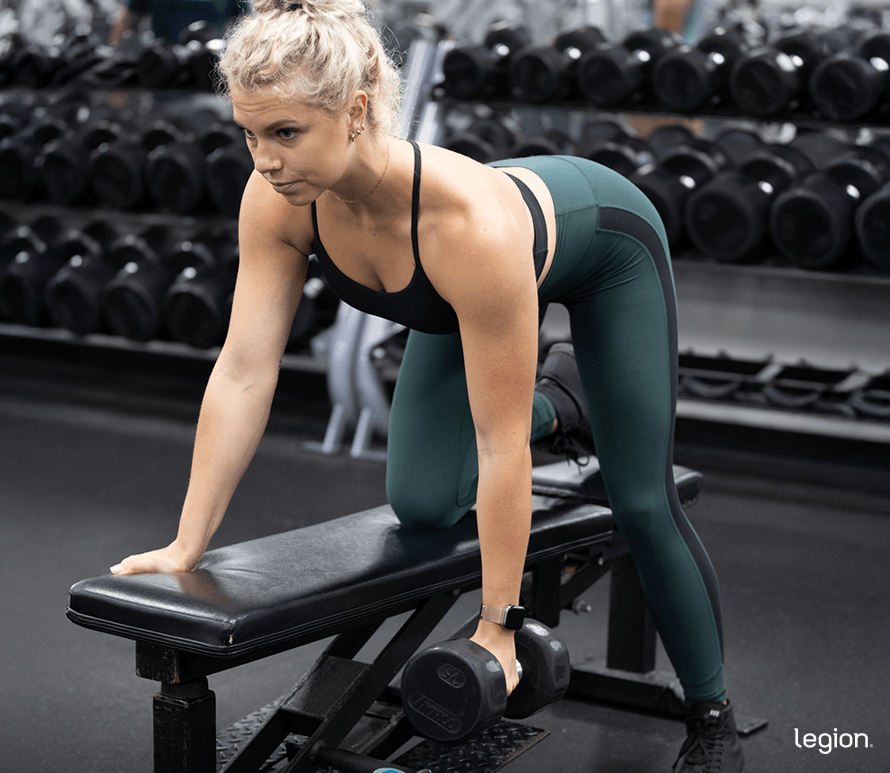
- One-Arm Dumbbell Row: 3 sets | 8–10 reps | 2–3 min rest
Do 30-60 Minutes of Cardio 3x Per Week
For your moderate-intensity cardio workouts, spend 30–60 minutes doing a low-impact form of exercise that you enjoy, like walking, swimming, cycling, or rucking.
This type of cardio is effective, easy to recover from, and usually easier to stick with than harder forms of exercise.
Aim to do this kind of workout at least twice per week, but three times per week is better.
(Optional) Try HIIT Cardio Workout
If you want to include HIIT, keep it simple:
On an exercise bike or rowing machine, sprint for 30 seconds at about 90% of your maximum effort, then do 2 minutes at a slow pace to recover. Repeat this 6 times for a total of 15 minutes.
If you opt for HIIT, do this at most once per week. There’s little benefit to doing more and the risk of overtraining and injury goes up markedly.
And if you don’t want to do HIIT for any reason, that’s fine. Just do another moderate-intensity cardio workout instead.
How To Stay Consistent With A PCOS Workout Plan

The best PCOS workout plan is the one you can follow consistently. That may sound obvious, but it matters.
A simple plan you complete every week will almost always do more for your PCOS symptoms than a “perfect” plan you regularly skip because it’s too hard or too time-consuming.
One way to make that easier is to plan your workouts in advance. Instead of saying, “I’ll work out a few times this week,” decide exactly what you’ll do, when you’ll do it, and where.
For example, you might decide that you’ll do your moderate-intensity cardio on Monday and Thursday evenings, your strength workouts on Tuesdays and Fridays immediately after work, and your HIIT workout on Saturday mornings at the gym.
Research shows this kind of planning can make you much more likely to follow through.7
It also helps to make backup plans for when life gets in the way. One good way to do that is to create “if-then” statements.8 In other words, decide in advance what you’ll do if something throws off your plan.
For example:
- If I miss my Tuesday strength workout, then I’ll do it on Wednesday.
- If I can’t do HIIT this week, then I’ll do another moderate-intensity cardio session instead.
- If I can’t get to the gym, then I’ll do the workout at home.
This works because it makes you decide ahead of time how you’ll respond if something goes wrong, instead of relying on motivation in the moment.
The goal isn’t to be perfect. It’s to keep showing up, even when the week doesn’t go exactly as planned.
Want More Content Like This?
Check out these articles:
- How to Get Rid of a FUPA: Exercises, Workouts, & Diet Tips
- How to Get Rid of Muffin Top: Exercises, Workouts, & Diet
- How to Get Rid of Bat Wings: Exercise & Diet That Works
Scientific References +
- ↩ Teede, Helena J., et al. “Recommendations from the 2023 International Evidence-Based Guideline for the Assessment and Management of Polycystic Ovary Syndrome.”
- ↩ Sabag, Angelo, et al. “Exercise in the Management of Polycystic Ovary Syndrome: A Position Statement from Exercise and Sport Science Australia.”
- ↩ Patten, Rhiannon K., et al. “Exercise Interventions in Polycystic Ovary Syndrome: A Systematic Review and Meta-Analysis.
- ↩ Carvalho, Diana, et al. “Effects of Physical Activity in Women with Polycystic Ovary Syndrome: A Systematic Review and Meta-Analysis.”
- ↩ Patten, Rhiannon K, et al. “High-Intensity Training Elicits Greater Improvements in Cardio-Metabolic and Reproductive Outcomes than Moderate-Intensity Training in Women with Polycystic Ovary Syndrome: A Randomized Clinical Trial.”
- ↩ Almenning, Ida, et al. “Effects of High Intensity Interval Training and Strength Training on Metabolic, Cardiovascular and Hormonal Outcomes in Women with Polycystic Ovary Syndrome: A Pilot Study.”
- ↩ Milne, Sarah, et al. “Combining Motivational and Volitional Interventions to Promote Exercise Participation: Protection Motivation Theory and Implementation Intentions.”
- ↩ Bieleke, Maik, et al. “If-Then Planning.”