
The only training periodization plan most people need: train hard when you’re feeling really good, ease up or rest when you’re exhausted or sick, and at least do enough to not get fatter when you’re busy or unmotivated.
That makes sense to most people. In real life, though, plenty of gymgoers still push it when they’re sick—because once you’ve built momentum, skipping a workout can feel like you’ll lose everything you’ve worked toward.
So you start bargaining: Maybe you can still lift. Maybe you can sweat it out. Maybe a hard session will make you feel better.
Usually, that backfires.
When you’re sick, your job isn’t to prove how disciplined you are. It’s to make the choice that gets you healthy again as fast as possible without sacrificing your long-term progress.
In this article, you’ll get a simple way to decide whether you should train at all, what “light” should actually look like if you do, when you should stay home no matter what, and how to return to the gym without feeling like you’re starting over.
Key Takeaways
- If you’re sick enough to wonder whether you should train, skip your normal workout—pushing through usually backfires.
- If symptoms are mild and mostly above the neck, light activity is usually fine—as long as you keep it easy and cut your workload.
- If you have a fever, chest symptoms, or GI issues, don’t train. Rest and recover instead
- A few sick days won’t erase your gains. Looking “smaller” is often glycogen and water loss, not muscle loss.
- If you’re contagious, don’t go to the gym. Stay home and avoid spreading whatever you’ve got.
Table of Contents
+
When You Should Skip Working Out When Sick

If you’re sick enough to wonder whether you should train, skip your normal workout. Research shows hard, prolonged training can temporarily depress immune function, and intense exercise during illness may make symptoms worse and recovery longer—so “pushing through” is usually the wrong move.
To make this even easier, here are the two “don’t even debate it” categories:
Fever, Chest Symptoms, or GI Symptoms
If you’ve got a fever or you’re dealing with chest symptoms (tightness, wheezing, shortness of breath, heavy coughing) or GI issues (nausea, vomiting, diarrhea), don’t try to “train through it.” Treat those as hard-stop symptoms—rest, recover, and if they’re severe or getting worse, talk to a clinician.
Severe Fatigue or Body Aches
Severe fatigue or body aches are a definite rest signal. If getting off the couch feels like a workout, don’t force a real one—rest and reassess tomorrow.
Will You Lose Muscle If You Take a Few Sick Days?
Research shows that taking a week or two away from the gym usually doesn’t meaningfully reduce strength or muscle, and even after three or more weeks you’ll generally lose only a little—and regain it quickly once you’re back.
Also, if you take time off and look “smaller” or flatter, that’s often glycogen and water, not muscle. Muscle glycogen can drop noticeably within about a week, and glycogen is stored with water—so when glycogen falls, your muscles can look less full even though you haven’t actually lost much muscle tissue.
When Working Out While Sick Is Usually Okay
If your symptoms are mild and you mostly feel “normal,” you don’t necessarily need to treat yourself like you’re on bed rest—you can often keep moving as long as you keep it easy.
Research consistently shows the immune system responds very differently to moderate exercise than it does to long, exhausting, high-intensity training. Moderate activity tends to support immune function, while prolonged, intense sessions can do the opposite.
So the goal here isn’t to “get a workout in.”
It’s to move a little, keep your routine intact, and then get back to recovering.
“Above-the-Neck” Symptoms
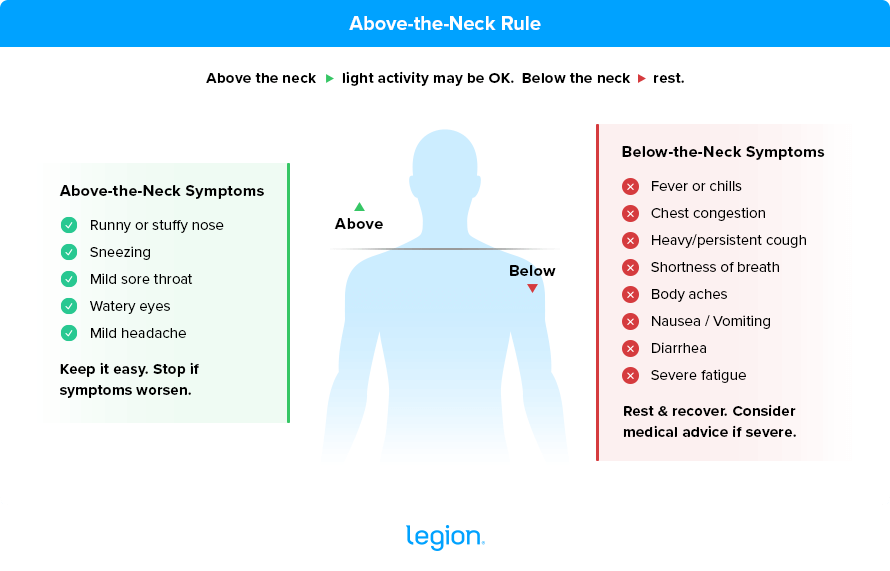
Here’s a quick rule of thumb that makes the “should I train?” decision a lot simpler: if your symptoms are mostly above the neck, light activity is usually fine; if they’re below the neck, rest is the smarter move.
Here’s a quick visual that makes the call simple.
How to Modify Your Workout When You’re Sick
If you’ve got mild, above-the-neck symptoms and you’ve decided you’re okay to move, the goal isn’t to “get after it.” It’s to stay lightly active without making recovery harder.
For cardio, that can be as simple as 20–30 minutes of easy walking.
If you’d rather lift weights, reduce your workload and effort. Cut your sets by 1–2 sets per exercise and stay further from failure than usual. For example, if you normally do 3 sets of bench press and stop 1–2 reps shy of failure, do 2 sets and leave 3–4 reps in the tank at the end of each set.
Don’t Spread Germs at the Gym

Even if you feel well enough to move, there’s a second question you have to answer:
Are you likely to spread whatever you’ve got to other people?
If the answer is “yes,” stay home. It’s the courteous move, and it saves everyone else from getting knocked out for a week.
If you’re on the fence and you do go out in public, act like you’re trying not to infect anyone—because you are. Here’s how that might look:
- Avoid close contact with other people
- Don’t share bottles, cups, or food
- Wash your hands often
- Keep your hands off your face
- Cough and sneeze into your elbow
- Avoid poorly ventilated gyms (crowded, stuffy rooms)
If you wouldn’t want the person next to you breathing on you, don’t be that person.
How to Return to Training After Being Sick
You don’t have to do anything dramatic when you get back in the gym. You don’t need to slash your volume in half or switch to baby weights. But you should treat your first workout back like a test run.
Show up and warm up as usual. If you feel okay, start your working sets—but train a little further from failure than normal. So if you usually stop sets 1–2 reps shy of failure, stop 2–3 reps shy instead.
Then pay attention to how you feel once the work starts. If after a set or two you feel sluggish, don’t force it. Pull the plug on the remaining sets. For example, if you planned 3 sets of deadlifts but you feel gassed after 2, skip the third. Move on to the next exercise and do the same thing again.
Do the same thing in your second workout back.
By your third workout, you should feel noticeably more normal. If you don’t—and you keep having to end workouts early because you feel awful—take a couple more days off. That’s a sign you weren’t ready yet.
Otherwise, once you can get through a session without feeling wrecked, you can basically train normally again.
RELATED: How to Get Back Into Weightlifting After a Break from the Gym (With a Training Program!)
The Bottom Line on Working Out When Sick
If you’re sick enough to wonder whether you should train, skip your normal workout.
Hard, prolonged training is a major stressor, and research shows it can temporarily suppress immune function for hours to days—exactly what you don’t want when your body’s trying to fight something off.
If your symptoms are mild and mostly above the neck, light activity is usually fine—as long as you keep it truly easy and cut your usual workload. But if you have fever, chest symptoms, GI issues, or you feel wiped out, rest is the smarter play. And if you’re contagious, stay home.
Most importantly: a few sick days won’t erase your gains. Get healthy first, then ease back into training.
FAQ #1: Is it better to rest or exercise when sick?
Most of the time, rest is a better choice than hard exercise when you’re sick. Research shows prolonged, intense exercise can temporarily suppress immune function. That said, if your symptoms are mild, light movement can be fine.
FAQ #2: Is it okay to workout when you have a cold?
Sometimes. If it’s mild and mostly “above the neck,” light activity is usually okay. But if you have fever, chest symptoms, GI issues, or crushing fatigue, rest. Also, if you’re contagious, don’t go to the gym.
FAQ #3: Does working out help get rid of a virus?
A hard workout won’t “sweat out” a virus. Research suggests moderate exercise can support immune function, while prolonged, intense exercise can do the opposite. So if you move at all while sick, keep it light. Otherwise, rest and recover.
FAQ #4: Can exercise help get rid of sickness?
Light activity can help you feel better and keep your routine, but it won’t magically cure you. The key is dose: moderate exercise tends to support immune function, while long, exhausting sessions can temporarily suppress it.
Want More Content Like This?
Check out these articles:
- Yes, You Can “Boost” Your Immune System. Here’s How (According to Science)
- How Fast You Lose Muscle When You Stop Working Out
- Do You Know These 8 Proven Signs of Overtraining?
Scientific References +
- Nieman, David C., and Laurel M. Wentz. “The Compelling Link between Physical Activity and the Body’s Defense System.” Journal of Sport and Health Science, vol. 8, no. 3, May 2019, pp. 201–217, www.ncbi.nlm.nih.gov/pmc/articles/PMC6523821/, https://doi.org/10.1016/j.jshs.2018.09.009.
- Shi, Xinxin, et al. “Exercise Workload: A Key Determinant of Immune Health – a Narrative Review.” Frontiers in Immunology, vol. 16, 24 July 2025, https://doi.org/10.3389/fimmu.2025.1617261.
- Ishak göçer, and Muhammed Oniz. “Effect of Exercise on Immune System.” Journal of Exercise Science & Physical Activity Reviews, vol. 3, no. 1, 2025, pp. 1–12, e-jespar.com/index.php/jespar/article/view/39, https://doi.org/10.5281/zenodo.15854810. Accessed 18 Oct. 2025.
- McMahon, Gerard E., et al. “Impact of Range of Motion during Ecologically Valid Resistance Training Protocols on Muscle Size, Subcutaneous Fat, and Strength.” Journal of Strength and Conditioning Research, vol. 28, no. 1, Jan. 2014, pp. 245–255, https://doi.org/10.1519/jsc.0b013e318297143a.
- Jespersen, J. G., et al. “Myostatin Expression during Human Muscle Hypertrophy and Subsequent Atrophy: Increased Myostatin with Detraining.” Scandinavian Journal of Medicine & Science in Sports, vol. 21, no. 2, 10 Mar. 2011, pp. 215–223, https://doi.org/10.1111/j.1600-0838.2009.01044.x.
- Dirks, Marlou L., et al. “One Week of Bed Rest Leads to Substantial Muscle Atrophy and Induces Whole-Body Insulin Resistance in the Absence of Skeletal Muscle Lipid Accumulation.” Diabetes, vol. 65, no. 10, 29 June 2016, pp. 2862–2875, diabetes.diabetesjournals.org/content/65/10/2862, https://doi.org/10.2337/db15-1661.
- Costill, D. L., et al. “Metabolic Characteristics of Skeletal Muscle during Detraining from Competitive Swimming.” Medicine and Science in Sports and Exercise, vol. 17, no. 3, 1 June 1985, pp. 339–343, pubmed.ncbi.nlm.nih.gov/3160908/.
- MUJIKA, I, and SABINO PADILLA. “Cardiorespiratory and Metabolic Characteristics of Detraining in Humans.” Medicine and Science in Sports and Exercise, vol. 33, no. 3, Mar. 2001, pp. 413–421, https://doi.org/10.1097/00005768-200103000-00013.
- Martin, Stephen A., et al. “Exercise and Respiratory Tract Viral Infections.” Exercise and Sport Sciences Reviews, vol. 37, no. 4, 1 Oct. 2009, pp. 157–164, www.ncbi.nlm.nih.gov/pmc/articles/PMC2803113/, https://doi.org/10.1097/JES.0b013e3181b7b57b.