Most upper body workouts for women are overcomplicated—and that’s exactly why they don’t work.
They’re packed with endless exercises, “toning” circuits, and finishers that feel hard but don’t actually make you stronger. You sweat, your muscles burn, and weeks later, nothing has changed.
Effective workouts are actually much simpler. Building a strong, defined upper body comes down to doing a few well-chosen exercises in the right order, with a clear plan for progress.
This article shows you exactly how to do that.
Key Takeaways
- Most upper body workouts for women fail because they’re overcomplicated; real progress comes from a small number of well-chosen exercises done in the right order and repeated consistently.
- An effective upper body workout trains the main upper body muscle groups: the chest, back, shoulders, biceps, and triceps.
- The foundation of upper body training should be big compound exercises, with pushing and pulling balanced to keep your physique proportionate, your shoulders healthy, and progress steady.
- To keep getting stronger, use weights that let you reach your target reps with good form while finishing each set about one to two reps shy of failure, then gradually add reps or weight over time.
- You don’t need supplements to build a strong upper body, but protein powder, creatine, and pre-workout can help you train harder, recover better, and get results faster.
Table of Contents
+
How to Build an Upper Body Workout for Women (Gym or At Home)
Building a great upper body workout for women isn’t complicated. That doesn’t stop people from making it complicated.
You’ll see workouts with 12 exercises, three “arm burners,” and a “toning” circuit that mostly just leaves you sweaty and unsure what you accomplished.
Here’s the truth:
You only need a handful of upper body exercises, arranged in a smart order, done consistently, and progressed over time.
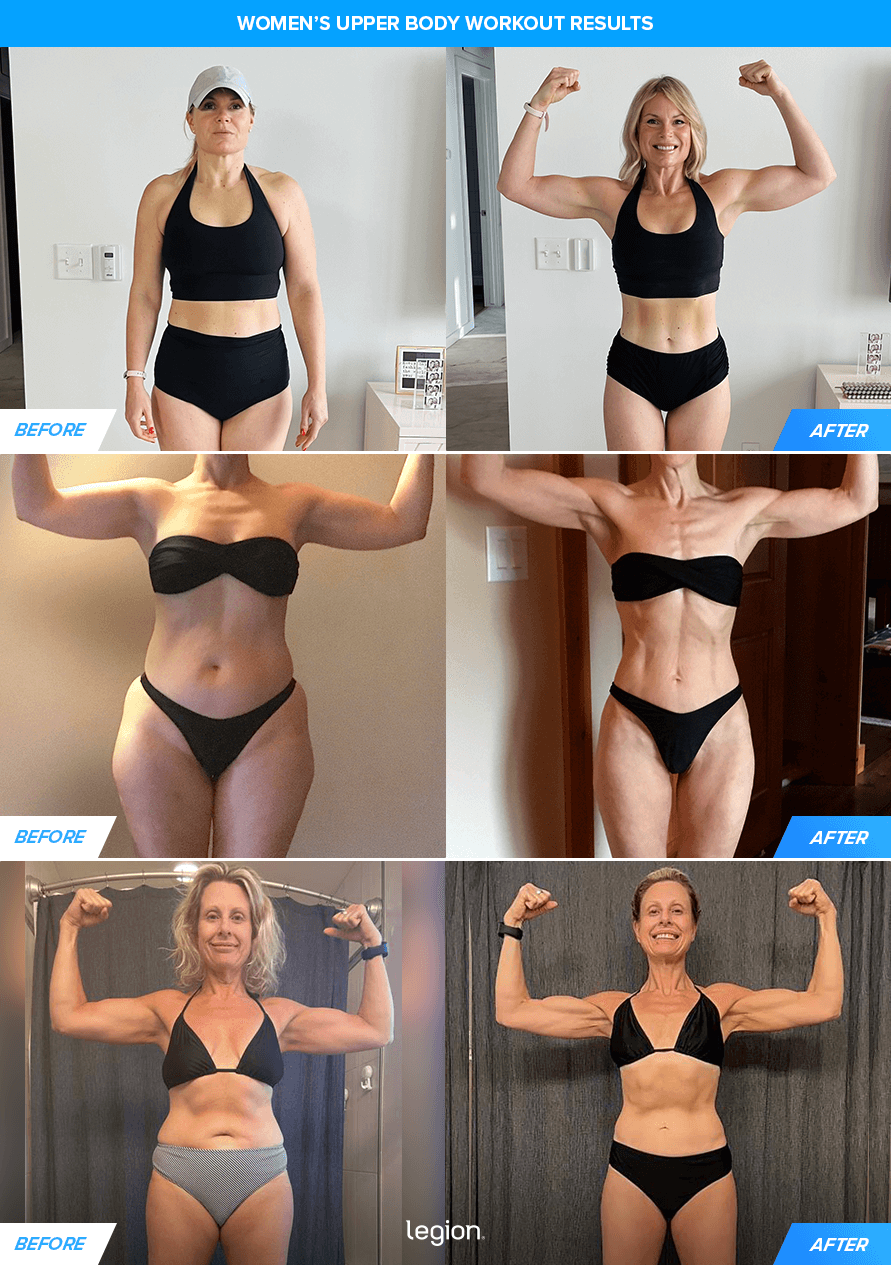
That’s it. In fact, that’s exactly the approach these women took on Legion’s body transformation coaching service and their results speak for themselves:
Let’s go over each step of this process in more detail:
Step 1: Train the whole upper body (not just arms)
A good women’s upper body workout trains your:
Here’s how all the individual muscles in these groups look on your body:
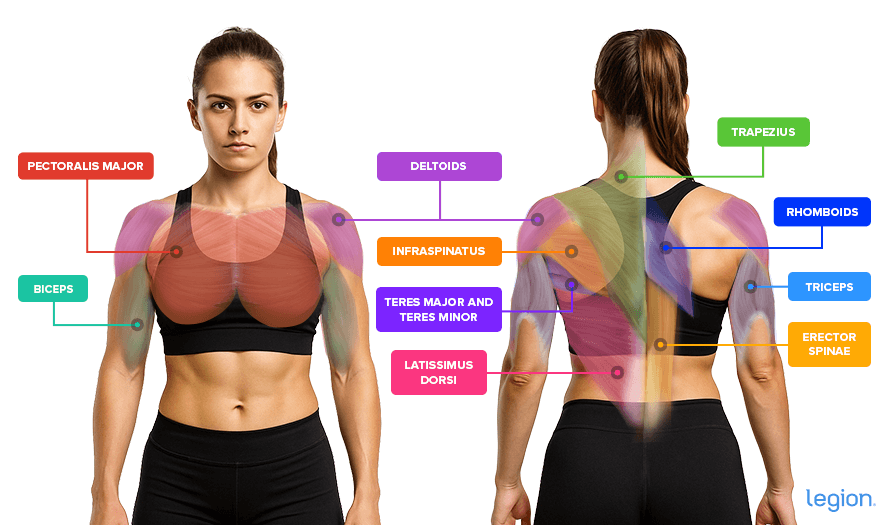
Training all these muscles creates the “shape” most women want—especially your back and shoulders.
Step 2: Build the workout around “big” compound exercises
Whether you’re doing an upper body workout at the gym or at home, your session should be built around exercises that:
- Train the most muscle at once (compound exercises)
- Let you lift the most weight
- Make it easy to get progressively stronger over time
Those are usually exercises like presses, rows, and pulldowns, and they should form the bedrock of your routine because they deliver the most results for the time you invest.
Step 3: Balance pushing and pulling
Most people naturally do more pushing (push-ups, bench presses) than pulling (rows, pulldowns), which often leads to three problems:
- An imbalanced physique (front develops faster than back)
- Cranky shoulders (because of front-to-back strength imbalances)
- Slower overall progress (because your pulling muscles help stabilize your pushing)
So use this simple rule: For every hard push, do a hard pull. It keeps your physique proportionate, your shoulders happier, and your progress steady.
Step 4: Keep it repeatable (and trackable)
The best workout routine is the one you can stick to. And the easiest way to stick to a program is to make it repeatable, because repetition gives you:
- Familiarity (better technique)
- Confidence (you know what’s coming)
- Progress you can actually measure
So instead of chasing variety, do this:
- Follow the same routine for at least 8–10 weeks
- Try to add a rep or a little weight in every workout
- Swap exercises only when you need to (equipment limits, pain, or boredom that threatens consistency)
This is how you turn a “random workout” into a real female upper body workout plan.
Step 5: Choose your path: gym or home
Train wherever you’ll be most consistent. That’s the “secret.”
The main difference between an upper body workout at the gym for females and one at home is equipment:
- At home, you’ll lean more on dumbbells and bodyweight.
- At the gym, you can use barbells, cables, machines, and—usually—heavier weights (which can make progression easier).
Either way, the structure in any well-designed workout program for women stays the same—and that’s what you’re going to get in the next sections.
Warm-Up for Upper Body Training
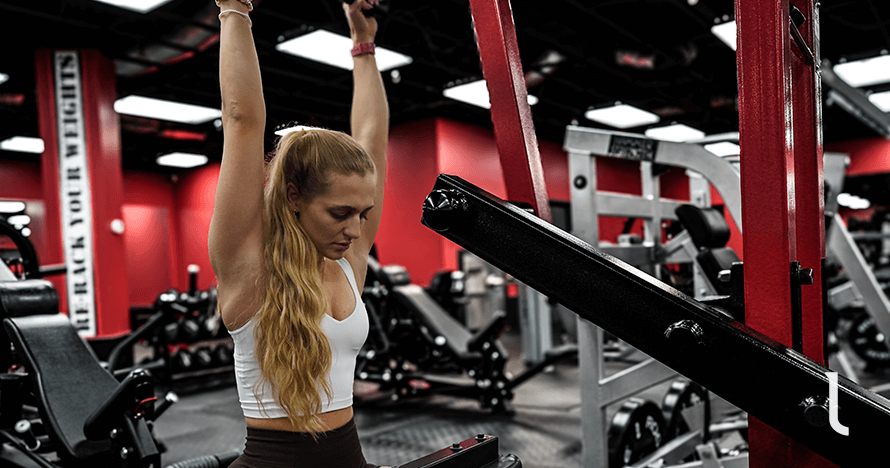
If you feel stiff, begin your upper body strength workout with a short general warm-up—3–5 minutes on a treadmill, elliptical, or some light arm circles and cross-body swings works well. If you already feel loose, skip straight to a more specific warm-up.
Here’s a research-backed protocol:
- Estimate the weight you’ll use for your first hard set of your first exercise.
- Do 6 reps with about 50% of that weight and rest for 1 minute.
- Do 4 reps with about 70% of that weight and rest for 1 minute.
After this, you’re ready to tackle your hard sets for your first exercise and the rest of your workout.
How to Choose the Right Weights
Choosing the right weights for an exercise mostly comes down to quick, common-sense experimentation.
When you’re new to an exercise, start lighter than you think you need, then add weight set by set until you find your “working” weights (those that are appropriate for your hard sets).
A good working weight is one that lets you:
- Hit your target reps with good form
- Finish the set feeling like you could do about 1–2 more reps if you had to—but no more
If you finish and feel like you could do 4–5 more reps, it’s too light. If you have to “cheat” (swing the weight, jerk your body, do half-reps, etc.) it’s too heavy.
If you’re completely unsure of where to start, the following chart will help you find your starting weights faster:
Upper Body Workouts for Women: Choosing the Right Weights
| Exercise | Starting Weight (lb.) |
|---|---|
| Barbell Bench Press | 45 (just the bar) |
| Incline Barbell Bench Press | 45 (just the bar) |
| Dumbbell Bench Press | 10 (per dumbbell) |
| Triceps Pushdown | 10 |
| One-Arm Dumbbell Row | 10 (per dumbbell) |
| Lat Pulldown | 20 |
| Alternating Dumbbell Curl | 5 (per dumbbell) |
| Seated Dumbbell Press | 10 (per dumbbell) |
| Dumbbell Side Lateral Raise | 5 (per dumbbell) |
| Dumbbell Rear Lateral Raise | 5 (per dumbbell) |
| Seated Triceps Press | 10 |

And if you can’t reach the bottom of your rep range on a barbell exercise even with just the bar, switch to a dumbbell variation for now. You’ll build strength quickly, and you can return to the bar later.
Same idea for warm-ups: if your first hard set on a barbell exercise would be 45 pounds or only slightly more, warm up with a dumbbell version of the movement instead.
Upper Body Workout for Women at Home (Dumbbells & Bodyweight)
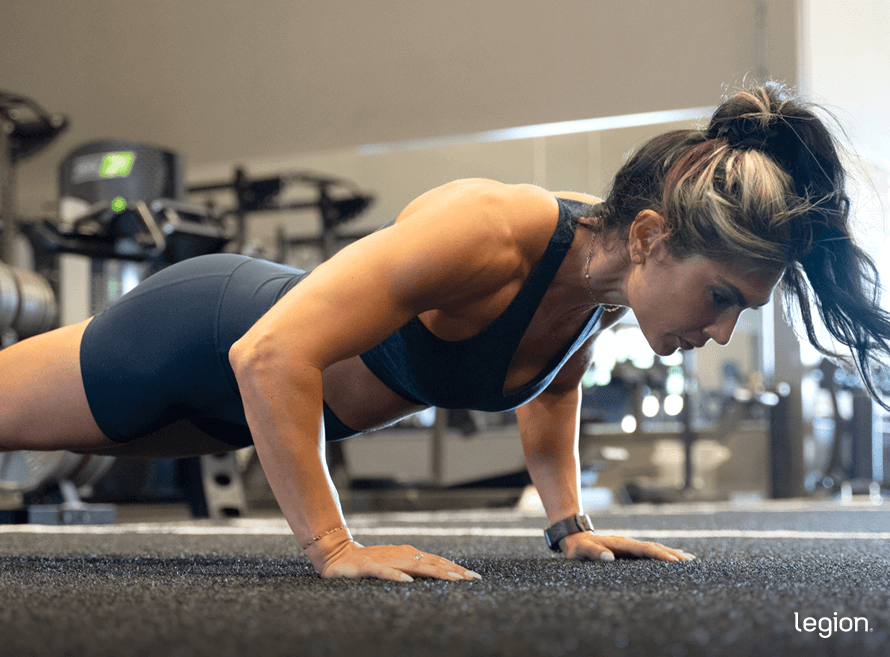
This workout is built for simplicity and results.
It trains your entire upper body, prioritizes big compound movements first, and finishes with a small amount of focused shoulder work. All you need is a pair of dumbbells, a sturdy chair or bench, and a little floor space, and you can run this workout for weeks by gradually adding reps or weight as you get stronger.
- Push-up: 3 sets | 8–10 reps | 3–5 min rest
- One-Arm Dumbbell Row: 3 sets | 8–10 reps | 3–5 min rest
- Seated Dumbbell Press: 3 sets | 8–10 reps | 3–5 min rest
- Dumbbell Pullover: 3 sets | 8–10 reps | 2–3 min rest
- Dumbbell Side Lateral Raise: 3 sets | 8–10 reps | 2–3 min rest
Upper Body Workout at the Gym for Females
This gym-based version follows the same structure as the at-home workout, but uses machines for added variety and barbells to make progression easier over time.
- Barbell Bench Press: 3 sets | 8–10 reps | 3–5 min rest
- Lat Pulldown: 3 sets | 8–10 reps | 3–5 min rest
- Seated Dumbbell Press: 3 sets | 8–10 reps | 3–5 min rest
- One-Arm Dumbbell Row: 3 sets | 8–10 reps | 2–3 min rest
- Dumbbell Side Lateral Raise: 3 sets | 8–10 reps | 2–3 min rest
How to Progress Your Women’s Upper Body Workout
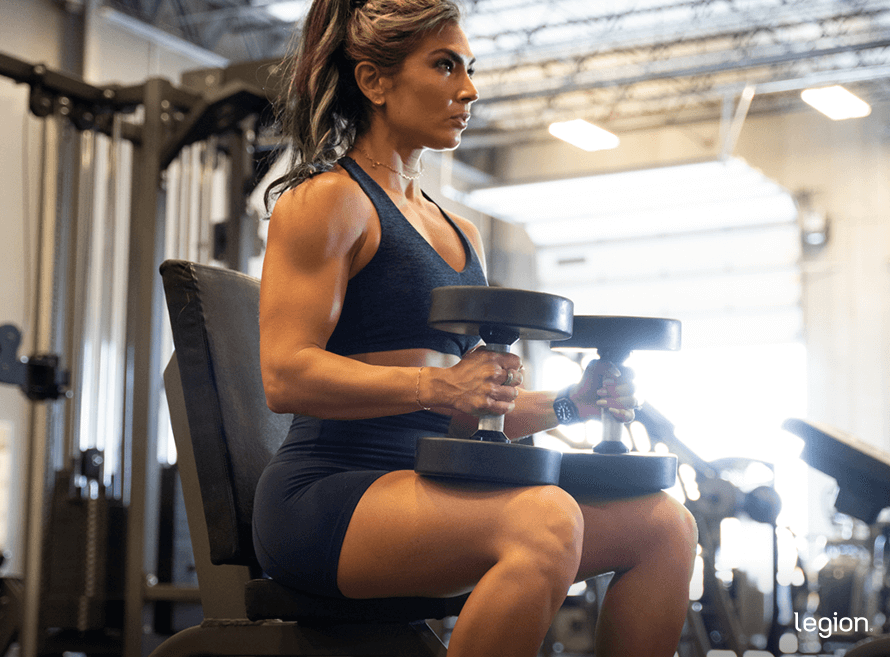
Progress comes from doing two things: training hard enough, and gradually asking your muscles to do more over time.
Intensity
To make your upper body workouts as effective as possible, take most of your sets to within 1–2 reps of failure—the point where you can’t perform another rep with proper form.
To gauge whether you’re reaching this point, ask yourself at the end of each set: “If I had to, how many more reps could I have done with good form?”
If the answer is more than two, increase the weight or reps on your next set to make it more challenging.
Progressive Overload
Training hard isn’t enough on its own. To keep building muscle and strength, you also need progressive overload, which simply means doing a little more over time.
Here’s how that looks in practice:
If your workout calls for 8–10 reps of the bench press and you complete 10 reps in a set, increase the weight by 10 pounds for your next set. If you do 7 reps or fewer in subsequent sets, reduce the load by 5 pounds to stay in the 8–10 rep range.
Apply this approach to every upper body exercise in your workouts, aiming to add either weight or reps every session.
By combining the right intensity (training close enough to failure) with progressive overload, you’ll consistently challenge your muscles, making each workout as effective as possible.
Supplements to Support Your Women’s Upper Body Workouts
Women don’t need supplements to develop their upper bodies, but the right ones can help you get results faster. Here are three worth considering:
- Protein powder: Eating enough protein is essential for building and repairing muscle. Protein powders like Whey+, Casein+ and Egg+ make hitting your target easier.
- Creatine: Creatine boosts muscle and strength gain, improves anaerobic endurance, and reduces muscle damage and soreness. For a natural source of creatine, try Legion’s creatine monohydrate powder, creatine gummies, creatine capsules, or post-workout Recharge.
- Pre-workout: A quality pre-workout helps you train harder by boosting energy, focus, and athletic performance. Legion’s Pulse is available with or without caffeine.
Want even more specific supplement advice? Take the Legion Supplement Finder Quiz to learn exactly what supplements are right for you.
The Bottom Line on Upper Body Workout for Women
An effective upper body workout for women doesn’t need to be complicated. Train your whole upper body, focus on big compound lifts, balance pushing and pulling, and stick with the same plan long enough to get stronger. Do that consistently, and results will follow.
FAQ #1: What is the best exercise for women’s upper body?
There isn’t one “best” exercise. The best upper body workout for women includes a mix of pressing and pulling movements so you train your chest, back, shoulders, biceps, and triceps. That’s how you build strength and shape evenly—and avoid turning your routine into “arms only.”
FAQ #2: How many days per week should women do an upper body workout?
It depends on how many days you train.
If you train 3 days per week, do one upper body workout and two lower body workouts. That split works well because it still keeps your upper body progressing, while letting you spend more time on the muscle groups the majority of women care most about developing—the glutes and thighs.
If you train four or more days per week, do two upper body days. You’ll generally progress faster, and it helps keep your physique balanced so your upper and lower body develop at a similar rate—which matters if you want to build the curvy, hourglass proportions many women like.
FAQ #3: Can women build upper body muscle without getting “bulky”?
Yes. Lifting heavy weights and building muscle won’t “make you bulky.” In fact, it’s very hard for women to build a big, bulky body. It doesn’t happen by accident or overnight—it takes years of intense training and eating. Even then, women can’t build as much total muscle as men unless steroids are involved.
Want More Content Like This?
Check out these articles:
- The Ultimate 3-Month Female Body Recomposition Workout Plan
- Cycle Syncing Workouts & Diet: What Science Really Says
- Hip Dips: What They Are and What to Do About Them
Scientific References +
- Ribeiro, Bruno, et al. “The Role of Specific Warm-up during Bench Press and Squat Exercises: A Novel Approach.” International Journal of Environmental Research and Public Health, vol. 17, no. 18, 22 Sept. 2020, p. 6882, pmc.ncbi.nlm.nih.gov/articles/PMC7558980/, https://doi.org/10.3390/ijerph17186882.
- Eckerson, Joan M., et al. “Effect of Creatine Phosphate Supplementation on Anaerobic Working Capacity and Body Weight after Two and Six Days of Loading in Men and Women.” The Journal of Strength and Conditioning Research, vol. 19, no. 4, 2005, p. 756, https://doi.org/10.1519/r-16924.1.
- Bassit, Reinaldo Abunasser, et al. “Effect of Short-Term Creatine Supplementation on Markers of Skeletal Muscle Damage after Strenuous Contractile Activity.” European Journal of Applied Physiology, vol. 108, no. 5, 3 Dec. 2009, pp. 945–955, https://doi.org/10.1007/s00421-009-1305-1.
- Schoenfeld, Brad J., et al. “Effects of Resistance Training Frequency on Measures of Muscle Hypertrophy: A Systematic Review and Meta-Analysis.” Sports Medicine, vol. 46, no. 11, 21 Apr. 2016, pp. 1689–1697, pubmed.ncbi.nlm.nih.gov/27102172/, https://doi.org/10.1007/s40279-016-0543-8.
- Er, Helms, et al. “Recommendations for Natural Bodybuilding Contest Preparation: Resistance and Cardiovascular Training.” The Journal of Sports Medicine and Physical Fitness, 1 Mar. 2015, pubmed.ncbi.nlm.nih.gov/24998610/.
- Refalo, Martin C, et al. “Sex Differences in Absolute and Relative Changes in Muscle Size Following Resistance Training in Healthy Adults: A Systematic Review with Bayesian Meta-Analysis.” PeerJ, vol. 13, no. 1, 25 Feb. 2025, p. e19042, www.researchgate.net/publication/389342217_Sex_differences_in_absolute_and_relative_changes_in_muscle_size_following_resistance_training_in_healthy_adults_a_systematic_review_with_Bayesian_meta-analysis, https://doi.org/10.7717/peerj.19042.