Many women think they need separate leg days, glute days, ab days, and other specialized workouts to build their ideal physique.
They don’t.
A well-designed full-body routine done a few times per week builds muscle faster, keeps workouts shorter, and produces a more balanced, athletic look than most complicated training splits.
This guide shows you exactly what actually works.
Key Takeaways
- Most women can build muscle and strength effectively with three 45-minute full-body workouts per week.
- The most effective routines train all major muscle groups each session and prioritize exercises that train the parts of the body women generally want to develop most (the lower body).
- Focus on compound exercises, train close to failure, and apply progressive overload to maximize progress.
- You can follow the same plan at home or in the gym—just use exercises that work the same muscles with whatever equipment you have.
- You don’t need supplements to develop full-body muscle, but protein powder, creatine, and pre-workout can help you get there faster.
Table of Contents
+
Full Body Workout for Women: The Simplest Gym Routine That Works
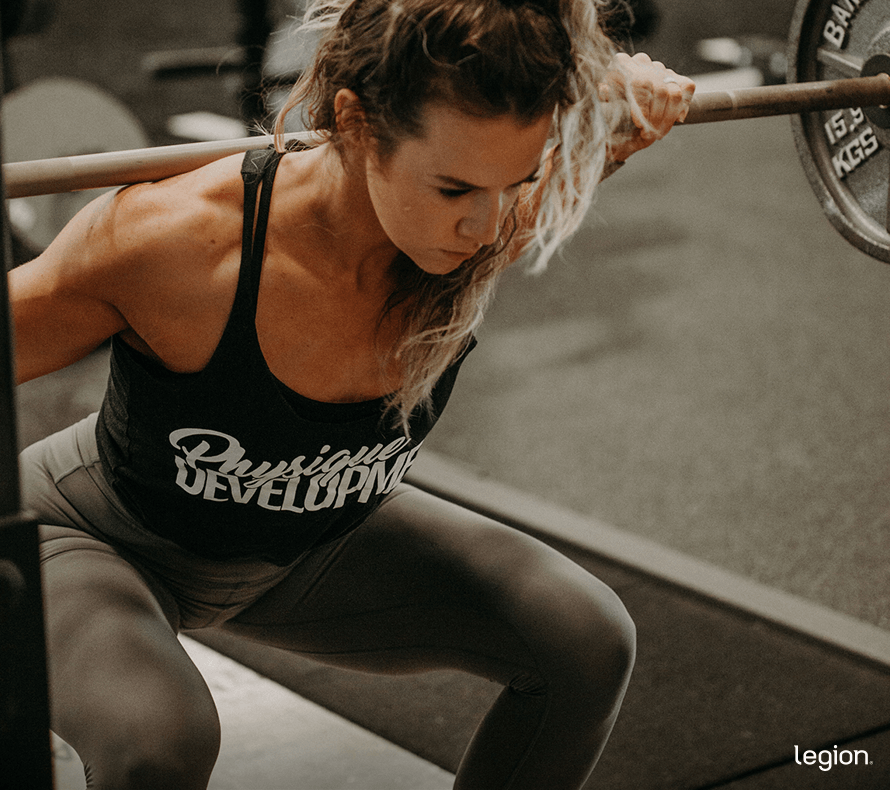
Building an effective full-body workout routine for women isn’t complicated—but plenty of people make it that way.
The most common mistake is imbalance.
Many women overemphasize certain areas (usually the lower body) while neglecting others, which leads to a physique that looks uneven instead of strong, athletic, and proportionate.
Another frequent issue is avoiding heavy weights because of the myth that lifting heavy makes you bulky (it doesn’t).
And then there’s the tendency to rely too heavily on isolation exercises for “problem areas” like the glutes, arms, or abs, instead of focusing on movements that train multiple muscle groups at once.
None of that produces the look most women are after: lean, defined, and strong.
What actually works is much simpler.
You choose the right kinds of exercises, perform enough hard sets in the right rep ranges, and gradually increase the demands on your muscles over time. Do that consistently, and you build muscle, gain strength, and improve your shape in all the ways most women want.
That’s also the basic framework the women below followed as part of Legion’s body transformation coaching—and their results speak for themselves:
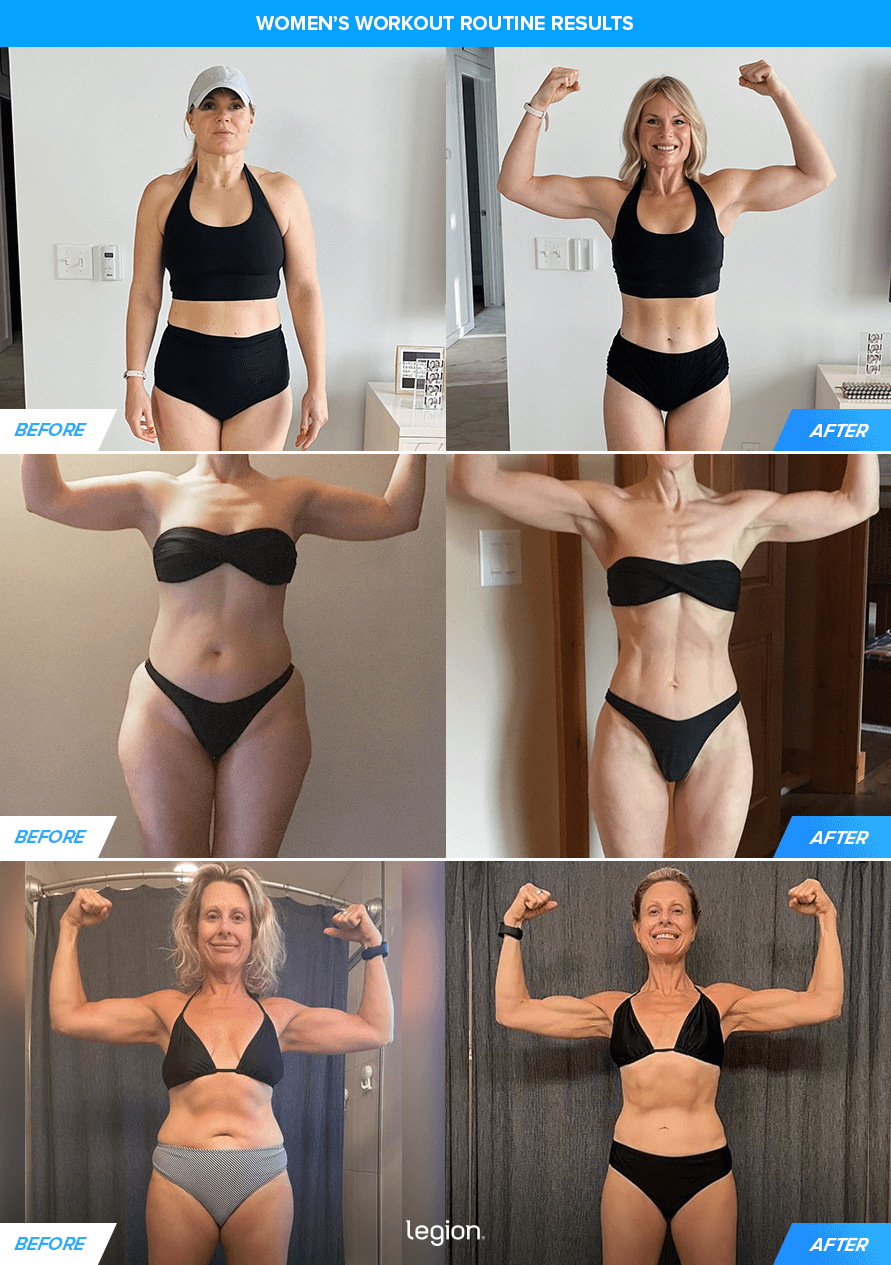
Now let’s walk through the key parts of the routine in more detail.
Training Schedule
You don’t need to spend hours in the gym day after day to see results. In fact, most women can make the majority of their progress with three focused, challenging workouts per week—each lasting about 45 minutes.
For best results on this schedule, train on any three non-consecutive days, like . . .
- Monday, Wednesday, and Friday
Or . . .
- Tuesday, Thursday, Sunday
Spacing your training out like this gives you enough frequency to make steady progress, while still allowing time to recover and come back stronger in the next session.
Muscle Worked
A good full-body workout routine for women trains all the major muscle groups in each session:
- Chest
- Back
- Shoulders
- Legs
- Arms
- Core
Here’s how the main muscles that make up each of these groups look on your body:
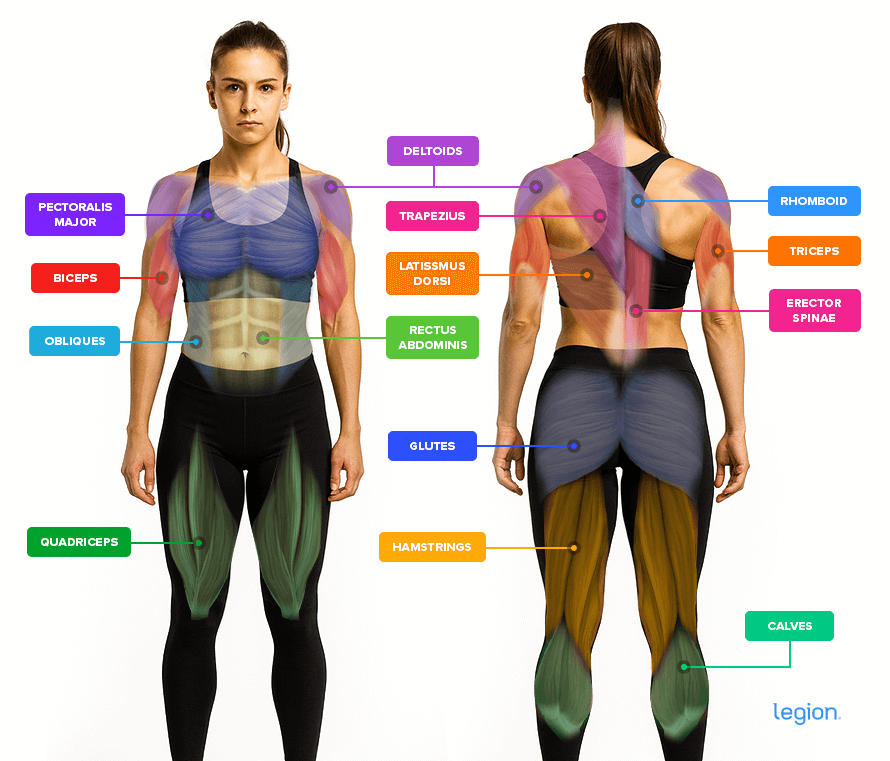
That said, since most women want to prioritize developing their lower body—especially the glutes, quads, and hamstrings—this routine starts each workout with a lower-body exercise.
That’s intentional. You make your best progress on the lifts you train when you’re freshest, and beginning with lower body work helps you put the most effort into the areas you likely care about most.
Exercise Selection
This routine won’t have you futzing around with a pile of isolation exercises designed to “fix” specific problem areas.
Instead, it’s built around compound weightlifting.
Compound exercises train multiple muscle groups at the same time, and they’re the foundation of effective strength training because they let you lift the most weight safely and progress consistently.
That matters because getting stronger over time is one of the most reliable ways to build muscle and improve your physique.
In practice, that means your workouts are built around exercises like presses, rows, pulldowns, squats, and deadlift variations—movements that deliver the most results for the time you invest.
Training Intensity
To make your full-body workouts as effective as possible, take most of your sets to within 1–2 reps of failure—the point where you can’t perform another rep with proper form.
A simple way to gauge this is to ask yourself at the end of a set: “If I had to, how many more reps could I have done with good form?”
If the answer is more than two, the set probably wasn’t hard enough to produce the best results, so increase the weight or reps on your next set to make it more productive.
Progressive Overload
Training hard is necessary, but it isn’t enough on its own. To keep building muscle and strength, you also need progressive overload, which simply means doing a little more over time.
Here’s how that looks in practice:
If your workout calls for 8–10 reps of the deadlift and you complete 10 reps in a set, increase the weight by 10 pounds for your next set. If you do 7 reps or fewer in subsequent sets, reduce the load by 5 pounds to stay in the 8–10 rep range.
Apply this approach to every exercise in your workouts, aiming to add either weight or reps every session.
The Best 45-Minute Full-Body Gym Workout Routine for Women
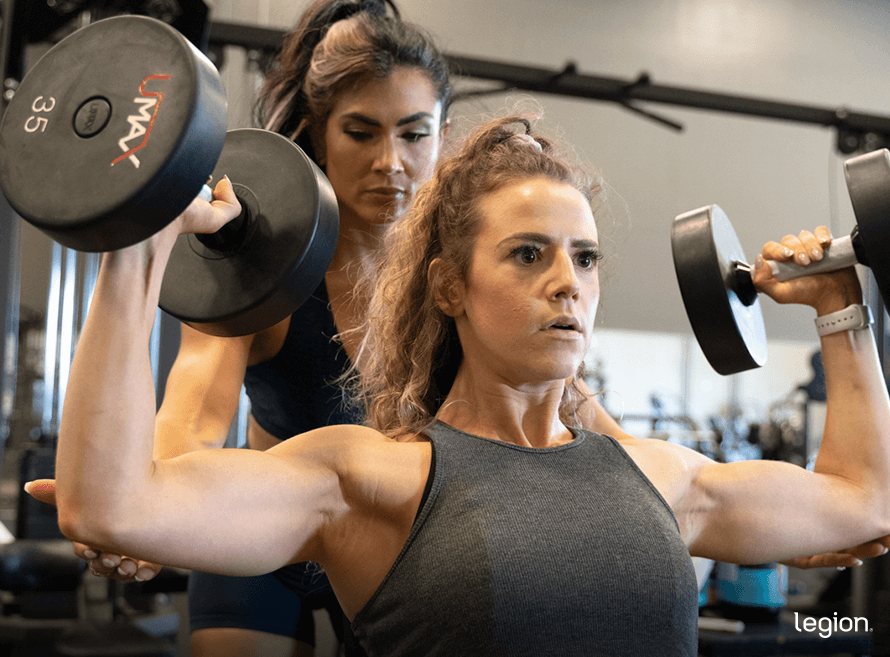
Here’s the routine. Stick to it as written, and it’ll take care of the rest.
Workout #1
- Barbell Back Squat: 3 sets | 8–10 reps | 3–5 min rest
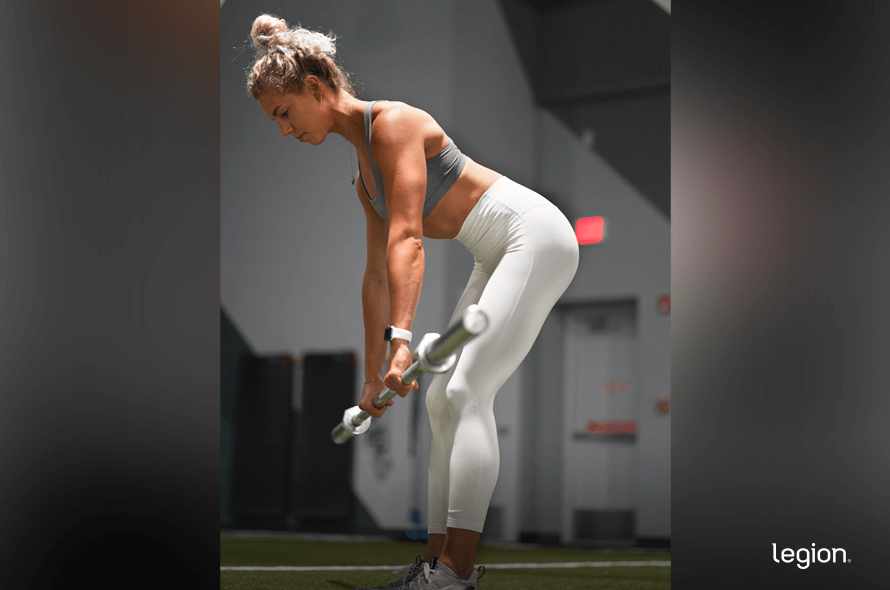
- Barbell Romanian Deadlift: 3 sets | 8–10 reps | 3–5 min rest
- Seated Shoulder Press: 3 sets | 8–10 reps | 2–3 min rest
- Barbell Curl: 3 sets | 8–10 reps | 2–3 min rest
Workout #2
- Barbell Deadlift: 3 sets | 8–10 reps | 3–5 min rest
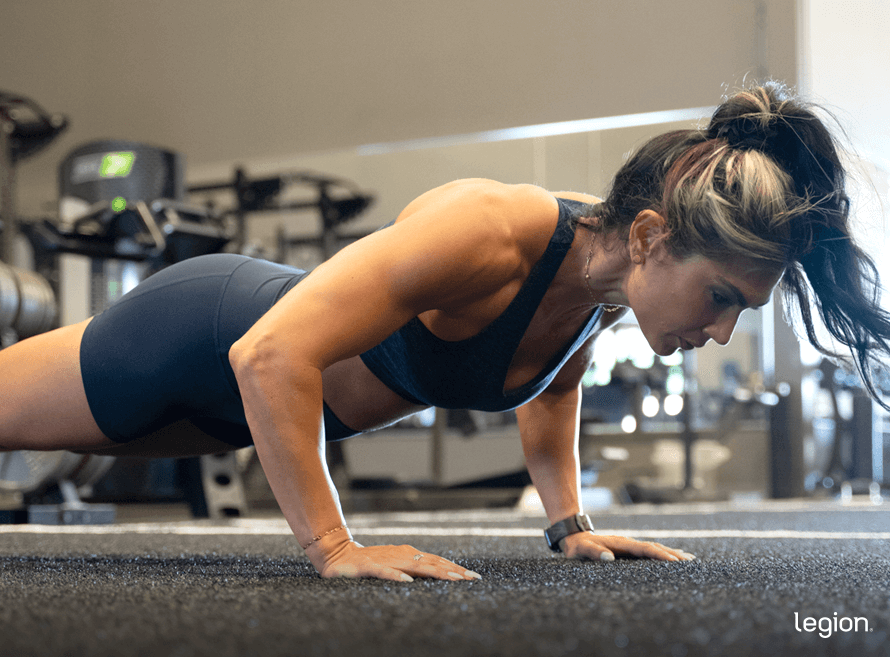
- Push-up: 3 sets | 8–10 reps | 3–5 min rest
- Lat Pulldown: 3 sets | 8–10 reps | 2–3 min rest
- Dumbbell Side Lateral Raise: 3 sets | 8–10 reps | 2–3 min rest
Workout #3
- Barbell Hip Thrust: 3 sets | 8–10 reps | 3–5 min rest
- One-Arm Dumbbell Row: 3 sets | 8–10 reps | 3–5 min rest
- Close-Grip Barbell Bench Press: 3 sets | 8–10 reps | 2–3 min rest
- Machine Reverse Fly: 3 sets | 8–10 reps | 2–3 min rest
How to Warm Up for Your Full Body Workout for Women
If you feel stiff, begin each workout with a short general warm-up—3–5 minutes on a treadmill, walking in-place, or some light arm circles and cross-body swings works well. If you already feel loose, skip straight to a more specific warm-up.
Here’s a research-backed protocol:
- Estimate the weight you’ll use for your first hard set of your first exercise.
- Do 6 reps with about 50% of that weight and rest for 1 minute.
- Do 4 reps with about 70% of that weight and rest for 1 minute.
After this, you’re ready to tackle your hard sets for your first exercise and the rest of your workout.
Supplements to Support Your Women’s Full-Body Workouts
Women don’t need supplements to build strong, athletic physiques, but the right ones can help you get results faster. Here are three worth considering:
- Protein powder: Eating enough protein is essential for building and repairing muscle. Protein powders like Whey+, Casein+ and Egg+ make hitting your target easier.
- Creatine: Creatine boosts muscle and strength gain, improves anaerobic endurance, and reduces muscle damage and soreness. For a natural source of creatine, try Legion’s creatine monohydrate powder, creatine gummies, creatine capsules, or post-workout Recharge.
- Pre-workout: A quality pre-workout helps you train harder by boosting energy, focus, and athletic performance. Legion’s Pulse is available with or without caffeine.
Want even more specific supplement advice? Take the Legion Supplement Finder Quiz to learn exactly what supplements are right for you.
Full Body Workout in the Gym for Females vs. At-Home: How to Adapt Without Changing the Plan
You don’t need a fully equipped gym to get excellent results. With just a few pairs of dumbbells—ideally a light, medium, and heavy set—you can train your entire body effectively at home.
If you want to follow this routine outside the gym, simply swap any exercises you can’t do with the closest dumbbell or bodyweight alternative.
Here are simple substitutions that preserve the intent of each exercise:
- Barbell Back Squat → Bodyweight Squat, Goblet Squat, or Bulgarian Split Squat
- Barbell Romanian Deadlift → Dumbbell Romanian Deadlift or Nordic Leg Curl
- Seated Shoulder Press → Standing Dumbbell Shoulder Press
- Barbell Curl → Dumbbell Curl
- Barbell Deadlift → Dumbbell Deadlift
- Lat Pulldown → One-Arm Dumbbell Row or Dumbbell Pullover
- Barbell Hip Thrust → Single-Leg Dumbbell Hip Thrust or Glute Bridge
- Close-Grip Bench Press → Diamond Push-up
- Machine Reverse Fly → Dumbbell Rear Lateral Raise or Dumbbell Rear Delt Row
Are Full-Body Workouts Effective for Women?
Yes—full-body workouts are highly effective for women. In fact, they’ve become increasingly popular in recent years, and for good reason.
One key advantage is frequency. Research suggests women may recover faster between workouts than men, which means they can benefit from training each muscle group more often. Full-body routines are the perfect workout split to exploit this because they work your entire body several times per week.
They’re also efficient. Every workout trains your whole body, so you can make progress without spending hours in the gym.
A well-designed three-day full-body routine also offers a few practical benefits:
- You don’t get brutally sore because you never hammer any single muscle group with lots of sets in a single workout.
- It’s flexible—if you miss a day, it doesn’t derail your whole week.
- It may help you build muscle by keeping muscle protein synthesis rates elevated more than other splits.
The Bottom Line on Full Body Workout for Women
A full body workout for women doesn’t need to be complicated to work. Train three times per week, focus on compound exercises, take most sets close to failure, and get a little stronger over time. Do that consistently, and you’ll build a lean, athletic, well-balanced physique.
FAQ #1: How many days a week should women do a full-body workout?
Three days per week works best for most women. It’s enough frequency to build muscle and strength consistently without requiring long gym sessions or making recovery difficult.
That said, four- or five-day routines can also work well if you structure them properly. To learn how to set those up, check out this article:
The Best Full-Body Workout Routines for Building Muscle
FAQ #2: Is a full body workout routine for women good for beginners?
Yes. Full-body routines are ideal for beginners because they build balanced strength and muscle without making you excessively sore.
If you’re new to weightlifting—or prefer training at home—you can use the substitutions above to adjust exercises to your experience level, strength, and the equipment you have available.
FAQ #3: Can I do a full-body workout at home with dumbbells?
Yes. A few pairs of dumbbells are enough to train your entire body effectively at home. As long as you choose exercises that train all your major muscle groups and continue challenging yourself over time, you can build muscle and strength just as reliably without access to machines or barbells.
Want More Content Like This?
Check out these articles:
- The Best Upper Body Workout for Women (Gym or Home)
- The Perfect Push Day Workout Routine for Women
- The Ultimate Pull Day Workout Routine for Women
Scientific References +
- Ribeiro, Bruno, et al. “The Role of Specific Warm-up during Bench Press and Squat Exercises: A Novel Approach.” International Journal of Environmental Research and Public Health, vol. 17, no. 18, 22 Sept. 2020, p. 6882, pmc.ncbi.nlm.nih.gov/articles/PMC7558980/, https://doi.org/10.3390/ijerph17186882.
- Eckerson, Joan M., et al. “Effect of Creatine Phosphate Supplementation on Anaerobic Working Capacity and Body Weight after Two and Six Days of Loading in Men and Women.” The Journal of Strength and Conditioning Research, vol. 19, no. 4, 2005, p. 756, https://doi.org/10.1519/r-16924.1.
- Bassit, Reinaldo Abunasser, et al. “Effect of Short-Term Creatine Supplementation on Markers of Skeletal Muscle Damage after Strenuous Contractile Activity.” European Journal of Applied Physiology, vol. 108, no. 5, 3 Dec. 2009, pp. 945–955, https://doi.org/10.1007/s00421-009-1305-1.
- Hagstrom, Amanda D, et al. “The Effect of Resistance Training in Women on Dynamic Strength and Muscular Hypertrophy: A Systematic Review with Meta-Analysis.” Sports Medicine (Auckland, N.Z.), vol. 50, 2019, pp. 10.1007/s40279-01901247-x, www.ncbi.nlm.nih.gov/pubmed/31820374, https://doi.org/10.1007/s40279-019-01247-x.
- Judge, Lawrence W., and Jeanmarie R. Burke. “The Effect of Recovery Time on Strength Performance Following a High-Intensity Bench Press Workout in Males and Females.” International Journal of Sports Physiology and Performance, vol. 5, no. 2, June 2010, pp. 184–196, https://doi.org/10.1123/ijspp.5.2.184.
- Häkkinen, K. “Neuromuscular Fatigue in Males and Females during Strenuous Heavy Resistance Loading.” Electromyography and Clinical Neurophysiology, vol. 34, no. 4, 1 June 1994, pp. 205–214, pubmed.ncbi.nlm.nih.gov/8082606/.
- Amdi, Christian Houmann, et al. “Impact of Training Protocols on Lifting Velocity Recovery in Resistance Trained Males and Females.” Sports, vol. 9, no. 11, 19 Nov. 2021, p. 157, https://doi.org/10.3390/sports9110157. Accessed 8 Dec. 2021.
- Damas, Felipe, et al. “A Review of Resistance Training-Induced Changes in Skeletal Muscle Protein Synthesis and Their Contribution to Hypertrophy.” Sports Medicine, vol. 45, no. 6, 6 Mar. 2015, pp. 801–807, https://doi.org/10.1007/s40279-015-0320-0.
- Zaroni, Rafael S., et al. “High Resistance-Training Frequency Enhances Muscle Thickness in Resistance-Trained Men.” Journal of Strength and Conditioning Research, vol. 33, July 2019, pp. S140–S151, https://doi.org/10.1519/jsc.0000000000002643.
- Schoenfeld, Brad J., et al. “Influence of Resistance Training Frequency on Muscular Adaptations in Well-Trained Men.” Journal of Strength and Conditioning Research, vol. 29, no. 7, July 2015, pp. 1821–1829, journals.lww.com/nsca-jscr/Pages/ArticleViewer.aspx?year=2015&issue=07000&article=00008&type=Fulltext, https://doi.org/10.1519/jsc.0000000000000970.