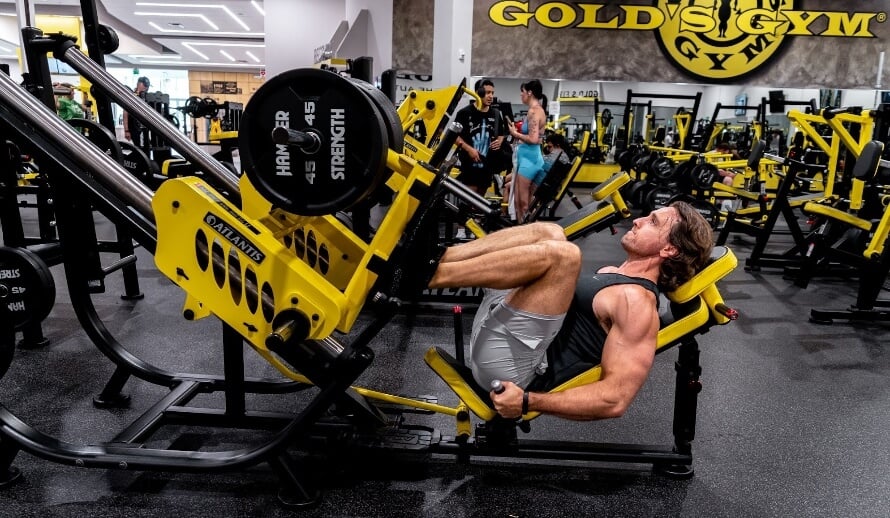
Most people don’t need to do a lot of leg exercises or volume to get great wheels.
A squat movement plus a few accessory exercises like hack squats, leg press, Bulgarian split squats, lunges, etc. for a total of 10 to 12 sets per week usually fits the bill.
So if you only get a small number of accessory slots each week, you want to choose the exercises that give you the biggest return on effort.
That’s why so many people compare the hack squat and the leg press. They look similar but feel different, so everyone assumes one must be “better” than the other.
In this guide, you’ll learn exactly how these two movements differ, what each is best for, and how to use them in your training to build stronger, bigger legs with as little wasted effort as possible.
Key Takeaways
- Both the hack squat and leg press train the same lower-body muscles to a similar degree and are excellent for building muscle and strength.
- The hack squat trains your quads through a longer range of motion and mimics a barbell squat more closely, which may offer slightly better carryover to free-weight squatting.
- The leg press lets you lift much heavier loads with less overall fatigue, making it great for adding extra volume (sets) without beating yourself up.
- Neither machine is universally “better.” The right choice depends on your goals, recovery, and what feels good for your body.
- If your gym has both, the smartest approach is to include both in your program. Rotate them every 8–10 weeks to maximize quad growth, manage fatigue, and build stronger legs with minimal wasted effort.
Table of Contents
+
Hack Squat vs Leg Press: At a Glance
Hack Squat vs. Leg Press: At a Glance
| Feature | Hack Squat | Leg Press |
|---|---|---|
| Body position | Standing with your shoulders and back against a pad | Seated with your back supported in the seat |
| Movement pattern | Squatting down and standing back up | Moving the footplate by bending and straightening your knees |
| Muscles emphasized | Quads and glutes | Quads and glutes |
| Load potential | Moderate-heavy | Very heavy |
| Stability demand | Moderate | Low |
| Back stress | Some spinal loading | Minimal when form is good |
| Best for | Squat carryover, functional strength, quad emphasis | Beginners, high volume, and back-friendly leg work |

Hack Squat vs Leg Press: Main Differences
At a high level, the hack squat is like a “training wheels” squat. Your feet are on a fixed platform, and your shoulders and back press against a padded sled that moves up and down on rails. The sled has posts on the sides where you load weight plates.
Here’s how it looks:
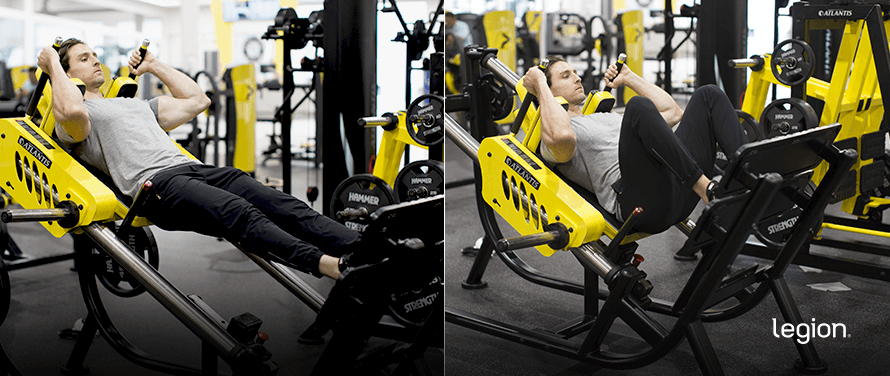
Because your knees usually bend more in the hack squat than in the leg press, it trains your quads through a greater range of motion, which typically benefits muscle growth.
On the leg press, you sit in the machine and push a sled away with your feet. The seat supports your back, your torso doesn’t move, and your job is simply to bend and straighten your knees.
Here’s how it looks:
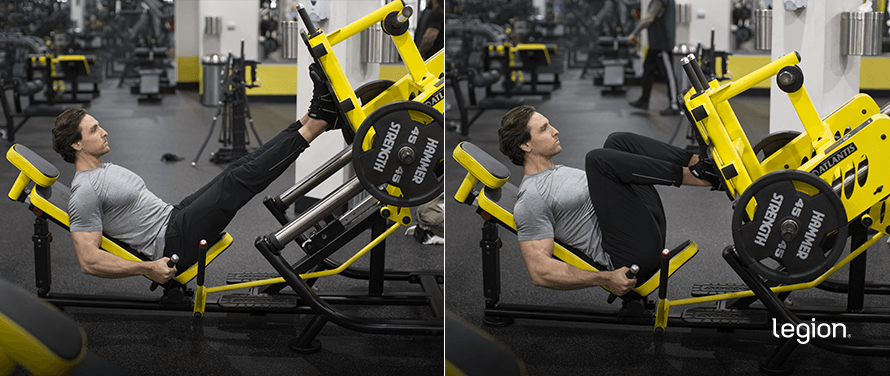
You can usually leg press more weight than you can hack squat, it’s typically less fatiguing overall, and it’s less taxing on your lower back when you perform it correctly.
Hack Squat: Pros and Cons
Pros
- Squat carryover: The hack squat mimics the movement and coordination of a squat better than the leg press, so strength you gain here tends to transfer more to barbell squats.
- Quad emphasis: Because of the machine’s angle and your foot position, it’s easy to get into a deep knee bend and hammer your quads without worrying as much about your lower back or balance as with free-weight squats.
- More stability work: Even though the movement is guided, you still have to control more moving parts (torso, hips, knees, ankles). That means your core and smaller stabilizer muscles work harder than they do on the leg press.
- Good middle ground: If squats wreck your lower back or you can’t quite get the hang of them, the hack squat can be a more forgiving way to train a similar movement while you work on your mobility, skill, and strength.
Cons
- Less beginner-friendly: You still have to think about bracing and controlling your whole body, which can overwhelm someone new to lifting.
- Can be tough on your joints: If you put your feet too low, go too deep, let your heels come up, or use a very narrow stance, you can end up dumping a lot of stress into your knees, hips, or ankles, especially if you have cranky joints.
- Availability: Many commercial gyms have a leg press; fewer have a hack squat.
- Some lower-back stress: The weight is positioned on your shoulders in the hack squat, so while it’s not nearly as demanding on your lower back as free-weight squats, you still have to support some load, which some find uncomfortable.
Leg Press: Pros and Cons
Pros
- Very easy to learn: You sit down, put your feet on the platform, and push. There’s still technique, but it’s far simpler than a squat or even a hack squat, which makes it ideal for beginners.
- Back- and balance-friendly: Your torso is supported and the machine moves on rails, so you don’t have to worry about falling over or keeping a heavy bar on your back. That’s helpful if your lower back is cranky or your balance isn’t great.
- Lets you lift heavy weights: Because the movement is so supported, most people can load a leg press heavier than almost any other lower-body exercise, which is great for gaining strength and muscle.
- Low overall fatigue: Compared to free-weight squats, lunge variations, or hack squats, the leg press tends to be easier to recover from.
Cons
- Easy to cheat: Because of the way your body is positioned on the leg press, it’s harder to feel when you’ve reached the bottom of the range of motion. Combine that with how easy it is to load a lot of weight, and many people end up doing partial reps with more weight than they can really control.
- Can stress the lower back: If you go too deep, your lower back can round, which can put stress on your spine.
- Doesn’t teach full-body tension: You don’t have to brace your torso or control a barbell, so leg pressing alone won’t teach the skills you need to get strong at squats and other free-weight lifts.
- Sometimes poorly designed: Leg press machines vary a lot from gym to gym, and some have limited range of motion or awkward seat and footplate angles that make it harder to train comfortably or effectively.
Hack Squat vs Leg Press: Muscles Worked and Movement Patterns
Both exercises train the same muscle groups:
- Quads (front of your thighs)
- Glutes (butt)
- Hamstrings (back of your thighs)
Here’s how those muscles look on your body:
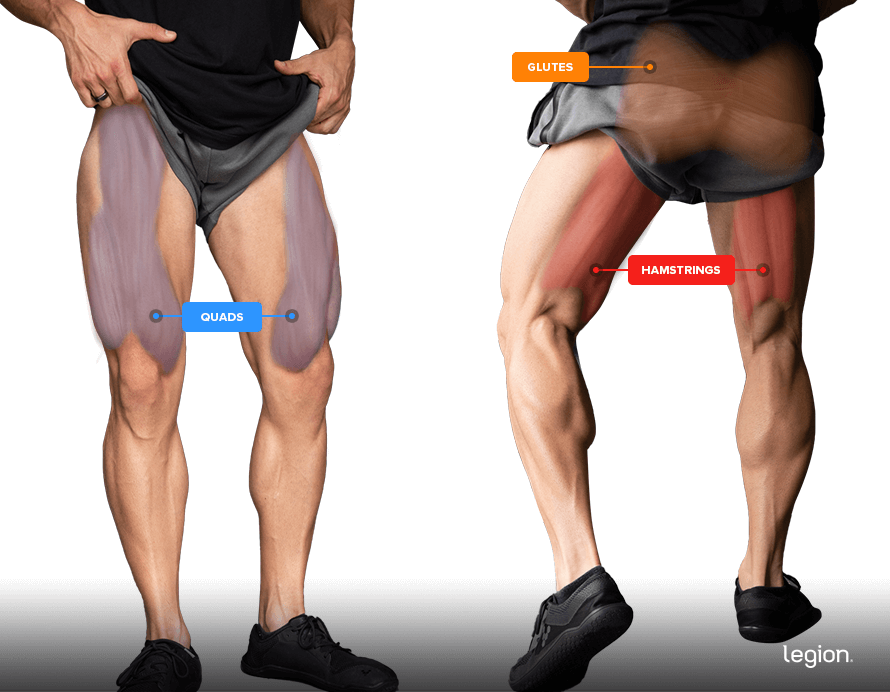
The hack squat and leg press work these muscles in slightly different ways, however.
On the hack squat, your knees usually bend more, which means you train your quads through a longer range of motion. This matters because training a muscle through a long range of motion is often better for growth.
The leg press typically has a slightly shorter range of motion—your knees don’t bend as much on each rep. However, the leg press lets you use significantly more weight, which likely helps make up for that shorter range of motion.
In other words, both exercises train your quads very well—but in different ways: the hack squat uses a longer range of motion with lighter loads, while the leg press uses a slightly shorter range of motion with heavier loads.
Hack Squat vs Leg Press: Strength, Load, and Joint Stress
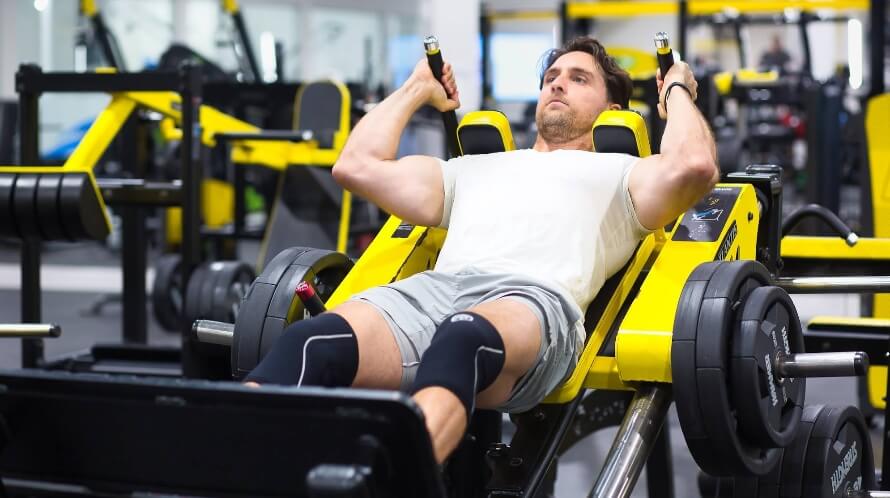
Because your back is supported and you don’t have to balance anything, you can load the leg press with far more weight than you could ever use on a hack squat. This matters because lifting heavy weights is an important driver of muscle and strength gain.
The downside is that leg press strength doesn’t always carry over to free-weight squatting. Even if your legs are very strong, your squat can still be limited by your core and back strength—muscles the leg press doesn’t challenge much.
Still, the leg press lets you train very hard with high volume without fatiguing your lower back or accumulating much systemic fatigue.
The hack squat, on the other hand, places the load on your shoulders and moves your hips and knees like a barbell squat, so the strength you gain transfers better to actual squatting.
The tradeoff is that it’s more fatiguing and, because of the spinal loading and deeper range of motion, can aggravate your joints more.
Hack Squat vs Leg Press: Which Is Better for Your Goals?
For Muscle and Size
If your main goal is bigger quads and glutes, both the hack squat and leg press can work very well. What matters most is:
- You can train through a full, pain-free range of motion
- You can safely train hard (take sets close to failure)
- You can add weight or reps over time
- You recover well between workouts
For some people, the hack squat makes those things easier. For others, it’s the leg press. And for most lifters, the best long-term results come from using a mix of both.
For Strength and Squat Carryover
Both exercises help you gain leg strength. The leg press lets you lift much heavier weights, which is great for building raw lower-body strength. The hack squat, however, feels more like a barbell squat and uses a similar movement pattern, so it probably has slightly more direct carryover to your actual squat.
In practice, though, this difference matters less than people think. If you follow a well-balanced program that also includes exercises like deadlifts and Romanian deadlifts—which strengthen your lower back and core—you don’t need your squat accessory exercises to mimic a squat perfectly.
Being able to train your legs hard and progressively (which both machines allow) is what drives long-term gains, so using both machines is usually the best approach.
For Beginners and Back Issues
If you’re new to lifting or dealing with a sensitive lower back, the leg press is usually the better starting point.
It’s simple to learn, it lets you build leg strength without worrying about balance, and it keeps your back supported—as long as you don’t round at the bottom of each rep.
Once you’re comfortable with the basics and your back feels good, you can add hack squats to work a movement pattern that’s closer to a barbell squat. Some people with back pain also do well on hack squats, but they usually need to play with foot position and depth to find a pain-free setup.
For Fatigue Management
Both exercises are far less fatiguing than free-weight squats or lunges because the machines take most of the balance and stability demands off your plate. So from a fatigue standpoint, both work well.
That said, the leg press is usually a little easier to recover from because it doesn’t load your spine. You can train hard, use high reps, and add a lot of volume without feeling as worn out afterward.
The hack squat is still much less fatiguing than barbell squats, but it does place some load on your back and generally feels a bit more demanding.
Overall, it’s not something to overthink—compared to free-weight exercises, both machines are relatively low-fatigue options. The leg press is just slightly better in that regard.
How to Use Hack Squats and Leg Presses in Your Leg Workouts
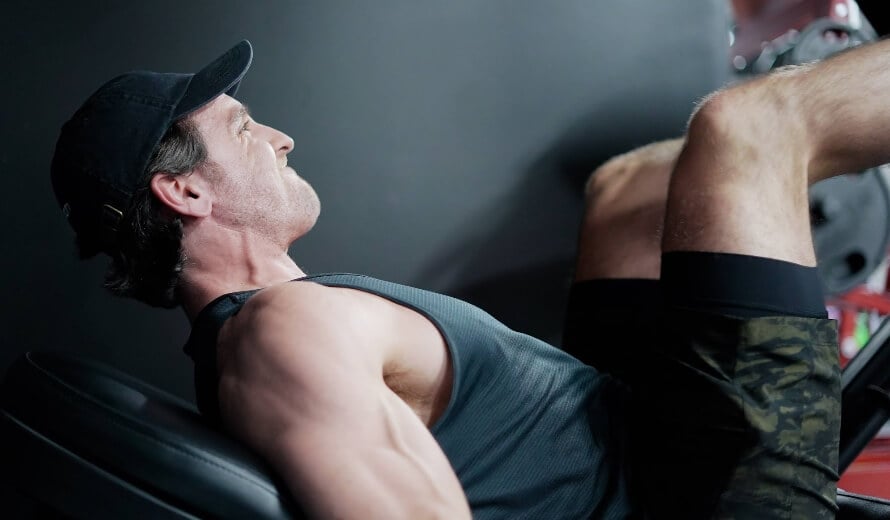
You don’t have to pick only the hack squat or only the leg press. If your gym has both, using both in your training is usually the best move.
A simple way to structure most leg workouts is:
- Start with a squat variation (back squat, front squat, safety bar squat).
- Follow with a hamstring-focused exercise (Romanian deadlift, stiff-legged deadlift, good morning).
- Move to a machine exercise—this is where the hack squat or leg press fits perfectly.
By the time you reach that third slot, your lower back and overall stability are fading, but your legs can still do productive work. Using a machine removes the balance and bracing demands so you can keep training your quads and glutes hard without beating up the rest of your body.
A simple way to include both in your program is to alternate the machines across “training blocks”:
- Use the hack squat for 8–10 weeks, then deload.
- Switch to the leg press for the next 8–10 weeks, then deload again.
- Continue rotating them this way.
This gives you the benefits of both movements, helps manage fatigue, and keeps your training fresh without overcomplicating your program.
The Bottom Line on Hack Squat vs Leg Press
You don’t need to choose between the hack squat and leg press—both are excellent for building muscle and strength.
The hack squat feels more like a barbell squat and may offer slightly better carryover to free-weight squatting. The leg press lets you lift heavier weights with less fatigue and back stress, which makes it great for doing extra lower-body volume.
If your gym has both, use both. Rotate them across training blocks and progress your weights and reps over time. Do that consistently, and your legs will grow no matter which machine you’re on.
FAQ #1: Which builds more muscle, the hack squat or the leg press?
The hack squat lets you train your quads through a longer range of motion, which generally benefits muscle growth. The leg press lets you use much heavier loads, which is also important for gaining muscle and strength.
Because each has a different advantage, both are effective, and most people do best by using both over time.
FAQ #2: What are the disadvantages of hack squats?
Hack squats require more whole-body control, can bother some people’s knees or hips, and place some load on your spine. They’re also more fatiguing per set than the leg press and less beginner-friendly.
FAQ #3: Can you get big legs with hack squats?
Yes. The hack squat lets you train your quads through a long range of motion with heavy weights, which is excellent for muscle growth. The key is the same as with any exercise: take your sets close to failure and try to get stronger over time.
FAQ #4: Should you do both hack squats and leg press in the same workout?
You can, but you don’t have to. A better approach is to use one for 8–10 weeks, take a deload, then switch to the other for the next 8–10 weeks. This gives you the benefits of both without overcomplicating your training.
FAQ #5: Which is better for beginners, hack squat or leg press?
Generally speaking, the leg press is better for beginners. It’s easier to learn, keeps your back supported, and lets you build basic leg strength without worrying about balance or bracing. Once you’re stronger and more comfortable, you can add hack squats to train a more squat-like movement.
Want More Content Like This?
Check out these articles:
- Split Squat vs. Lunge: Key Differences & Which Is Best
- Deadlift vs. Squat: Which Is Best for Size and Strength?
- Glute Bridge vs. Hip Thrust vs. Kas Glute Bridge: Which Is Best?
- Front Squat vs. Back Squat: What’s the Difference and Which Is Best for You?
- Deadlift vs. Romanian Deadlift: Differences & Common Mistakes
Scientific References +
- Kubo, Keitaro, et al. “Effects of Squat Training with Different Depths on Lower Limb Muscle Volumes.” European Journal of Applied Physiology, vol. 119, no. 9, 22 June 2019, https://doi.org/10.1007/s00421-019-04181-y.
- Schoenfeld, Brad J, and Jozo Grgic. “Effects of Range of Motion on Muscle Development during Resistance Training Interventions: A Systematic Review.” SAGE Open Medicine, vol. 8, no. 8, Jan. 2020, p. 205031212090155, https://doi.org/10.1177/2050312120901559.