Instructions
- Find a pull-up bar that’s slightly higher than the height of your hands when you reach straight up.
- Either jump up and grab the bar or place a weight plate, platform, or aerobics step on the floor that you can stand on. Grip the bar with your palms facing forward (pronated grip) and your hands about shoulder-width apart, and let your legs hang straight down.
- Keeping your torso as still as you can, raise your legs straight out in front of you until they’re parallel to the floor (no swinging).
- Lower your legs slowly to return to the starting position.
- Pause for a beat to dissipate any momentum, then begin the next rep.
Expert Tips
- To keep tension on your abs rather than your hip flexors, think about bringing your belt buckle to your belly button during each rep.12 In other words, focus on curling your pelvis posteriorly under your torso.
- For the hanging leg raise to train your abs effectively, focus on keeping your upper body as stable as possible and raising and lowering your legs in a controlled manner. Any amount of swinging means your abs don’t work as hard (and thus won’t be trained as effectively).
- If your grip fails before your abs do, try one of these options: 1) Use chalk 2) Use weightlifting straps 3) Switch to the Captain’s Chair Leg Raise instead.
- Don’t bother lifting your legs above parallel. This trains your hip flexors more than your abs, which are better trained by other exercises anyway.
Mike’s Take
The hanging leg raise is one of the few ab exercises I recommend in my programs for men and women, Bigger Leaner Stronger and Thinner Leaner Stronger.
Here’s why:
- It’s easy to progress. You can start with bent knees and straighten your legs over time as you get stronger. Once you can do it with straight legs, it’s challenging enough that you can keep doing it for years without adding weight.
- You can do it anywhere—no machines or other equipment required. Even crappy hotel gyms typically have a bar you can hang from.
- It’s one of the few bodyweight ab exercises that’s genuinely challenging, even in moderate rep ranges. For example, most people quickly hit a point with exercises like bodyweight crunches where they need to do 30+ reps to tax their abs. Even people with strong abs often struggle to do more than a dozen strict reps of hanging leg raises.
I’ve included the hanging leg raise in my workout routine many times over the years—usually for 2–3 sets of 10–20 reps at the end of one of my regular workouts—and I’ve never had an issue with it becoming “too easy.”
The two main downsides of this exercise relate to progression and grip.
Once you can do 10–20 strict reps of hanging leg raises, you don’t have many options to keep progressing. You can hold a dumbbell between your feet, but that only works with relatively light weights. Holding anything over about 10 lb. between your feet simply isn’t practical.
You could simply do more reps, but a) that’s not very time-efficient and b) you’ll eventually reach a point where your grip gives out before your abs. While you can compensate for this by using weightlifting straps and chalk, my preferred solution is to simply do the captain’s chair leg raise instead. This gives you all of the same benefits but removes grip strength as a limiting factor.
Even with the captain’s chair variation, though, you still run into the issue of progression—you’ll quickly hit a point where adding weight or reps becomes impractical. At this point, you’re generally better off graduating from both exercises (the hanging and captain’s chair leg raise) to something like the cable crunch, weighted sit up, or ab machine, which allow you to incrementally add weight more effectively.
It’s fine to periodically include the hanging leg raise in your training for variety, but once you’ve mastered it, most of your energy should go into ab exercises that make it easier to add weight.
Muscles Worked
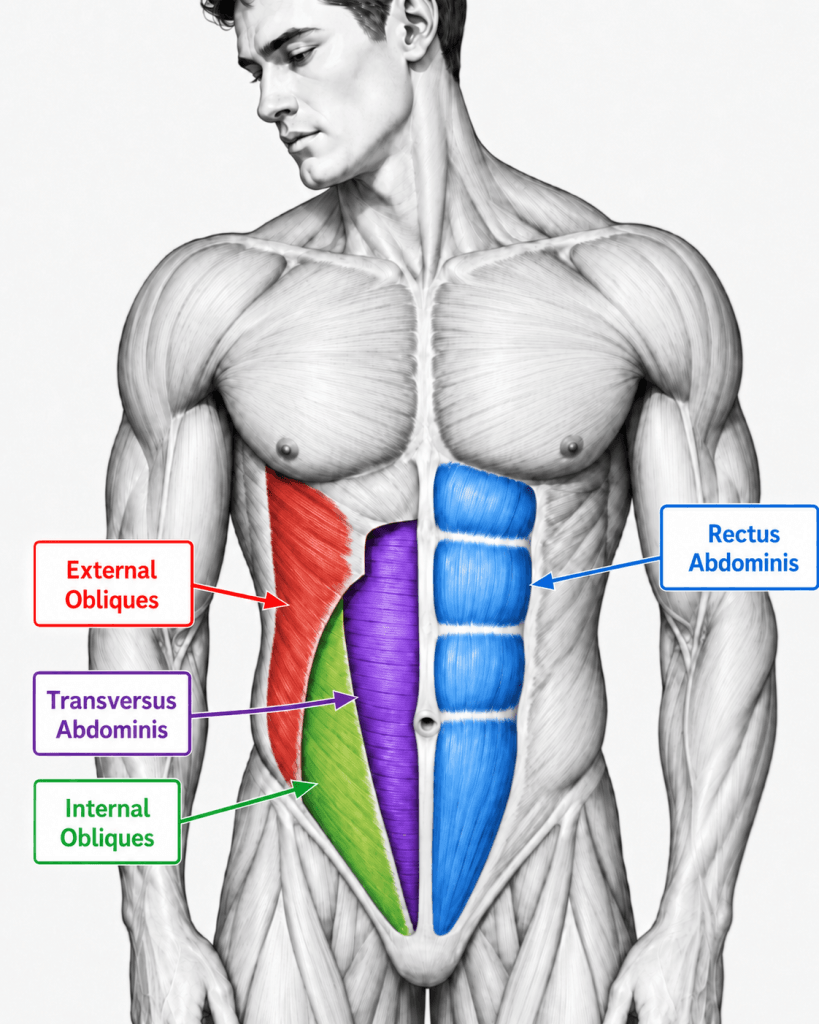
The hanging leg raise primarily works the rectus abdominis—the “six-pack” muscles. It also trains the obliques, transverse abdominis, and forearms to a lesser degree.
The abs’ main job is to flex your spine, which is why thinking about bringing your belt buckle to your bellybutton helps: it encourages you to round your lower back, which makes your abs do most of the work.
The hanging leg raise also trains your hip flexors—by definition, these are involved in lifting your legs in front of you—but they aren’t the primary muscle you’re trying to target and shouldn’t be a limiting factor in the exercise. If you primarily feel this exercise in your upper thigh and groin, that’s a sign you’re relying more on your hip flexors than your abs.
You might also be wondering whether the hanging leg raise emphasizes the lower abs.
The answer is: probably—to a small degree. Research shows that the portion of your abs closest to whatever you’re lifting has to work the hardest.3 Since you’re lifting your legs toward your chest, your lower abs are likely working a little harder than your mid or upper abs.
Don’t read too much into that, though. Every abs exercise trains the entire rectus abdominis—the hanging leg raise may just emphasize the lower portion of the abs a bit more than other ab exercises.
3 Hanging Leg Raise Workouts
Here are three sample workouts that incorporate the hanging leg raise the way I’d program them if you were my coaching client.
Upper Body Workout with Hanging Leg Raise
Barbell Bench Press: 3 sets of 4–6 reps
Chest-Supported Row: 3 sets of 6–8 reps
Dumbbell Side Lateral Raise: 3 sets of 8–12 reps
Barbell Curl: 2 sets of 8–12 reps
Hanging Leg Raise: 2 sets of 10–15 reps
Push Workout with Hanging Leg Raise
Barbell Bench Press: 3 sets of 4–6 reps
Incline Dumbbell Bench Press: 3 sets of 6–8 reps
Chest Press Machine: 3 sets of 6–8 reps
Dumbbell Side Lateral Raise: 3 sets of 8–12 reps
Hanging Leg Raise: 2 sets of 10–15 reps
Lower Body Workout with Hanging Leg Raise
Barbell Back Squat: 3 sets of 4–6 reps
Barbell Romanian Deadlift: 3 sets of 6–8 reps
Leg Extension: 3 sets of 8–12 reps
Seated Hamstring Curl: 3 sets of 8–12 reps
Hanging Leg Raise: 3 sets of 8–12 reps
As you can see, my preferred approach is to simply tack on 2–3 sets of the hanging leg raise to the end of your existing workouts. You don’t need to do dedicated ab workouts.
More Ab Exercises
- How to Do Cable Crunches: Form, Benefits & More
- The 3 Best Ab Workouts for Building a Defined Six Pack
- The 8 Best Lower Ab Workouts & Exercises (Bodyweight + Weighted)
Scientific References +
- ↩ Sarti MA, Monfort M, Fuster MA, et al. Muscle activity in upper and lower rectus abdominus during abdominal exercises. Arch Phys Med Rehabil. 1996;77(12):1293-1297.
- ↩ Workman JC, Docherty D, Parfrey KC, et al. Influence of pelvis position on the activation of abdominal and hip flexor muscles. J Strength Cond Res. 2008;22(5):1563-1569.
- ↩ Gomirato AP, Grenier SG. Diagnostic ultrasound shows preferential activation of rectus abdominis segments with exercises targeting upper versus lower segments. Int J Exerc Sci. 2023;16(1):1077-1086.