For decades, bodybuilders have lived by the rule that you must eat one gram of protein per pound of body weight per day, or you’re leaving gains on the table.
Over the past few years, though, many researchers and fitness influencers have backpedaled, claiming that the real threshold is 0.7 g/lb, and eating more than this is a waste of calories and money.
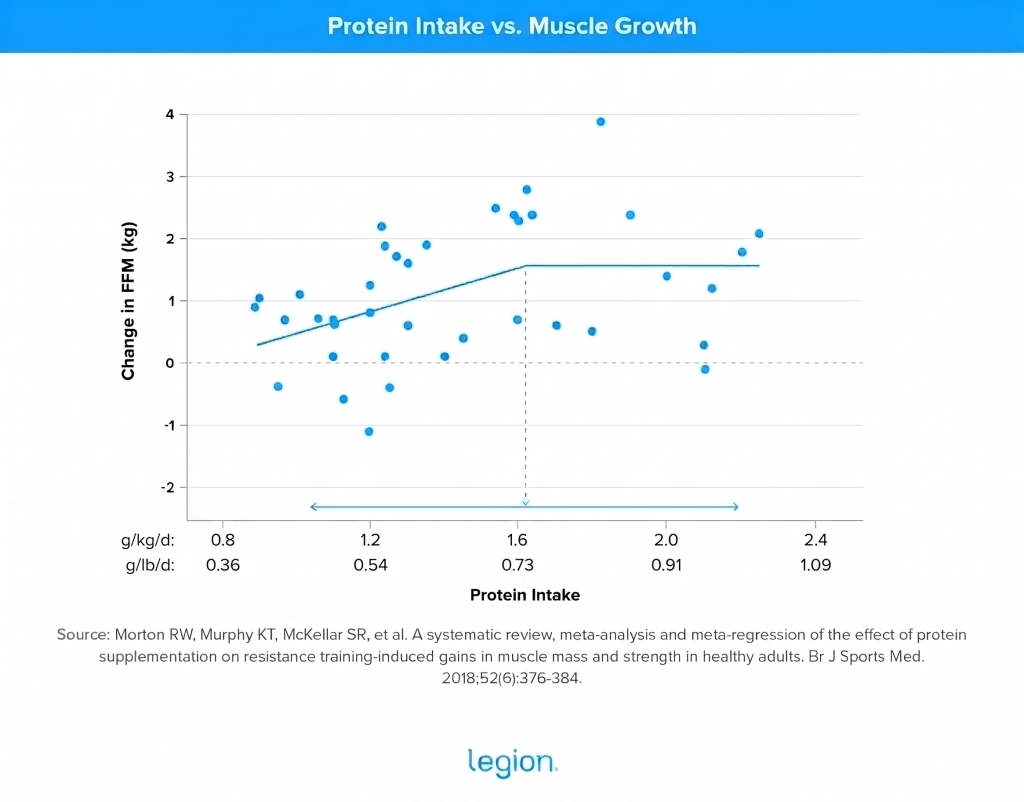
The main piece of evidence for this position was a 2018 meta-analysis from McMaster University.1 Scientists pooled the results of 49 studies with ~1,900 people and found that muscle growth plateaued at about 0.73 g/lb of protein per day.
Here’s what the results looked like:
And just like that, the “1g/lb” rule sank like the Bismark.
Or did it?
There are 3 reasons you should take these study results with a grain of salt:
1. Every single study on trained weightlifters found they gained more muscle with protein intakes over 0.7 g/lb.
When the researchers zoomed in on people who actually lifted weights, they found that they gained more muscle when they ate closer to 1 g/lb of protein per day.
The authors of the paper wrote that, when it comes to people who lift weights, “… it may be prudent to recommend ~2.2 g protein/kg/d…,” exactly what bodybuilders have recommended for decades (2.2 g/kg = 1g/lb).
2. The confidence interval was huge.
A confidence interval is the range where the true answer likely falls. The narrower it is, the more precise the estimate. Think of it like estimating a time of arrival: saying someone will arrive between 2:59 and 3:01 is precise; saying they’ll arrive between 2:30 and 3:30 is much less helpful.
In this case, the interval ran from 0.47 g/lb all the way up to 1.0 g/lb.
Put differently, the data actually showed that the “true” plateau might be about half the old bodybuilding recommendation . . . or exactly equal to it.
3. The result wasn’t statistically significant.
The p-value—a number researchers use to judge whether a result is determined by the study intervention or random chance—came in at 0.079. By most scientific standards, that number has to be below 0.05 to be considered valid.
In other words, the data was too inconsistent to be confident in the results.
Two more recent meta-analyses also bolster the case for higher protein intakes.
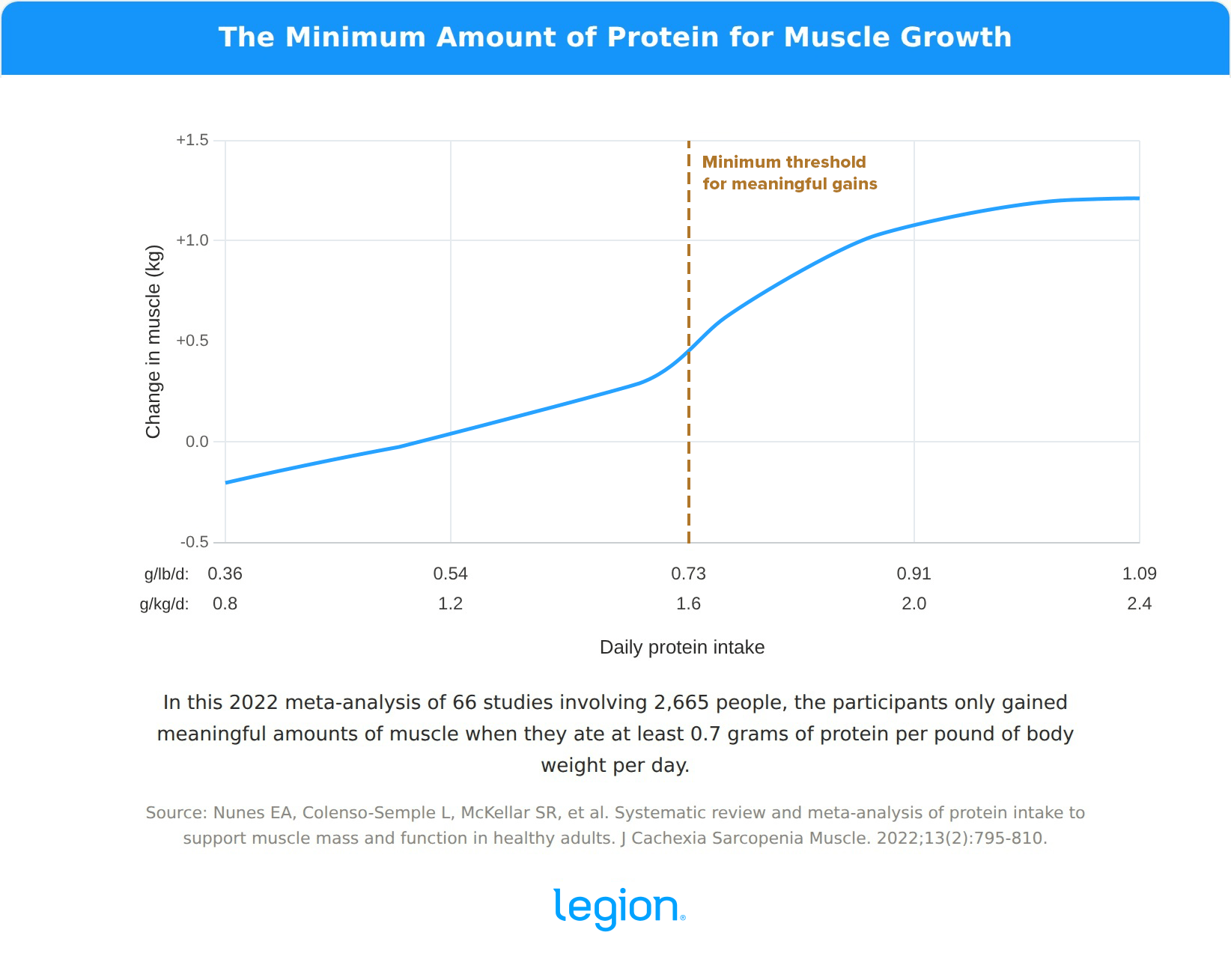
A 2022 meta-analysis from the same lab at McMaster University looked at 66 studies involving over 2,600 people and found that muscle mass and lower-body strength only meaningfully improved in people who ate at least ~0.7 g/lb of protein per day.2
In this study, 0.7 g/lb was the minimum required to see improvements in muscle mass, not the ceiling for supporting growth.
Here’s what the results looked like:
A 2020 meta-analysis published in Nutrition Reviews combined data from 105 studies involving over 5,400 people.3 It found that the muscle-building benefits of protein kept increasing all the way up to about 1.4 g/lb, which was the maximum amount consumed. The gains got smaller as intake rose, but they didn’t disappear.
Neither analysis was able to pinpoint the exact point where muscle growth leveled off, but they both indicate it’s higher than 0.7 g/lb.
One problem with meta analyses like these is that it’s hard to control for variables like calorie intake, differences in training, adherence, the trainee’s level of experience, and so on.
That’s why it’s also helpful to look at how the body processes protein at an individual level.
Specifically, scientists can use various techniques to estimate how much of the protein you eat is actually used to build and repair muscle, and how much is oxidized (“burned”) for energy. Generally speaking, if your body is oxidizing large amounts of protein, it means you’re consuming more than you need to support muscle growth.
The gold standard for determining this is called the Indicator Amino Acid Oxidation (IAAO) test, and it involves giving people varying amounts of protein and seeing how much of it is oxidized.
Three studies have used this method to estimate protein requirements in experienced weightlifters.4Malowany JM, West DWD, Williamson E, et al. Protein to maximize whole-body anabolism in resistance-trained females after exercise. Med Sci Sports Exerc. 2019;51(4):798-804.5 The average requirement across all three was about 0.85 g/lb. But to cover almost everyone—not just the average person—the estimate rises to about 1.07 g/lb.
In other words, while most people needed about 0.85 g/lb to maximally support muscle growth, some people needed significantly more than this, and there’s no way to know which group you belong to without undergoing this kind of testing. These studies also didn’t examine how factors like total muscle mass, calorie intake, training intensity and volume, age, and so on influenced the results.
For example, it’s possible that more muscular, active people, who train harder than most, might need more protein. It’s also well established that you need to consume more protein when restricting calories to avoid muscle loss, and that people over age ~60 generally need more protein to support muscle growth than younger people.67
A 2025 systematic review by Deakin University found that dieting weightlifters generally needed about 0.9 g/lb of protein to avoid losing muscle while in a calorie deficit.8 The leaner they were, the more important hitting that target was.
As experts like Lyle McDonald have pointed out for decades, many studies on protein intake only measured muscle protein synthesis, but ignored other tissues in your body that also need protein.
Your tendons, ligaments, and other connective tissues, your organs, your blood vessels, and even the mitochondria in your cells all need protein to repair and recover from exercise.9 It’s hard to measure exactly how much, but it’s almost certainly not zero.
On a practical note, the difference between 0.85 g/lb and 1 g/lb is also largely irrelevant. For a 180-pound man, it’s 25 grams of protein—about one scoop of protein powder. For a 120-pound woman, that’s the difference between ~100 and 120 grams of protein—a cup of yogurt or a small chicken breast.
So, given the ambiguity in the research and the strong theoretical arguments for erring on the side of more protein rather than less, eating close to 1 g/lb of protein per pound of body weight per day is still wise.
There are some circumstances where you may want to eat slightly more or less than this amount, but this is easy to figure out with a calculator like this one:
→ Protein Calculator for Weight Loss & Muscle Gain
For most active people, though, 1 gram per pound of protein per body weight per day is a smart starting place.
Scientific References +
- ↩ Morton RW, Murphy KT, McKellar SR, Schoenfeld BJ, Henselmans M, Helms E, Aragon AA, Devries MC, Banfield L, Krieger JW, Phillips SM. A systematic review, meta-analysis and meta-regression of the effect of protein supplementation on resistance training-induced gains in muscle mass and strength in healthy adults. Br J Sports Med. 2018;52(6):376-384. PMID: 28698222.
- ↩ Nunes EA, Colenso-Semple L, McKellar SR, et al. Systematic review and meta-analysis of protein intake to support muscle mass and function in healthy adults. J Cachexia Sarcopenia Muscle. 2022;13(2):795-810.
- ↩ Tagawa R, Watanabe D, Ito K, et al. Dose-response relationship between protein intake and muscle mass increase: a systematic review and meta-analysis of randomized controlled trials. Nutr Rev. 2021;79(1):66-75.
- ↩ Bandegan A, Courtney-Martin G, Rafii M, Pencharz PB, Lemon PW. Indicator amino acid oxidation protein requirement estimate in resistance-trained men 24 h postexercise exceeds both the EAR and RDA. J Nutr. 2017;147(6):1098-1105.
- ↩ Mazzulla M, Volterman KA, Packer JE, et al. Protein intake to maximize whole-body anabolism during postexercise recovery in resistance-trained men with high habitual intakes is ∼2.0 g kg-1 d-1. Am J Clin Nutr. 2020;111(2):328-335.
- ↩ Helms ER, Zinn C, Rowlands DS, Brown SR. A systematic review of dietary protein during caloric restriction in resistance trained lean athletes: a case for higher intakes. Int J Sport Nutr Exerc Metab. 2014;24(2):127-138.
- ↩ de Oliveira do Rêgo ML, Nunes EA, Phillips SM. Age-related anabolic resistance: nutritional and exercise-based strategies for maintaining muscle mass in master athletes. Nutrients. 2025;17(22):3503.
- ↩ Banaszek A, Oliver JM. Effect of dietary protein on fat-free mass in energy restricted, resistance-trained individuals: an updated systematic review with meta-regression. Strength Cond J. 2025;47(1):11-23.
- ↩ Brosnan ME, Rafii M, Wykes L, et al. Endocrine, metabolic, and skeletal muscle proteomic adaptations to short-term energy deficit in active males. Physiol Rep. 2025;13(21):e16281.