Most everyone knows that if you want to build muscle, perform better, and recover faster, you should take 3–5 grams of creatine monohydrate every day.
New research, though, shows that by taking 10, 20, or even 30+ grams per day, creatine may support cognition, mood, sleep, and overall brain health.
The theory goes like this:
Creatine helps your cells produce energy more efficiently. The brain uses more energy per unit of mass than almost any other organ in the body—it makes up just 2% of your body weight, yet accounts for about 20% of your resting energy expenditure.1
Thus, increasing brain creatine levels could help it run more efficiently.
Now, why can’t you get these benefits from the standard dose of 3–5 grams per day?
Muscles absorb creatine from the blood relatively easily, but your brain is much more “resistant” to creatine because it’s separated from the rest of your body by the blood-brain barrier.
This is a semipermeable membrane that prevents unwanted substances from your bloodstream from reaching your brain. Think of it like a group of bouncers keeping riffraff out of the VIP section of your body (your noodle).
Taking much higher doses of creatine keeps your blood levels elevated for longer, which allows more time for it to trickle through your blood-brain barrier.23
And several studies show this might work.
For example, in a study conducted by scientists at the University of Auckland, people who took 20 grams of creatine per day for 7 days were better able to stay focused and think clearly while breathing air containing very little oxygen—a condition that stresses brain function.4
In another study conducted by scientists at the University of Tokyo, people who took 8 grams of creatine per day for 5 days felt less mentally exhausted while doing repeated math problems.5
Studies on Alzheimer’s disease, chronic fatigue syndrome, traumatic brain injury, and age-related cognitive decline have also found that high-dose creatine improves cognitive function in a number of ways.6789
Creatine may also help protect against the negative effects of sleep deprivation.
In one widely cited study from the Institute of Neuroscience and Medicine, researchers kept healthy people awake for 21 hours, then gave them a single large dose of creatine: 0.35 grams per kilogram of body weight.10 That’s about 29 grams of creatine for a 180-pound person, or 6–10 times the amount needed to maximize performance.
This was enough to increase brain phosphocreatine, reduce fatigue, and help people perform better on tests of memory, logic, math, language, and vigilance. On some tasks, they even performed better while sleep-deprived after taking creatine than they did with sufficient sleep but no creatine.
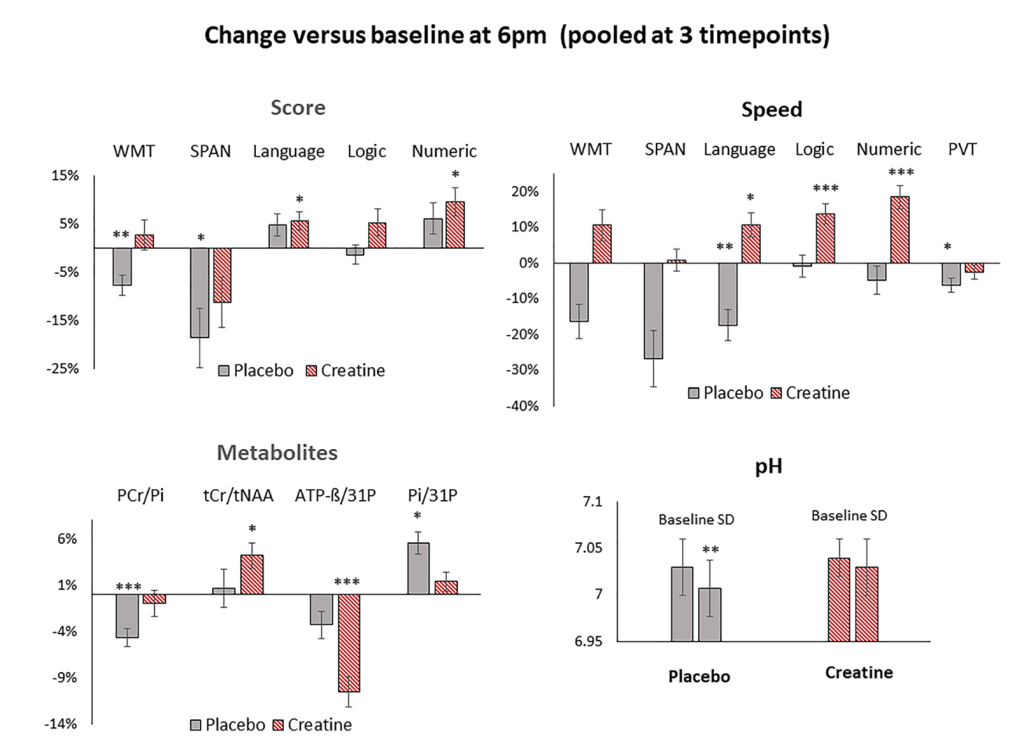
A follow-up study from the same lab tested a lower dose—0.2 grams per kilogram, or about 16 grams for a 180-pound person—and found a similar but smaller effect.11
All very exciting … but there are a few reasons you should hesitate before you start downing several tablespoons of creatine per day.
First, most of these studies were relatively short with only a handful of subjects.
The study on sleep deprivation only examined 15 people over a single day and several of the brain-creatine measurements were performed on just 6 of these folks.
Second, almost all of the studies showing cognitive benefits of high-dose creatine involved situations where the brain was either struggling with disease or under severe stress.
When you look at studies on healthy, well-rested people, the results look less rosy.
In a 2023 study from the University of Northern Iowa, healthy young adults took either 10 or 20 grams of creatine per day for 6 weeks.12 Neither dose improved processing speed, memory, or executive function. Creatine also didn’t meaningfully change blood-oxygen levels in a brain region involved in thinking and decision-making, suggesting it wasn’t doing much to change brain activity during the tests.
In a separate study from the University of São Paulo, children took a high dose of creatine—0.3 grams per kilogram of body weight (10–20 grams for most kids).13 After a week, they showed no increase in brain creatine or cognitive performance.
So where does that leave us?
Given how cheap and safe creatine is, there’s a case for upping your dose to 10–20 grams per day in the hopes of reaping some small cognitive benefits.
Skeptics would argue that even if high-dose creatine is cheap and safe, you’re still taking 2–10 times more than what most studies show is necessary, which is an inconvenience and a waste of money.
Here’s my take:
If your primary goal is to improve strength, muscle growth, and recovery, and are unconvinced by the research on cognitive function, take 3–5 grams of creatine monohydrate per day.
If you want to gain muscle and strength and ensure you reap any cognitive benefits that creatine might offer, there’s little downside to taking 10–20 grams per day.
What’s more, there’s a growing body of evidence showing that it’s best to calibrate your creatine intake to body weight, specifically taking around 0.1 g/kg/day.14 For a 180-pound man, that’s about 8 grams per day. Thus, even if your goal is to maximize athletic performance, there’s an argument for taking more than 3–5 grams per day.
While that might sound like a lot of creatine, research shows this dose is well tolerated by most everyone.15
If you find unflavored creatine powder unappealing, you can also take capsules, gummies, and flavored creatine powder instead.
Just make sure whatever you buy has been independently tested for purity and potency, or hitting your target dose may be harder than the label suggests. Also—all of the studies used creatine monohydrate, which is also the most affordable and well-researched form of creatine, so don’t bother taking anything else.
Scientific References +
- ↩ Padamsey Z, Rochefort NL. Paying the brain’s energy bill. Curr Opin Neurobiol. 2023;78:102668.
- ↩ McMorris T, et al. Creatine supplementation research fails to support the theoretical basis for an effect on cognition: evidence from a systematic review. Behav Brain Res. 2024;466:114982.
- ↩ Pratt J, Fuchs CJ, van Loon LJC, Kennerley AJ, Sale C. Creatine supplementation and brain health: methodological challenges, current evidence, and translational perspectives. J Nutr Physiol. 2026.
- ↩ Turner CE, et al. Creatine supplementation enhances corticomotor excitability and cognitive performance during oxygen deprivation. J Neurosci. 2015;35(4):1773-1780.
- ↩ Watanabe A, Kato N, Kato T. Effects of creatine on mental fatigue and cerebral hemoglobin oxygenation. Neurosci Res. 2002;42(4):279-285.
- ↩ Smith AN, et al. Creatine monohydrate pilot in Alzheimer’s: feasibility, brain creatine, and cognition. Alzheimer’s Dement (N Y). 2025;11(2):e70101.
- ↩ Godlewska BR, et al. Six-week supplementation with creatine in myalgic encephalomyelitis/chronic fatigue syndrome (ME/CFS): a magnetic resonance spectroscopy feasibility study at 3 Tesla. Nutrients. 2024;16(19):3308.
- ↩ Traumatic Brain Injury Center of Excellence, Clinical Translation Office. Information paper on creatine and traumatic brain injury. Defense Health Agency; July 2025.
- ↩ McMorris T, et al. Creatine supplementation and cognitive performance in elderly individuals. Aging Neuropsychol Cogn. 2007;14(5):517-528.
- ↩ Gordji-Nejad A, et al. Single dose creatine improves cognitive performance and induces changes in cerebral high energy phosphates during sleep deprivation. Sci Rep. 2024;14(1):4937.
- ↩ Gordji-Nejad A, et al. Single-dose creatine reduces sleep deprivation-induced deterioration in cognitive performance. Nutrients. 2026;18(8):1192.
- ↩ Moriarty T, et al. Dose–response of creatine supplementation on cognitive function in healthy young adults. Brain Sci. 2023;13(9):1276.
- ↩ Merege-Filho CAA, et al. Does brain creatine content rely on exogenous creatine in healthy youth? A proof-of-principle study. Appl Physiol Nutr Metab. 2017;42(2):128-134.
- ↩ Antonio J, et al. Common questions and misconceptions about creatine supplementation: what does the scientific evidence really show? J Int Soc Sports Nutr. 2021;18(1).
- ↩ Gonzalez DE, et al. Creatine supplementation dose and duration are not associated with increased side effects: a structured review and study-level dose–response analysis of randomized controlled trials. Sports. 2026;14(4):137.