If you’ve shopped for supplements in recent years, you’ve probably seen phrases like these on bottles, banners, and product pages all over the internet: “lab tested,” “third-party tested,” and “third-party certified.”
Why are these so commonplace?
The supplement industry has a long history of shenanigans—underdosing, mislabeling ingredients, using low-quality forms of ingredients, and so on.
Consumers have rightfully become incredulous about supplement claims, and so many brands responded by paying independent labs to test their products. This allows the brand to claim their products are “third-party tested” and even include the lab’s logo on their packaging.
Generally, these results are published in what’s referred to as a Certificate of Analysis (COA)—a document from the lab confirming the product is free of contaminants and contains what the label claims at the doses listed.
For many brands, this is one of their strongest selling points. “We aren’t like the other guys—all of our products are certified to be safe, pure, and effective.”
Sounds nice in theory, but here’s the rub:
“Third-party” labs are rarely independent, many companies only test a handful of products and pretend all of their products were tested, and some companies simply lie—they claim their products were third-party tested, but instead just buy “clean” test results or fabricate them.
In other words, “third-party testing” has become a fig leaf to hide the same lies it was meant to expose.
In this article, you’ll understand what these terms actually mean, how they’re misused, and how to verify a product is actually tested before you buy it.
Key Takeaways
- The FDA doesn’t pre-approve supplements before they’re sold, and neither “lab-tested” nor “third-party tested” has any legal definition.
- The three most common ways brands abuse these terms are to test one product or ingredient and then mislead people into thinking all of their products were tested, to influence labs not to share testing results, or to simply lie and claim their products were tested when they weren’t.
- To verify a product is actually third-party tested, look for a recognized certification logo on the label (NSF, USP, Informed Sport, Informed Choice, BSCG, Labdoor), search the relevant certification body’s free public database to confirm the certification is real, and check the brand’s website for a public Certificate of Analysis you can read yourself.
Why “Lab-Tested” Is (Usually) a Scam
To understand why “lab-tested” doesn’t mean what most people think it means, you first need to understand what happens before a supplement ever reaches a shelf.
The FDA Doesn’t Test or Approve Supplements
Most people assume that if a supplement is being sold legally, someone must have verified that what’s on the label is actually in the bottle.
But that’s not how it works.
Unlike drugs, which have to be tested, reviewed, and approved by the FDA before they’re sold, supplements can be manufactured, packaged, and put on shelves without proving anything to anyone.
Manufacturers are supposed to test their own products under a set of rules called current Good Manufacturing Practices (cGMP)—the basic federal standards that say things like “test your raw materials for identity” and “establish written specifications for each product before you make it.”
The problem is that almost no one is checking.
The FDA inspects roughly 5% of supplement facilities each year. And when it does, what it finds isn’t reassuring.
In both 2023 and 2024, the FDA’s most common finding during supplement inspections was that companies hadn’t even established the basic product specifications they’re supposed to be testing against—they had no frame of reference for how much or how little the products were supposed to contain.1
To put this into perspective, imagine you’re buying pre-workout, the label says it contains 300 mg of caffeine, but the product can “pass” testing with either 1 or 1,000 mg of caffeine per serving. You might as well not test at all.
The second most common finding in 2024 was that companies hadn’t set “identity specifications” for the individual ingredients they were using.
An identity specification is a written standard that defines what an ingredient is, and how you confirm it’s the right thing. For example, before a manufacturer uses turmeric in a product, they’re legally required to have a written specification that says: this is what real turmeric is, and here’s how we’ll verify each incoming batch matches it.
Without an identity specification, a manufacturer can’t verify that they’re using the right ingredient. They might be receiving the right thing from the supplier—or they might be receiving sawdust labeled as turmeric.
In this environment, “lab-tested” can mean anything from “we followed the rules nobody checks” to “we didn’t follow the rules.”
“Lab-Tested” Has No Legal Definition
No governing body or regulator—including the FDA and FTC—has defined the phrase “lab-tested.”
When a brand claims its product is “lab-tested,” the test could be a single check on a single ingredient, conducted by a lab the brand owns, years before the bottle in your hand was even packaged.
It’s because of this that ConsumerLab—an independent supplement watchdog—explicitly flags two phrases as meaningless on supplement labels:
- “FDA Approved laboratory,” because the FDA doesn’t approve labs (it only registers them).
- “Third-party tested” when the third party isn’t named.
If a label doesn’t say who tested the product, the claim has no enforcement behind it. The brand could be telling the truth, lying outright, or anywhere in between—and you have no way to know.
So when a brand says its product is “lab-tested,” the honest translation is usually: “We may or may not have followed the rules that are almost never enforced.”
Why “Third-Party Tested” Is a Scam
The term “third-party tested” implies an outside lab—not the brand itself—did the testing.
This conjures up images of a team of scrupulous scientists in white lab coats analyzing the product and honestly reporting on the results.
And that’s exactly what brands want you to think, but it’s almost never the case.
Companies Often Lie About Third-Party Testing
In a 2022 study published in JAMA Network Open, scientists at the Uniformed Services University analyzed 30 immune-boosting supplements sold on Amazon.2
Sixteen of the 30 products were labeled with wording like “third party tested,” “lab tested verified,” and “purity and potency.” Often with fancy little seals to boot.
Not one of the 30 products was actually third-party tested—nothing from BSCG, NSF, Informed Sport, or USP—even though many were using language designed to imply otherwise.
The companies simply lied.
When researchers tested the products in a lab, seventeen of the 30 had inaccurate labels. Thirteen claimed ingredients that didn’t show up in the product at all, and nine contained substances that weren’t listed on the label.
Companies Often Do Partial Third-Party Testing
In some cases, brands will get a legitimate third-party to test their products . . . but only partially.
Then, they’ll slap their “third-party tested” seal on all of their product labels, ads, and product pages, deliberately misleading people into thinking that every ingredient in every product was third-party tested.
For example, a brand could send a 10-ingredient pre-workout to a third-party lab, ask the lab to analyze the caffeine content, and then market the product or their entire product line as “third-party tested.”
And technically, the brand did receive third-party testing . . . for one ingredient . . . in one product . . . once.
This is like a professional athlete saying they’re natty because they passed a single drug test, for one drug, ten years ago.
Grüns gummies are one offender.
Grüns is third-party tested by Eurofins—a legitimate, well-respected lab—but only the vitamins and minerals in their gummies are tested. The greens, mushrooms, adaptogens, and prebiotics—most of the ingredients that actually differentiate Grüns from competitors—aren’t verified by anyone.
Yet the label still says “third-party tested.”
1st Phorm is another example. The company’s Help Center tells customers “Yes . . . not only are our products third-party tested, they are third-party tested by FDA-approved parties.”
The logical conclusion (and what they want you to believe) is that all of their products have been independently tested by a third party.
But in reality, they only got third-party testing on their most popular products.
Their protein powders, creatine monohydrate, and fish oil all received Informed Choice or NSF Certified for Sport certification, which are legitimate, stringent third-party certifications. Most of their other products, though—like their stim-free pre-workout, regular pre-workout, and EAA supplement—were not third-party tested.
Nothing on those product pages mentions independent lab testing or certification, and they don’t appear in any major testing databases.
Onnit plays the same trick.
The “Ingredients” section of the brand’s website claims that “third-party testing ensures purity and potency, so you can feel confident in what’s going into your body”—and the “Quality and Safety” section says that they “test every lot to meet product specification, label claims, and requirements for heavy metals and microbial contamination.”
How reassuring.
But none of Onnit’s biggest products appear in any of the large third-party testing databases. Only two of their products show up in the Informed Sport database—creatine and glutamine—neither of which is what Onnit is best known for. Their flagship product, Alpha Brain, doesn’t appear to be certified by anyone.
Companies Often Do a One-Time Third-Party Test
When most people read that a supplement is “third-party tested,” they assume that a sample from every batch of that supplement is sent to a third-party lab for testing.
They also assume that each of those samples gets its own Certificate of Analysis (COA)—a document from the lab confirming the product is free of contaminants and contains what the label claims at the doses listed.
That’s often not the case.
A brand can send one sample from one batch to a third-party lab, get a clean COA back, and then market every batch it produces from that point on as “third-party tested”—indefinitely.
That includes batches made years later, with different ingredient suppliers, different manufacturing facilities, and different formulations. None of these batches have to be retested.
Here’s an extreme example:
One version of a pre-workout could be third-party tested in 2015 at a factory in New Jersey, and the company could continue to claim that a new version of the product, with different ingredients, different ingredient suppliers, and a new manufacturer in Shenzhen, China, made last week, is still “third-party tested.”
And as explained above, they could do this with a single version of a single product and pretend that it applies to their whole product line.
Third-Party Labs Are Often Biased
In 2018, ConsumerLab tried to hire several “independent” labs to run unbiased, third-party tests on popular supplements, but the labs refused.
Now, why would a privately run, impartial lab turn away paying customers?
They already had contracts with the companies that made those supplements, and they believed that testing their clients’ products for an independent reviewer would be a “conflict of interest.”
In other words, the labs might be “independent third-parties” in a legal sense—they’re owned and run by different people.
But in a practical, financial, and ethical sense, the labs are essentially captured by the supplement companies, and are often more focused on laundering their claims than providing unbiased information to consumers.
Third-Party Labs Can Lie About Testing
In some cases, third-party labs will issue COAs to companies without ever actually testing the products, a particularly devious practice known as “dry labbing.”
The brand sends the lab a product sample and a sheet of expected results. The lab rubber stamps it and sends it back.
This is essentially information laundering and fraud.
A 2012 Dateline NBC investigation exposed this by creating a fake supplement company and sending intentionally contaminated samples—including one spiked with toxic levels of selenium—to several labs. One lab returned a clean COA matching the fake specifications the investigators had provided.
While supplement companies (and labs) would like you to believe these labs were just a few bad apples, the reality is nothing has changed that would compel labs to behave any differently nowadays. If anything, there’s more money and competition, which creates an even stronger incentive for labs to help companies lie.
Companies Sometimes Forge Third-Party Testing Results
Why go to the trouble and expense of getting third-party testing when you can spend 60 seconds editing a PDF instead?
If you’re a greedy, amoral criminal, that’s an easy decision.
In 2016, Alkemist Labs—a well-respected analytical lab in California—discovered that copies of their COAs were circulating in the supplement supply chain. The copies looked almost identical to the real thing, but the batch numbers and test results had been changed.
Suppliers were simply editing PDFs and using these fake COAs to make their ingredients look like they’d passed Alkemist’s testing—when they hadn’t been tested by Alkemist at all.
Manufacturers then bought those ingredients in good faith, used them in brands’ products, and the brands told customers that the products had been third-party tested.
This isn’t a one-off.
In 2020, when the COVID pandemic sent supplement brands scrambling for immune-boosting ingredients, Alkemist and other testing labs caught a fresh wave of falsified COAs being used to sell raw elderberry extracts. Some forgeries had altered the lot numbers, others had swapped out the client name, and others had changed the actual test results.
These forgeries have become so common that in 2024, Alkemist rolled out a system that lets buyers verify whether a COA bearing the lab’s name is the genuine article.
The bottom line is that in some cases, supplement brands are misled by their own manufacturers. They’re being told that the ingredients are third-party tested and claim that in their marketing, when in reality, their manufacturer was blowing smoke.
Companies Can Refuse to Share Third-Party Testing Results
Some brands will label products “Third-Party Tested” on packaging and Amazon listings, then refuse to provide the underlying Certificates of Analysis when customers ask for them—citing “proprietary” or “confidentiality” concerns.
Their only proof is “trust me bro.”
Nutricost is a well-documented example.
The company markets its products as third-party tested, claiming products are “tested by an independent, accredited lab to help verify that what’s on the label is what’s in the bottle.”
But when contacted, Nutricost refuses to divulge which lab does the testing or share copies of the test results.
Several Reddit threads show correspondence from the company refusing to share this information going back several years.
If a company does this, you can safely assume they’re not actually getting their products third-party tested, or they’re committing one of the other sleights of hand on this list and want to avoid additional scrutiny.
The reality is that there is absolutely no reason for a company to refuse to share third-party testing results—that’s the whole point of the test, to verify that the product actually contains what it says on the label and nothing else.
Companies Imply Third-Party Testing (Without Getting Third-Party Testing)
In many cases, supplement companies don’t overtly lie about third-party testing.
Instead, they phrase their marketing claims to strongly imply their products were third-party tested, without actually getting the tests done.
For example, Bloom describes its products as “rigorously tested to meet the highest standards for safety and quality” and “verified to meet specifications for identity, purity, strength and composition.”
Well, the “highest standards” would generally be some kind of independent third-party test, but that’s not what they’re referring to. They don’t list or share any of the labs they’ve worked with (if any) or COAs.
At the time of writing, only one of Bloom’s products appears in any of the large third-party testing databases—its sparkling energy drink, in the NSF database.
Maybe they’ve actually done third-party testing on all of their products, as they strongly imply, but one wonders why they haven’t shared any details . . .
Sometimes, brands will try to bolster these misleading claims by pointing to documents that sound authoritative and scientific, but that don’t actually support their point.
For example, supplement brands will make a hoopla over their “Certificates of Independent Laboratory Analysis” or “Good Manufacturing Practices (GMP) Certification.”
Neither of these documents has anything to do with third-party testing.
Certificates of Independent Laboratory Analysis only cover the raw materials the brand received from a supplier, not the finished product the customer eventually buys and puts into their body.
In 2022, the FDA issued a warning letter to a supplement manufacturer called Quality Supplement Manufacturing, Inc. that did exactly this—they did third-party testing on one ingredient in their finished products and tried to pass off raw material certificates from their suppliers as if they were COAs.3
GMP certification means the facility follows proper manufacturing processes—clean equipment, documented procedures, trained staff, hair nets and rubber gloves for line workers, etc. It says nothing about whether the finished product was independently tested for label accuracy, potency, or contaminants.
What’s more, every supplement manufacturer is legally required to be GMP certified. It’s the bare minimum—and important to have—but not proof of purity or potency.
Is “Third-Party Testing” Completely Useless?
No, not entirely.
Despite the myriad ways this term can be manipulated and abused, it can be helpful in determining which supplement brands to buy from if you can verify the claims.
In other words, if a brand claims their products are “third-party tested,” you should assume they’re full of it until proven otherwise.
But if they can prove they aren’t lying, that’s a major green flag.
For example, a brand that says “third-party tested,” tells you which lab did the testing, publishes the COA for every product, and lets you check the results yourself is probably telling the truth.
This is exactly what we do at Legion. We describe our products as “lab-tested for purity and potency and certified by Labdoor™,” link directly to the Labdoor report and the COA for every product page, and let you read the reports and compare them to our product labels.
And frankly, it’s a lot of work to do this, which is why we’re one of the only brands that goes to the trouble.
How to Verify A Supplement Is Actually Third-Party Tested in 60 Seconds
Start with the label.
Don’t look for words like “lab-tested” or “third-party tested”—those, as you now know, can mean almost anything.
Look for an actual logo from a recognized certification body. The most credible ones are NSF Certified for Sport, USP Verified, Informed Sport, Informed Choice, BSCG, and Labdoor.
Here’s what the labels look like:
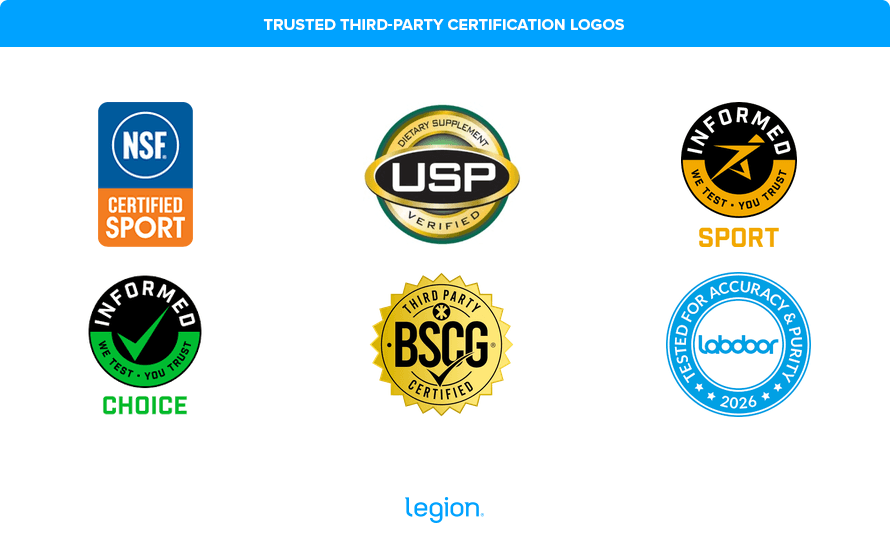
If you don’t see a logo from one of these organizations, that’s a red flag.
If you do see a logo, the next step is to make sure it’s real. Each of these organizations publishes a free, searchable database of every product they’ve certified.
Look the product up directly using one of these links:
If the exact product you’re looking at doesn’t appear in the relevant database, the certification claim is either expired, applied to the wrong product, or fake.
The final step is to find a public Certificate of Analysis.
A real COA shows everything: the testing lab’s name, the product name, the lot or batch number, the date of testing, the specific things tested for, the numeric results (not just a “PASS” or “FAIL”), the pass/fail criteria, and an authorized signature.
Brands that third-party test their products usually publish the COA on the product page or under a “testing” or “certificates” section of the website. If the brand makes these difficult to find or refuses to share them, you should assume they don’t exist.
Some more red flags to watch out for:
- “FDA-approved laboratory”: The FDA doesn’t approve labs. It only registers them. Any brand using this phrase is either misinformed or trying to pull a fast one.
- “Pharmaceutical grade”: This is not an official designation for most supplements. It’s a marketing term with no enforceable meaning. Not technically lying, but misleading (you can claim tap water is “pharmaceutical grade.”)
- “Meets USP standards” without the USP Verified mark. What companies are really saying is “we think our product meets USP standards and you should trust us even though we can’t prove it.” Make of that what you will.
- An unnamed testing lab: If the brand doesn’t tell you who did the testing, you have no way to verify it happened.
- No lot or batch numbers on the COA: A real COA is tied to a specific production run, not the product line in general.
That’s the whole framework. A logo you can verify, a database that confirms it, and a COA you can actually read. If a brand passes all three, you can trust the claim. If it doesn’t, you can’t.
Does Legion Pass the Test?
The framework you just learned applies to every supplement brand—including Legion.
Let’s see how we stack up.
First, every Legion product is independently certified by Labdoor™, one of the credible third-party organizations listed earlier. Labdoor uses FDA-registered, ISO 17025-accredited laboratories—the same standards used by federal regulators.
You can search any Legion product directly on labdoor.com and find the test results yourself.
And importantly, Labdoor doesn’t accept samples submitted by the brand. They purchase products anonymously from retail channels—the same way you would—which eliminates the possibility of a brand stage-managing the certification process by only providing high-quality samples for testing.
Every Legion product page also links directly to the latest Certificate of Analysis and Labdoor report for that product. You don’t have to email anyone or wait for a response—the numbers are there for you to read.
A few more details worth knowing.
Legion’s products are manufactured in NSF-certified, FDA-inspected, cGMP-compliant facilities in the USA. As you learned earlier, this is a baseline expectation rather than a premium feature, but worth noting.
And we don’t use proprietary blends or hide ingredient amounts. Every label is 100% transparent, so you can compare every ingredient on every product to what the COA says.
We publish this information because customers shouldn’t have to trust testing claims on faith. You should be able to verify it yourself, and after reading this article, you know how.
Want More Content Like This?
Check out these articles:
- The Protein Content Scam Hiding in Plain Sight on Supplement Labels (And It’s Not Just Amino Spiking)
- The Creatine Gummy Scandal: What You Need to Know
- Is Grass-Fed Whey Protein Powder a Scam?
Scientific References +
- ↩ U.S. Food and Drug Administration. Inspection observations.
- ↩ Crawford C, Avula B, Lindsey AT, et al. Analysis of select dietary supplement products marketed to support or boost the immune system. JAMA Netw Open. 2022;5(8):e2226040.
- ↩ U.S. Food and Drug Administration. Warning letter: Quality Supplement Manufacturing, Inc.. December 13, 2022.