Lyle McDonald’s Generic Bulking Routine is a 4-day upper-lower workout program designed to help intermediate lifters gain muscle and strength while eating in a calorie surplus.
In other words, it’s best for people who have trained consistently for at least 12 months, moved past their “newbie gains,” and need more volume (sets) and structure to keep progressing.
It’s called a “bulking routine” because it’s a demanding program that most people recover from best when they’re eating plenty of calories and enough protein.
You can adapt it for cutting, but running the full 4-day version unchanged in a calorie deficit is hard to recover from (and unnecessary for retaining muscle mass).
That’s also why it’s usually overkill for people new to strength training. Beginners usually don’t need this much volume or exercise variety to gain muscle while bulking or maintain muscle while cutting.
In this guide, you’ll learn how Lyle McDonald’s Generic Bulking Routine works, including the weekly schedule, workout templates, exercise choices, rest times, progression scheme, deloads, and how to set it up correctly.
Key Takeaways
- The Generic Bulking Routine works best for intermediate lifters who are eating enough to recover. You can use it while cutting, but you usually have to reduce volume or frequency while keeping the weights heavy.
- The program emphasizes progressive overload. You ease in with two submaximal weeks, spend several weeks pushing to add reps or weight, then deload before starting the next cycle.
- Most muscles are trained with 10–14 weekly sets, which research shows is optimal for gaining muscle.
Table of Contents
+
A Complete Guide to Lyle McDonald’s Generic Bulking Routine
Here’s everything you need to get started with the Lyle McDonald Generic Bulking Routine.
Schedule
Lyle’s Generic Bulking Workout Routine alternates between upper-body and lower-body workouts 4 days a week.
You can plan your workout days however it suits you; just remember two rules:
- Alternate lower body and upper body workouts. Don’t do both lower or upper body sessions back-to-back, and don’t mix them up randomly.
- Don’t train more than two days in a row. Taking a break after every two workouts helps your body recover, which is vital for making steady progress.
Here’s a sensible way to schedule your workouts that’ll work well for most:
- Mon: Lower Body A
- Tues: Upper Body A
- Wed: Rest
- Thurs: Lower Body B
- Fri: Upper Body B
- Sat: Rest
- Sun: Rest
Lyle recommends doing lower body workouts before upper body workouts in the rotation, but you can do your upper body workouts first if you prefer.
So in this case, your schedule would be Upper Body A, Lower Body A, Upper Body B, Lower Body B. Just know that if your upper body is sore or fatigued, it will affect your performance on squats and deadlifts, too, which is why Lyle recommends against it.
Exercises
You do 3–4 compound and 2–3 isolation exercises in each training session.
Much like Eric Helms’s Novice Bodybuilding Program, the Generic Bulking Program offers guidelines on the types of exercises to perform rather than prescribing specific ones.
This flexibility is a benefit because it allows you to customize the plan to fit your circumstances and preferences.
Here’s the template the program provides:
Lyle McDonald’s Generic Bulking Routine Template
| Workout | Exercise |
|---|---|
| Lower Body Workout |
|
|
|
|
|
|
|
|
|
|
|
| Upper Body Workout |
|
|
|
|
|
|
|
|
|
|

You’ll notice that there are only templates for two workouts, yet the program involves training four times per week. The reason is that you can choose to repeat the same two workouts, or you can tweak the routine to create 4 similar but slightly different workouts.
Bulking Workout Routine
As we’ve already seen, you can organize the bulking workout routine however you like within the framework provided.
If you aren’t sure where to start, though, here’s one way you could organize your workouts based on the template:
Lyle McDonald’s Generic Bulking Workout Routine
| Workout | Exercise |
|---|---|
| Lower Body A |
|
|
|
|
|
|
|
|
|
|
|
| Upper Body A |
|
|
|
|
|
|
|
|
|
|
|
| Lower Body B |
|
|
|
|
|
|
|
|
|
|
|
| Upper Body B |
|
|
|
|
|
|
|
|
|
|
Unlike most programs, which only give rep ranges to work in, the Generic Bulking Routine also gives you set ranges. For example, instead of prescribing 4 sets of 6–8 reps of squats, it says do 3–4 sets of 6–8 reps.
McDonald includes set ranges so you can adjust each workout based on how you’re performing that day rather than forcing yourself to do extra work when you’re too fatigued. As he explains in a forum post:
3-4 sets means 3 to 4 sets. So after your third set, you need to make a judgement call if I were there coaching you, I”d make it for you. Judging by how fatigued you looked on the third set, what your reps looked like, how fried you looked. If you still looked strong, I’d have you do a 4th set. If you looked fried, you’d stop at 3.
Rest
Rest 2–4 minutes between compound exercises and 1–3 minutes between isolation exercises.
Progression
McDonald recommends doing the bulking workout plan in 8-week cycles. The first two weeks are “submaximal” weeks designed to help you ease into the heavy training.
In the first week:
- Use 85% of your 8-rep max for sets in the 6–8 rep range.
- Use 85% of your 12-rep max for sets in the 10–12 rep range.
- Use 85% of your 15-rep max for sets in the 12–15 rep range.
For example, if your 8-rep max on the squat is 100 pounds, use 85 pounds for all sets of squats in week 1 of the program.
For the second week, follow the same protocol but use 95% of your 8-, 12-, or 15-rep max instead of 85%.
For the following six weeks, add as much weight as you can while staying within the target rep range and taking each set 1–2 reps short of failure.
For example, if you’re aiming for sets of 6–8 reps of the squat, choose a weight that allows you to perform at least 6 reps but no more than 8.
Use this weight until you get 8 reps for a set, and then add 5–10 pounds to your next set (aim for 10, but if you can’t stay within the target rep range with this weight, go with 5).
This method of adding reps and weight over time is known as double progression, and it’s a highly effective way to gain size and strength.
At the end of this 5-week period of striving to lift progressively heavy weights, take a deload week, and start the process again. Before beginning your next cycle, use the Legion One-Rep Max Calculator to recalculate the weights you’ll use in the first two weeks of your next cycle.
For best results, base your recalculations on the weights you used during your final week of heavy training in the previous cycle.
Does the Generic Bulking Routine Have Enough Volume?
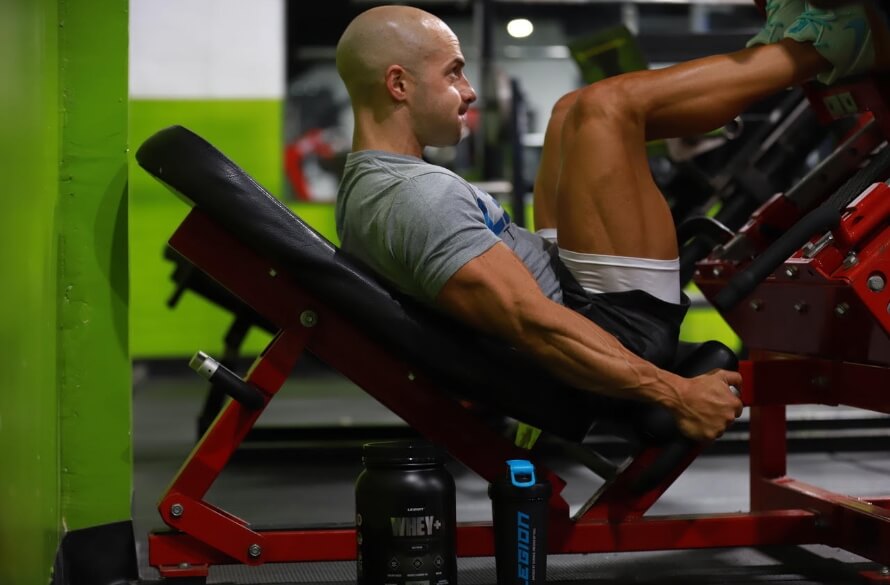
The Generic Bulking Routine gives most intermediate lifters enough volume to build muscle, provided they train hard, use proper form, rest long enough between sets, and prioritize recovery.
That’s not the impression many get when they first see the program, however. And it’s easy to see why.
Most versions of the routine include 10–14 weekly sets for most major muscle groups. Compared with a lot of online chatter in recent years—where it’s common to see people promoting studies that use 30, 40, or even 50+ sets per muscle group per week—that can look low.
If you look at the research overall, however, this is a solid target. Muscle growth generally improves as volume rises from low to moderate (above 10 weekly sets), but once you move beyond roughly 10–20 hard sets per muscle group per week, the case for adding more volume gets much less clear.1234
While it’s true some studies report slightly better growth with very high volumes, these higher volumes often don’t beat moderate volumes consistently enough, by enough, or efficiently enough to be the default for most lifters.
The practical trade-off matters, too. Very high-volume training takes longer, creates more fatigue, and becomes harder to apply across an entire program.
For example, one recent study had experienced gymgoers build up to 52 weekly sets for their quads.5 The higher-volume groups may have had a small edge for hypertrophy, but the researchers noted that the certainty of this finding was “limited” and “warranted caution.”
The higher-volume sessions also took about twice as long.
Even if that approach produced a meaningful benefit for quad growth, applying the same logic across your chest, back, shoulders, biceps, triceps, quads, hamstrings, glutes, and calves would make your workouts absurdly long and be nearly impossible to recover from without steroids.
What’s more, training with very high volumes doesn’t necessarily increase your genetic ceiling for muscle growth—it just (might) help you reach that ceiling a little faster than moderate volumes, but with a much higher risk of injury, larger time commitment, and risk of burnout.
So, yes, the Generic Bulking Routine has enough volume to grow. It sits in the range where most intermediate lifters can do enough hard work to gain muscle while still recovering well enough to add reps or weight over time.
What About Arm Volume?
One of the most common concerns about the Generic Bulking Routine is that it’s light on biceps and triceps work because it only includes 1–2 sets of biceps and triceps isolation exercises per upper-body workout.
But that undercounts the work your arms are already doing.
Pressing exercises also train your triceps, while pulling exercises—especially chin-ups and pulldowns—also train your biceps. Once you include this indirect work, arm volume usually lands much closer to the same weekly range as the larger muscle groups.
If your arms are a weak point, use the higher end of the range for biceps and triceps exercises or add a small amount of extra direct work—maybe an extra set or two for each. Just don’t assume the program is “low arm volume” because it only lists a few sets of curls and extensions.
What Should You Do If You Can’t Recover from the Generic Bulking Routine?
If you can’t recover from the full 4-day Generic Bulking Routine, there are a couple of ways to reduce the workload.
The simplest option is to lower the volume. If you currently do 4 sets of exercises in the 6–8 rep range and 3 sets of exercises in the 10–12 rep range, cut this to 3 sets and 2 sets, respectively.
If that’s still too much, cut them one set further: 2 sets for exercises in the 6–8 rep range and 1 set for exercises in the 10–12 rep range.
This preserves the structure of the program while greatly reducing how much fatigue you create in each session.
Another option is to reduce training frequency. Instead of training 4 days per week, switch to a 3-day alternating upper-lower schedule:
Week 1:
- Monday: Upper Body
- Tuesday: Rest
- Wednesday: Lower Body
- Thursday: Rest
- Friday: Upper Body
- Saturday: Rest
- Sunday: Rest
Week 2:
- Monday: Lower Body
- Tuesday: Rest
- Wednesday: Upper Body
- Thursday: Rest
- Friday: Lower Body
- Saturday: Rest
- Sunday: Rest
This means you do each workout three times every two weeks rather than twice per week. You’ll train each muscle group slightly less often, but you’ll also never train two days in a row, which can greatly improve recovery.
If you take this approach, don’t increase volume to “make up” for training three days per week—that defeats the purpose. Instead, stick to 3–4 sets for exercises in the 6–8 rep range and 2–3 sets for exercises in the 10–12 rep range, as outlined in the routine.
Supplements to Maximize Results on the Generic Bulking Routine
You don’t need supplements to gain muscle and strength on Lyle McDonald’s Bulking Routine, but the right ones can help you progress faster. Here are three worth considering:
- Protein powder: Eating enough protein is essential for building and repairing muscle. Protein powders like Whey+, Casein+ and Egg+ make hitting your target easier.
- Creatine: Creatine boosts muscle and strength gain, improves anaerobic endurance, and reduces muscle damage and soreness.34 For a natural source of creatine, try Legion’s creatine monohydrate powder, creatine gummies, creatine capsules, or post-workout Recharge.
- Pre-workout: A quality pre-workout helps you train harder by boosting energy, focus, and athletic performance. Legion’s Pulse is available with or without caffeine.
Want even more specific supplement advice? Take the Legion Supplement Finder Quiz to learn exactly what supplements are right for you.
FAQ #1: Can you cut on Lyle McDonald’s Generic Bulking Routine?
You can use the general outline of the routine, but you’ll probably need to reduce the volume, frequency, or both.
The Generic Bulking Routine is designed for lifters eating enough to recover, so running it unchanged while cutting can quickly become too demanding. If you use it in a calorie deficit, the goal should shift from gaining muscle and strength to maintaining as much muscle and strength as possible while losing fat.
McDonald’s advice is to keep the weight on the bar heavy, but reduce the amount of work you do:
Rather than 4 sets of 6-8 + 2-3 sets of 10-12 when you had plenty of food to recover from, you drop back to 2 sets of 6-8 and 1 set of 10-12 but try to keep the weight on the bar.
What you really don’t ever want to do is lower the weight on the bar. That’s a fantastic way to lose muscle.
FAQ #2: Can you do deadlifts on the Generic Bulking Routine?
Yes, but deadlifts should usually replace squats or become the main lower-body exercise on one lower-body day.
The main issue is lower-back fatigue. If you deadlift heavy and then try to squat hard afterward, your squat performance and form may suffer. McDonald’s preferred setup is to pair deadlifts with leg presses and leg curls rather than trying to force heavy squats into the same workout. Here’s how that might work:
- Deadlift: 3–4 sets | 6–8 reps
- Leg Press: 3–4 sets | 6–8 reps
- Leg Curl: 2–3 sets | 10–12 reps
- Split Squat: 2–3 sets | 10–12 reps
- Standing Calf Raise: 3–4 sets | 6–8 reps
- Seated calf Raise: 2–3 sets | 10–12 reps
FAQ #3: When should you change exercises on the Generic Bulking Routine?
The program works best when you repeat the same exercises for at least a cycle. That way, you can track your performance more clearly and push hard to progress.
If you want to change exercises, do it between cycles during the 2-week submaximal run-up. That way, you can practice the new movements, dial in your form, and find the right starting weights before the heavy progression weeks begin.
Want More Content Like This?
Check out these articles:
- An Expert Guide to the Push Pull Legs Upper Lower (PPLUL) Split
- The Best Upper Lower Split Workouts for Mass & Strength
- The Complete Guide to the Doggcrapp Training Program
Scientific References +
- ↩ Wernbom, Mathias, et al. “The Influence of Frequency, Intensity, Volume and Mode of Strength Training on Whole Muscle Cross-Sectional Area in Humans.”
- ↩ Heaselgrave, Samuel R., et al. “Dose-Response Relationship of Weekly Resistance-Training Volume and Frequency on Muscular Adaptations in Trained Men.”
- ↩ Schoenfeld, Brad J, et al. “Dose-Response Relationship between Weekly Resistance Training Volume and Increases in Muscle Mass: A Systematic Review and Meta-Analysis.”
- ↩ Schoenfeld, Brad J, et al. “Dose-Response Relationship between Weekly Resistance Training Volume and Increases in Muscle Mass: A Systematic Review and Meta-Analysis.”
- ↩ Enes, Alysson, et al. “Effects of Different Weekly Set Progressions on Muscular Adaptations in Trained Males: Is There a Dose-Response Effect?”