- Instructions (Hack Squat Calf Raise)
- Instructions (Leg Press Calf Raise)
- Expert Tips
- Workout Programming
- Mike's Take
- Standing Calf Raise Alternatives
- 3 Standing Calf Raise Workouts
- Muscles Worked by the Standing Calf Raise
- More Calf Exercises
Table of Contents
+Instructions (Hack Squat Calf Raise)
- Face the back pad and place the balls of your feet about hip-width apart on the raised calf ledge at the lower end of the platform.
- Fit your shoulders under the shoulder pads, rest your chest against the back pad, and take hold of the handles. Stand up to lift the sled off its stops. If your machine has a release lever, use it as directed. Look up slightly so your face isn’t pressed into the back pad.
- Keep a slight bend in your knees and hold that angle as you lower your heels. When you feel a deep stretch in your calves and it feels like your toes are about to slip, pause for 2 seconds.
- Push through the balls of your feet to raise your heels as high as you can. Hold this position for about one second, then lower your heels to begin your next rep.
Instructions (Leg Press Calf Raise)
- Set the back pad so that it’s at about a 30-degree angle to the floor, or as flat as it will go without allowing your butt to slip backward. Sit in the leg press machine seat and wedge your butt down into the base of the seat.
- Place your feet hip-width apart and toward the bottom of the footplate so that the balls of your feet are touching the footplate, but the rest of your foot hangs off the bottom.
- Using your legs, press the footplate away from your body and use the safety handles to release the weight.
- While keeping a slight bend in your knees, lower the footplate toward your chest by allowing the weight to push your toes toward your shins.
- When you feel a deep stretch in your calf muscles and you feel your toes are about to slip, pause for 2 seconds.
- Push through the balls of your feet to push the foot plate as far away from you as you can. Hold this position for about one second, then lower your heels to begin your next rep.
Expert Tips
- You can do straight-leg calf raises on a hack squat machine, leg press, Smith machine, or a dedicated standing calf raise machine. I prefer the calf raise machine, but most gyms don’t have one, so my second choice is typically the hack squat machine or leg press machine. I like to do these immediately after doing either hack squats or leg presses because the machine is already loaded and it saves time.
- Make sure you pause for a full 2 seconds at the bottom of each rep. This puts maximum tension on your calf muscles and ensures you can’t cheat by bouncing the weight.
- Squeeze your calves hard at the top of every rep for 1–2 seconds. This ensures you’re getting maximum range of motion out of every rep, and that you aren’t using momentum to cheat.
- Think about driving through your big toe—this helps keep your feet positioned properly on the footplate.
- Lower your heels as far as you can without your toes slipping. You shouldn’t have to keep resetting your feet midset, but you also don’t want to cut the range of motion short, either.
Workout Programming
Program standing calf raises near the end of a leg, lower-body, or full-body workout, after your more difficult exercises. Or, if you want to focus on growing your calves, you can also try putting them at the beginning of your workout, but I would only do this if you haven’t gotten results despite using good technique and training hard.
A good default is 3 sets of 8–10 reps. Take each set 0–1 reps shy of failure—a little closer than the other exercises in the sample workouts below—and rest 2–3 minutes between sets.
Mike’s Take
The standing calf raise is an outstanding exercise for building your calves, especially your gastrocnemius, the muscle that gives your calves much of their shape.
If you can only do one calf exercise, I generally recommend a straight-leg version like this one.
The main reason is that it trains both of your calf muscles, whereas the seated calf raise mostly trains one.
Researchers at Ritsumeikan University had 14 untrained adults do standing calf raises with one leg and seated calf raises with the other for 12 weeks. The inner and outer heads of the gastrocnemius gained about 9% and 12% in volume with standing raises, versus less than 2% each with seated raises.1
The soleus, the muscle underneath, grew about the same amount with both exercises.
The takeaway? Standing calf raises train both portions of your calves, whereas seated calf raises tend to emphasize the soleus and don’t meaningfully train the gastrocnemius.
The standing calf raise has a few other advantages, too:
- The machine holds you steady, so you don’t have to balance the weight and your calves are the only thing limiting how many reps you can do.
- You can safely take your sets close or all of the way to failure and add weight gradually over time.
- You don’t need a dedicated calf raise machine. A hack squat or leg press machine works well, and almost every gym has one or the other.
In terms of downsides of this exercise, it depends on which variant you do.
It can be hard to avoid bending your knees when doing the leg press calf raise, and not all hack squat machines have the elevated block for doing calf raises. Smith machine calf raises can also be uncomfortable and annoying to set up.
All of this is why I prefer a dedicated straight-leg calf raise machine, but unfortunately most gyms don’t have one.
By far, the biggest problem with any straight-leg calf raise isn’t the exercise itself, but how you do it. Namely, most people use too much weight, a short range of motion, and bounce the weight.
And, they typically do calves as an afterthought at the end of their workouts, and then wonder why they never get any bigger or stronger.
If you want your calves to grow, follow these three steps:
- Avoid any kind of bouncing during your reps.
- Use a full range of motion.
- Take your sets close or all of the way to failure.
The Achilles tendon can actually function like a spring during calf raises, storing and releasing elastic energy to help move the weight. The more you bounce the weight, the more the Achilles assists, and the less work your calf muscles are forced to do.
Research shows that the faster you do calf raises, the more your tendons stretch and spring back, and the less your calf muscles shorten and lengthen.2 In other words, when you rush through your reps, your tendons do work your calves should be doing.
Instead, pause for a full two seconds at the bottom of every rep to dissipate this stored elastic energy in your Achilles tendons. This ensures your calf muscles are doing all of the work.
I also recommend you squeeze your calves as hard as possible for about a second at the top of each rep. The calves only move over a relatively short range of motion, and this helps ensure you take full advantage of it.
Make sure you don’t cut the bottom of the rep short, either, because it seems to be the most important part for building muscle.
In an eight-week study, women who did leg press calf raises using only the bottom half of each rep grew the inner head of their gastrocnemius about 15% thicker, compared with 7% for women who did full reps and 3% for women who only did the top half.3
If your heels barely dip below the platform, you’re missing an important part of each repetition.
Finally, push yourself hard on this exercise. Most people end their sets when the weight starts to feel difficult, but if you keep pushing, you can almost certainly get another 2–3 reps (or more) after this point.
If you haven’t taken this exercise to true muscular failure—the point where you’re giving your maximum effort with good form and the weight still won’t budge—then try it so you at least know where this point is. Then, aim to take each working set to failure or stop one rep short.
You don’t need to do sets of 20 or 30 reps to grow your calves, either, despite what you’ll often hear. In one study, untrained men trained one calf with sets of 6–10 reps and the other with sets of 20–30 reps, taking every set to failure. After eight weeks, both calves had grown by similar amounts.4
In other words, you can build your calves with heavier or lighter weights, so long as you train hard.
Many people who think they have “bad calf genetics” would actually see rapid gains if they started using proper technique and training harder.
I recommend including both straight- and bent-knee raises in your training. For example, you could do standing calf raises at the end of one leg workout and seated calf raises at the end of another.
If growing your calves is a major priority for you, try doing your calf exercises earlier in your workouts. For example, you could start your leg or full-body workouts with 3 sets of straight-leg calf raises and 3 sets of seated calf raises.
Research shows you generally gain the most strength on the exercises you do first in your workouts, and this applies to calf raises just as much as any other exercise.5
Standing Calf Raise Alternatives
- Smith Machine Calf Raise. A good alternative if you have a Smith machine, though positioning the block to rest your feet on can be a hassle.
- Bodyweight Single-Leg Calf Raise. A good option if you’re new to weightlifting or don’t have access to gym equipment. Once you can do at least 20 reps, though, you’re better off switching to a weighted variant.
- Donkey Calf Raise. This machine lets you train with straight knees while leaning forward with a pad across your lower back. This makes the exercise more stable, since you don’t need to worry about stabilizing your torso or hips the way you do on normal standing variations.
- Standing Dumbbell Single-Leg Calf Raise. A good option if you don’t have access to machines, but your balance will often limit how much weight you can use or how close you can take your sets to failure.
- Standing Barbell Calf Raise. I don’t recommend this exercise. It’s fine if you’re using light weights, but your balance will almost always prevent you from using heavy weights or taking your sets to true failure.
- Seated Calf Raise. An excellent exercise for training your soleus. It’s not ideal for training your gastrocnemius, but if you can’t do straight-leg calf raises, it’s better than nothing.
3 Standing Calf Raise Workouts
Here are three sample workouts that show how to program the standing calf raise in a leg workout, a full-body workout, and a calf-focused lower-body workout.
Leg Workout with the Standing Calf Raise
Barbell Back Squat: 3 sets | 4–6 reps | 2–3 min rest
Barbell Romanian Deadlift: 3 sets | 6–8 reps | 2–3 min rest
Leg Extension: 2 sets | 6–8 reps | 2–3 min rest
Seated Leg Curl: 2 sets | 6–8 reps | 2–3 min rest
Hack Squat Calf Raise: 3 sets | 8–10 reps | 2–3 min rest
Full-Body Workout with the Standing Calf Raise
Barbell Back Squat: 3 sets | 4–6 reps | 2–3 min rest
Barbell Bench Press: 3 sets | 4–6 reps | 2–3 min rest
Chest-Supported Machine Row (elbows close to your sides): 3 sets | 6–8 reps | 2–3 min rest
Seated Leg Curl: 3 sets | 6–8 reps | 2–3 min rest
Leg Press Calf Raise: 3 sets | 8–10 reps | 2–3 min rest
Calf-Focused Lower-Body Workout with the Standing Calf Raise
Leg Press: 3 sets | 6–8 reps | 2–3 min rest
Leg Press Calf Raise: 3 sets | 8–10 reps | 2–3 min rest
Seated Calf Raise: 3 sets | 8–10 reps | 2–3 min rest
Seated Leg Curl: 3 sets | 6–8 reps | 2–3 min rest
Do two warm-up sets before your first exercise in each workout. On the first set, do 5 reps with about 50% of the weight you plan to use for your first hard set, and rest for 1–2 minutes. On the second, do 5 reps with about 80% of your target weight, and rest for 1–2 minutes.
To progress these workouts, use double progression: use a weight that allows you to work within the given rep range, take each set 1–2 reps shy of failure, and once you hit the top of the range for your first set, add weight.
Muscles Worked by the Standing Calf Raise
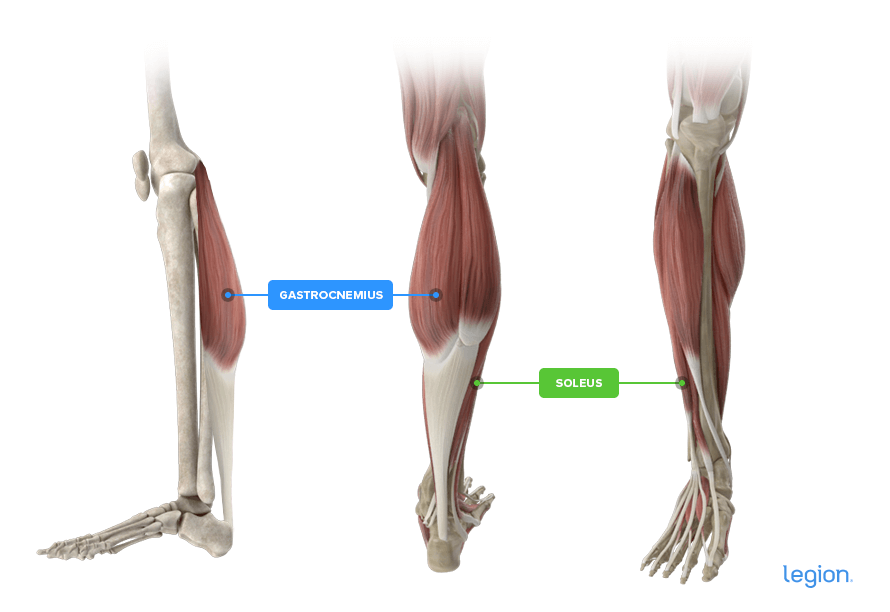
The standing calf raise trains the gastrocnemius and soleus. Both muscles pull on the Achilles tendon to lift your heel, a movement called ankle plantar flexion.
The gastrocnemius also crosses the knee, so keeping your knee straight puts it in a more stretched position. The soleus only crosses the ankle, which is why it can work hard whether your knee is straight or bent.
More Calf Exercises
Scientific References +
- ↩ Kinoshita M, Maeo S, Kobayashi Y, et al. Triceps surae muscle hypertrophy is greater after standing versus seated calf-raise training. Front Physiol. 2023;14:1272106.
- ↩ Sakuma J, Kanehisa H, Yanai T, et al. Fascicle-tendon behavior of the gastrocnemius and soleus muscles during ankle bending exercise at different movement frequencies. Eur J Appl Physiol. 2012;112(3):887-898.
- ↩ Kassiano W, Costa B, Kunevaliki G, et al. Greater gastrocnemius muscle hypertrophy after partial range of motion training performed at long muscle lengths. J Strength Cond Res. 2023;37(9):1746-1753.
- ↩ Schoenfeld BJ, Vigotsky AD, Grgic J, et al. Do the anatomical and physiological properties of a muscle determine its adaptive response to different loading protocols? Physiol Rep. 2020;8(9):e14427.
- ↩ Nunes JP, Grgic J, Cunha PM, et al. What influence does resistance exercise order have on muscular strength gains and muscle hypertrophy? A systematic review and meta-analysis. Eur J Sport Sci. 2021;21(2):149-157.