- Instructions
- Expert Tips
- Workout Programming
- Mike's Take
- Single-Leg RDL Alternatives
- 3 Single-Leg RDL Workouts
- Muscles Worked by the Single-Leg RDL
- More Hamstring and Glute Exercises
Table of Contents
+Instructions
- Stand upright holding a dumbbell in your right hand in front of your right thigh.
- Keep your back flat and push your hips back as you lower the weight straight toward the floor, letting your right leg extend behind you for balance.
- Lower until you feel a deep stretch in your left hamstring or just before your lower back rounds.
- Reverse the movement and return to the starting position.
- Complete all reps on your left leg, then switch sides.
Expert Tips
- You can also do the single-leg RDL with the dumbbell in the hand on the same side as your standing leg, as shown in the second pair of videos. Research shows the opposite hand may be a bit better for activating your glutes, though.1
- If you struggle with balance on the single-leg RDL, you can also put your free hand on something for support—an incline bench, wall, squat rack, chair, table—anything about waist height works.
- When you use your hand for support, keep your back foot off the floor. If you set it down, you’re doing a B-stance (or "kickstand") RDL, and your rear leg supports some of the weight, which lightens the load on the leg you’re trying to train.
- If you struggle to feel your hamstrings and glutes working during the single-leg RDL, focus on keeping your back straight, extending your back leg straight out behind you, and your hips high, holding the dumbbell just in front of your shin, and lowering it just to the point you feel a deep stretch in your hamstring, but no further.
- Keep a slight bend in your standing knee throughout each rep. This allows you to go a little deeper and is more comfortable for most people.
- Keep your hips square to the floor throughout each rep, so the hip on the side of your raised leg isn’t tilted up or down. If you can’t do this, it’s smart to hold on to something for balance.
- The best way to know you’re using proper form is to film yourself (either ask a friend, prop your phone up on something, or bring a tripod to the gym). From the side, check that your back is flat and the dumbbell stays close to your standing leg. From behind, check that your hips stay level.
- A good cue for maintaining balance is to think about "grabbing" the floor with your foot like an eagle claw. You want your weight balanced over your midfoot, not on your toes or your heel.
Workout Programming
Use the single-leg RDL in place of the regular RDL in a leg, glute-focused, or full-body workout when you don’t have access to barbells or machines, such as when you’re traveling or training at home.
Program it as the first or second exercise in your workout. It takes more balance and coordination than most lower-body exercises, so it’s best to do it while you’re fresh.
A good default is 3 sets of 8–12 reps per leg with a weight you could lift for about 10–12 reps on each side. Do all of your reps on one leg, switch sides, and then rest 2–3 minutes.
Take each set 2–3 reps shy of failure (the point where you can’t move the weight with good form despite giving your maximum effort). If you lose your balance before you get that close, rest your free hand on a bench or squat rack for support.
Mike’s Take
The single-leg RDL is a workable substitute for the barbell RDL when you don’t have access to barbells or machines, such as when traveling or training from home.
It isn’t a great exercise, and if you can’t do the barbell RDL, you’re better off just using machines or other exercises instead.
Like any exercise, though, it comes with its own set of pros and cons.
First, the pros:
- It trains each side of your body independently, which means it’s useful for finding and fixing muscle imbalances.
- You can do it nearly anywhere—all you need is a dumbbell.
- It activates your gluteus medius and minimus, two smaller glute muscles on the side of your butt responsible for stabilizing your hips.2
Now the cons:
- You can’t use nearly as much weight as you can with the regular Romanian deadlift, and your balance almost always forces you to end your sets before your muscles are fully trained. When researchers at Maastricht University Medical Centre had 10 athletic men work up to the heaviest barbell single-leg RDL they could lift once, most were limited by their balance, not their strength.3
- Because the exercise requires more balance than most, it isn’t practical or safe to take your sets all the way to failure—you’ll almost certainly tip over before reaching true failure. It’s just too hard to focus on staying upright and taking your muscles all of the way to true failure simultaneously.
- Your sets take twice as long to complete, since you’re only training one leg at a time.
You can partially overcome the balance issue by holding onto something for support, but it’s still more awkward than a regular barbell Romanian deadlift, hamstring curl, or hip thrust.
Some people claim that the fact that the single-leg Romanian deadlift requires you to balance on one leg is a good thing, since you’re improving your coordination and strength simultaneously. I mostly disagree.
While this might make sense for someone recovering from an injury or going through physical therapy, in general, balance is very specific to the exercise you’re doing (improving your balance on the single-leg RDL doesn’t necessarily transfer to everyday activities or make you better at, say, skiing).
And, because you’re limited by your balance, it’s simply a subpar exercise for building muscle and strength.
There are also two ways to perform the single-leg RDL: with the dumbbell in the hand closest to your support leg (your right hand if you’re balancing on your right foot), or the hand opposite your support leg (left hand in this case).
I generally recommend you hold it in your opposite hand, as this may be a bit better for activating your glutes.
Researchers at the Technological and Higher Education Institute of Hong Kong had 12 experienced male lifters do single-leg RDLs with a dumbbell weighing about 60 pounds.4 The men held it on the same side as their standing leg for some sets and on the opposite side for others.
When the men held the dumbbell in the opposite hand, the upper part of their gluteus maximus (the largest muscle in your butt) was about 46% more active as they lifted the weight. Their gluteus medius was about 42% more active as they lowered it.
Activity in the biceps femoris, one of the hamstring muscles, was about the same either way.
If your heaviest dumbbell starts to feel too light, you can try holding one in each hand, but this requires even more balance and usually isn’t practical.
Hand support helps, but the single-leg RDL is still harder to balance and to load than the regular version. This is why I recommend you stick to the traditional Romanian deadlift, and only use single-leg deadlift variations when you don’t have access to a barbell or heavy dumbbells (when traveling or training at home, for example).
And if your gym doesn’t have a barbell, I’d still generally use machine exercises like the hip thrust, hamstring curl, and hip abduction machine to train the same muscles instead of the single-leg dumbbell RDL, as this generally allows you to better train the target muscles.
Single-Leg RDL Alternatives
- Barbell Romanian Deadlift (RDL). This is the best barbell hamstring exercise you can do. It allows you to use very heavy weights and trains your glutes, low-back, and forearms, too. It’s what I recommend instead of the single-leg RDL whenever you have access to a barbell.
- Dumbbell Romanian Deadlift. All of the same pros and cons of the barbell RDL, but with dumbbells. It’s just like the single-leg RDL, but you stand on both feet.
- B-Stance RDL. This allows you to use your rear leg for stability, so it requires less balance. The tradeoff is that your rear leg supports some of the weight, which lightens the load on the leg you’re trying to train.
- Barbell Good Morning. This is basically the same hip-hinge movement as the RDL, except you perform it with a barbell on your back instead of in your hands. Which you use largely comes down to personal preference.
- Nordic Hamstring Curl. This is one of the best (and only) bodyweight hamstring exercises you can do. It complements the single-leg RDL rather than replacing it, since it trains knee flexion (bending your knees), not hip extension (straightening your hips).
3 Single-Leg RDL Workouts
Here are three sample workouts that show how to program the single-leg RDL in a leg, glute-focused, or full-body workout when you’re training with dumbbells. Each one pairs it with a knee-flexion exercise (the Nordic curl) so you train every part of your hamstrings.
Leg Workout with the Single-Leg RDL
Dumbbell Goblet Squat: 3 sets | 6–8 reps | 2–3 min rest
Single-Leg Dumbbell Romanian Deadlift: 3 sets | 8–12 reps per leg | 2–3 min rest
Dumbbell Step-Up: 3 sets | 6–8 reps per leg | 2–3 min rest
Nordic Hamstring Curl: 3 sets | 6–8+ reps | 2–3 min rest
Bodyweight Single-Leg Calf Raise: 4 sets | 10–15 reps per leg | 2–3 min rest
Glute-Focused Workout with the Single-Leg RDL
Dumbbell Hip Thrust: 3 sets | 8–10 reps | 2–3 min rest
Single-Leg Dumbbell Romanian Deadlift: 3 sets | 8–12 reps per leg | 2–3 min rest
Dumbbell Bulgarian Split Squat: 3 sets | 8–10 reps per leg | 2–3 min rest
Nordic Hamstring Curl: 2 sets | 6–8+ reps | 2–3 min rest
Full-Body Workout with the Single-Leg RDL
Dumbbell Goblet Squat: 3 sets | 6–8 reps | 2–3 min rest
Single-Leg Dumbbell Romanian Deadlift: 3 sets | 8–12 reps per leg | 2–3 min rest
Dumbbell Bench Press: 3 sets | 6–8 reps | 2–3 min rest
One-Arm Dumbbell Row: 3 sets | 6–8 reps per arm | 2–3 min rest
Nordic Hamstring Curl: 2 sets | 6–8+ reps | 2–3 min rest
Do two warm-up sets before your first exercise in each workout. On the first set, do 5 reps with about 50% of the weight you plan to use for your first hard set, and rest for 1–2 minutes. On the second, do 5 reps with about 80% of your target weight, and rest for 1–2 minutes.
To progress these workouts, use double progression: use a weight that allows you to work within the given rep range, take each set 1–2 reps shy of failure, and once you hit the top of the range for your first set, add weight.
With the single-leg RDL, stay 2–3 reps shy of failure, and add weight once you hit the top of the range on both legs in your first set.
Muscles Worked by the Single-Leg RDL
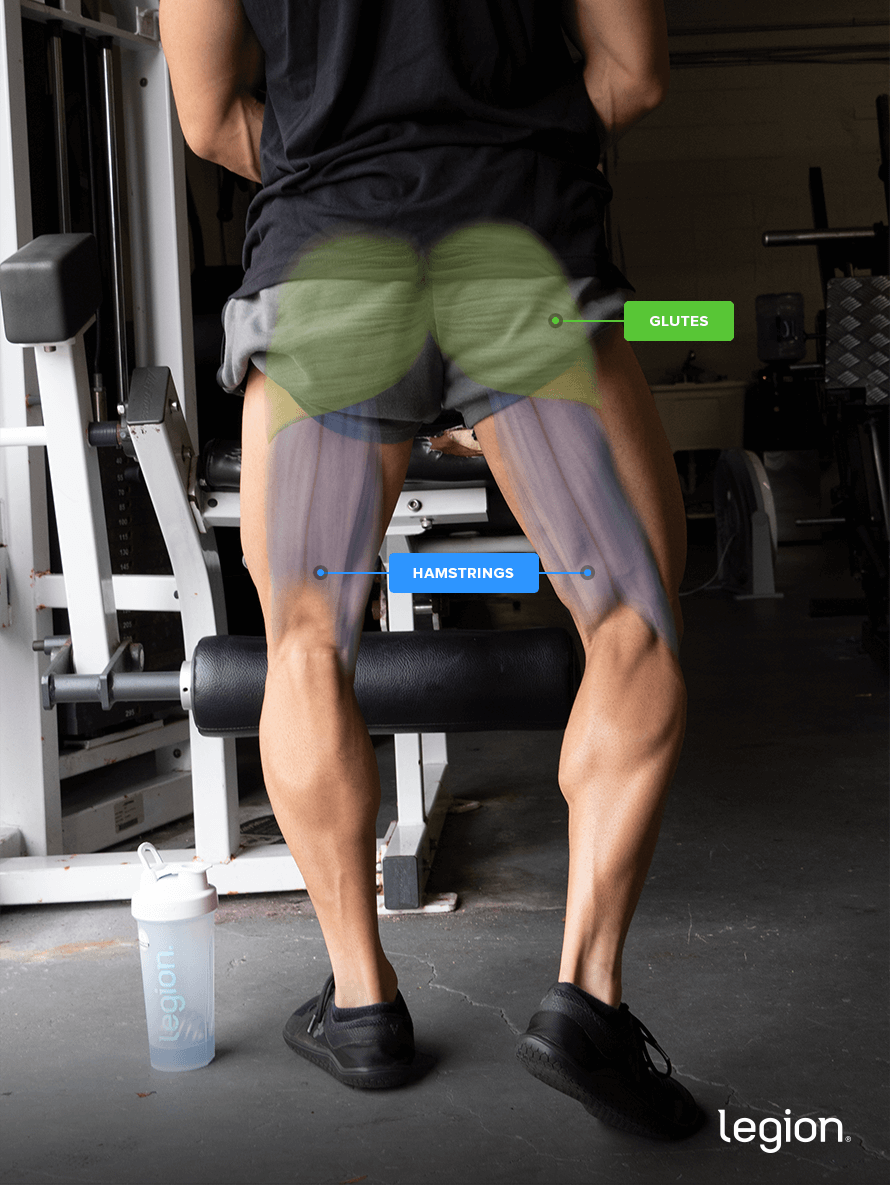
The single-leg RDL primarily trains your hamstrings and glutes (gluteus maximus), which straighten your hips as you stand back up (hip extension).
The smaller glute muscles on the side of your hip (gluteus medius and minimus) help keep your pelvis level while you stand on one leg, and your inner-thigh muscles (adductors) help straighten your hips. Your abs and lower-back muscles keep your torso stable, and your forearms help you keep a firm grip on the dumbbell.
Three of your four hamstring muscles cross both the hip and the knee, but one of them—the short head of the biceps femoris (the part closer to the outside of your thigh)—only crosses the knee. That means it barely does anything during a hip hinge like the RDL. To train it, make sure your program also includes some kind of knee flexion exercise like a seated or lying leg curl or Nordic curl.
More Hamstring and Glute Exercises
- The Best Way to Do the Barbell Romanian Deadlift
- The Best Way to Do the Dumbbell Romanian Deadlift
- The 5 Best Hamstring Exercises for Stronger, More Defined Legs
Scientific References +
- ↩ Mo RCY, Ngai DCW, Ng CCM, et al. Effects of loading positions on the activation of trunk and hip muscles during flywheel and dumbbell single-leg Romanian deadlift exercises. Front Physiol. 2023;14:1264604.
- ↩ Collings TJ, Bourne MN, Barrett RS, et al. Gluteal muscle forces during hip-focused injury prevention and rehabilitation exercises. Med Sci Sports Exerc. 2023;55(4):650-660.
- ↩ Van Hooren B, Vanwanseele B, van Rossom S, et al. Muscle forces and fascicle behavior during three hamstring exercises. Scand J Med Sci Sports. 2022;32(6):997-1012.
- ↩ Mo RCY, Ngai DCW, Ng CCM, et al. Effects of loading positions on the activation of trunk and hip muscles during flywheel and dumbbell single-leg Romanian deadlift exercises. Front Physiol. 2023;14:1264604.