- Instructions
- Expert Tips
- Workout Programming
- Mike's Take
- Yates Row Alternatives
- 3 Yates Row Workouts
- Muscles Worked by the Yates Row
- More Back Exercises
Table of Contents
+Instructions
- Hold a barbell in front of your thighs with your palms facing forward and your hands a little wider than shoulder-width apart.
- Bend your knees slightly and lean forward at the hips, keeping your back straight and your chest higher than your hips.
- Let your arms hang straight down so the bar is directly beneath your shoulders, and allow your shoulder blades to move forward around your rib cage.
- Pull the bar toward your abdomen by bending your elbows and retracting your shoulder blades simultaneously. Keep your elbows close to your sides and pull until the bar touches your abdomen and your shoulder blades are pinched together and down.
- Pause for a brief moment, and then reverse the movement to return to the starting position.
Expert Tips
- Avoid "whipping" the weight upward by heaving your torso back and forth. While this makes each rep easier, it reduces how much tension your back and arm muscles need to produce, which reduces the effectiveness of the exercise. A little upper body movement is fine to help finish the rep at the top, but it should be gentle and controlled. Otherwise your legs and torso should remain fairly stable throughout each rep.
- Keep your elbows close to your sides instead of flaring them out. Research shows this better activates your lat muscles.1
- Keep your chest proud throughout the entire rep. You should end each rep with your chest high, upper back slightly arched, shoulders back and down, and elbows at your sides.
- A good weightlifting cue for this exercise is to think about slamming your elbows into the ceiling.
- If your grip fails before your lats or arms do, use lifting straps or weightlifting chalk. This prevents you from having to end your sets prematurely due to your grip giving out, allowing you to train your back, traps, and biceps more thoroughly.
- Before each set, take a deep breath of air into your belly (as opposed to your chest), bracing your abs as if you were about to get punched in the stomach.
Workout Programming
Use the Yates row as a horizontal pulling exercise in a back, pull, or upper-body workout.
Program it as the first or second exercise in your workout. Like the conventional barbell row, it requires enough coordination and lower-back strength that it’s best to do it while you’re fresh. And if you’re trying to develop your back and biceps, you can also do it as the first exercise in one of your workouts.
Start with 3 sets of 6–8 reps, resting 2–3 minutes between sets, and finishing each set 1–2 reps shy of failure (the point where you can’t move the weight with good form despite giving your maximum effort).
Mike’s Take
As far as barbell back exercises go, the Yates row is one of my favorite options. It’s not my favorite compound back exercise overall (I’ll explain why in a moment), but it can be an outstanding exercise for some people depending on their anatomy and where they are in their lifting journey.
The Yates row allows you to effectively train the target muscles—your lats, biceps, and traps—through a long range of motion, and it generally isn’t as dependent on lower-back strength as the traditional overhand barbell row.
This is because you aren’t lowering the bar all of the way to the floor after each rep, and because you maintain a more upright posture during each set. Research also shows that using an underhand grip helps better activate your biceps, so it’s probably a little better at developing your arms than the regular barbell row.2
Like all barbell exercises, it allows you to add weight in small increments over time, and you can do it in any gym with a barbell and plates. It’s also relatively easy to learn and set up.
Now, the reason I say the Yates row isn’t my favorite compound back exercise overall is it also has a few disadvantages:
- Like all compound exercises, sometimes one muscle group will fail before the others, forcing you to end your sets before all of the involved muscles are fully trained. In the case of the Yates row, it’s common for your lower-back or biceps to cry uncle before your lats or traps, meaning these muscles aren’t fully stimulated.3 You can take your lower back out of the equation by doing a chest-supported row, such as the chest-supported machine row or T-bar row. Exercises like the underhand machine lat pulldown and close-grip lat pulldown often do a better job training your lats and traps, while the cable pullover is a good option when you want to focus on your lats.
- It’s easier to cheat when doing Yates rows than when you’re doing a pulling exercise that fixes your torso in place, like the chest-supported machine row or T-bar row. As the reps get harder, it’s hard to resist the temptation to add just a little momentum by swinging your torso or pushing your hips forward a little. For example, if you add 5 pounds one week, is it because your muscles actually got bigger and stronger, or because you used a bit more leg drive and momentum to swing the weight upward? It’s often hard to tell and even harder to avoid cheating unless you’re very disciplined about your form.
- It has a more variable resistance curve than most machine or isolation exercises, meaning the weight is significantly more or less challenging at different points throughout each rep. Generally speaking, exercises with a smoother resistance curve are going to be better for gaining muscle over time.
All of these problems are even more true for the conventional barbell row. Since these exercises are so similar, here’s a table comparing them:
| Yates row | Conventional bent-over row | |
|---|---|---|
| Grip | Underhand, slightly wider than shoulder width | Overhand, often slightly wider than Yates row |
| Setup | Usually starts from rack pins or safety arms | Starts from the floor |
| Torso | More upright | More bent over |
| Execution | Controlled pull | More explosive pull with some leg drive |
| Between reps | Bar stays off the floor | Bar returns to floor between each rep |
| Legs and hips | Hold your position | Help complete each rep with momentum |
Overall, the Yates row is a solid exercise, but it tends to be much better for some than others depending on your anatomy.
Some people find that the Yates row is highly effective at training their biceps, lats, and traps more or less equally, and others find they make better progress by training these muscles with other compound exercises or isolation exercises.
Others find it works for a while, but eventually they get strong enough that their lower-back almost always gives out before their lats and biceps, at which point they’d make better progress with machines and isolation exercises.
Thus, my recommendation is to try it and see how it works for you.
Yates Row Alternatives
- Seated Machine Row. My favorite alternative. It provides consistent tension throughout each rep, a long range of motion, and allows you to train your biceps, traps, lats, and rear delts (and completely takes your lower back out of the equation).
- T-Bar Row. Another outstanding alternative, especially if it’s a chest-supported version.
- Seated Cable Row. This is a great alternative, but many people still find their lower back gives out before their traps, lats, and biceps.
- One-Arm Dumbbell Row. One of my favorite back exercises and a great alternative to the Yates row.
- Chest-Supported Dumbbell Row. Another pulling exercise that takes your lower-back out of the equation, but most people find it limits their range of motion more than the single-arm dumbbell row, which I prefer.
- Barbell Seal Row. This removes your lower back as a limiting factor and makes it impossible to cheat, but it also has a very challenging resistance curve, can feel awkward, and few gyms have one.
- Barbell Row. This trains most of your upper-body pulling muscles, but it demands more from your lower back and makes it easier to use leg drive and momentum. I generally prefer the Yates row.
3 Yates Row Workouts
Here are three sample workouts that show how to program the Yates row.
Back Workout with the Yates Row
Yates Row: 3 sets | 6–8 reps | 2–3 min rest
Lat Pulldown: 3 sets | 6–8 reps | 2–3 min rest
Cable Pullover: 3 sets | 8–12 reps | 2–3 min rest
Machine Rear Delt Fly: 3 sets | 8–12 reps | 2–3 min rest
Barbell Shrug: 3 sets | 8–10 reps | 2–3 min rest
Pull Workout with the Yates Row
Barbell Deadlift: 3 sets | 4–6 reps | 2–3 min rest
Yates Row: 3 sets | 6–8 reps | 2–3 min rest
Close-Grip Lat Pulldown: 3 sets | 6–8 reps | 2–3 min rest
Machine Rear Delt Fly: 3 sets | 8–12 reps | 2–3 min rest
EZ-Bar Curl: 3 sets | 8–10 reps | 2–3 min rest
Upper-Body Workout with the Yates Row
Barbell Bench Press: 3 sets | 4–6 reps | 2–3 min rest
Yates Row: 3 sets | 6–8 reps | 2–3 min rest
Pec-Deck Machine: 3 sets | 6–8 reps | 2–3 min rest
Underhand Machine Lat Pulldown: 3 sets | 6–8 reps | 2–3 min rest
Machine Lateral Raise: 3 sets | 8–10 reps | 2–3 min rest
Bayesian Cable Curl: 3 sets | 8–10 reps (per arm) | 2–3 min rest
Do two warm-up sets before your first exercise in each workout. On the first set, do 5 reps with about 50% of the weight you plan to use for your first hard set, and rest for 1–2 minutes. On the second, do 5 reps with about 80% of your target weight, and rest for 1–2 minutes.
To progress these workouts, use double progression: use a weight that allows you to work within the given rep range, take each set 1–2 reps shy of failure, and once you hit the top of the range for your first set, add weight.
Muscles Worked by the Yates Row
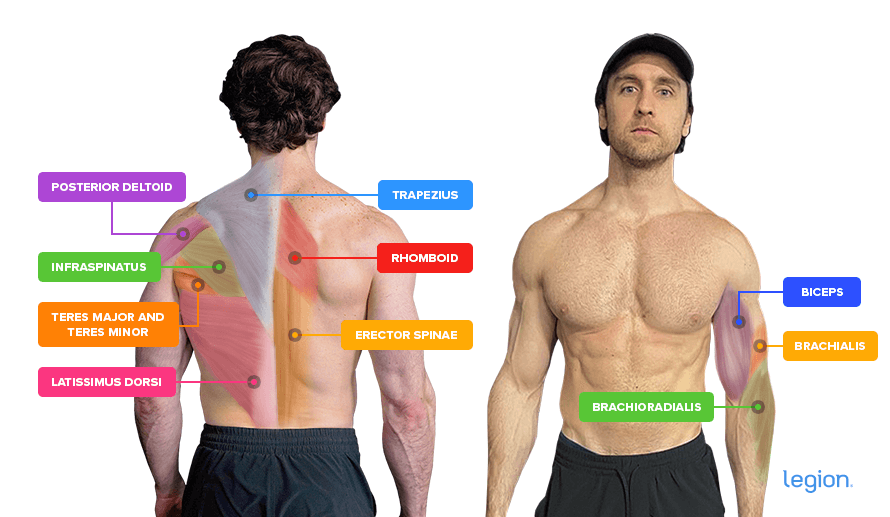
The Yates row primarily trains your lats, traps, and biceps. It also trains a number of smaller muscles on your back, your elbow flexors, rear delts, and spinal erectors.
Your lats (latissimus dorsi) pull your upper arms toward your torso (shoulder extension), while your middle traps (trapezius) and rhomboids pull your shoulder blades together (scapular retraction). Your biceps, brachialis, and brachioradialis bend your elbows (elbow flexion) to bring the bar toward you.
Your rear delts (posterior deltoids) help pull your upper arms back, and your forearms help you keep a firm grip on the bar. Your abs, lower-back muscles, glutes, and quads hold your body in position throughout each rep.
More Back Exercises
- The Best Way to Do the Barbell Bent-Over Row
- The Best Way to Do the Seated Cable Row
- The 13 Best Lat Exercises and 3 Lat Workouts
Scientific References +
- ↩ Vasconcelos CMWA, Lopes CR, Almeida VM, et al. Effect of different grip position and shoulder-abduction angle on muscle strength and activation during the seated cable row. Int J Strength Cond. 2023;3(1).
- ↩ Fusco AM, Dhariwal H, McBride SP, et al. Impact of grip orientation on strength and muscle activation during the incline prone row. Biomed Hum Kinet. 2026;18(1):328-336.
- ↩ Fenwick CMJ, Brown SHM, McGill SM. Comparison of different rowing exercises: trunk muscle activation and lumbar spine motion, load, and stiffness. J Strength Cond Res. 2009;23(2):350-358.