- Instructions
- Expert Tips
- Workout Programming
- Mike's Take
- Underhand Machine Lat Pulldown Alternatives
- 3 Underhand Machine Lat Pulldown Workouts
- Muscles Worked by the Underhand Machine Lat Pulldown
- More Back Exercises
Table of Contents
+Instructions
- Adjust the seat and thigh pad so that your legs are locked in place and your butt doesn’t rise off the seat when pulling the handles down.
- Grab the handles with your palms facing toward you (supinated), sit down, and wedge your legs underneath the thigh pad.
- Sit with your chest proud and a slight arch in your lower back. If the machine has a chest pad, keep your chest against it.
- Relax your arms and shoulders, letting the weight pull your arms straight and your shoulders as high as possible.
- Staring straight ahead, pull the handles down by bending your elbows and pulling your shoulder blades down and back simultaneously, ending when your hands are about level with your midchest.
- Pause briefly, then reverse the movement to return to the starting position: straighten your arms and let the weight pull your shoulder blades as high as they’ll go.
Expert Tips
- If you struggle with pulling your shoulder blades down, practice this movement a few times during your warm-up (this is called a “shrug-down”). This may feel strange at first, but it’s the best way to ensure the lat pulldown effectively trains your traps.
- If your grip gives out before your lats do, use lifting straps or weightlifting chalk. This prevents you from having to end your sets prematurely due to your grip giving out, allowing you to train your back, traps, and biceps more thoroughly.
- Avoid swinging your torso back and forth to finish your reps. A slight lean back is good, but don’t use momentum to make your reps easier.
- Focus on keeping your chest high throughout the entire rep, getting a deep stretch in your shoulders and upper back at the top of every rep, and pulling your elbows all the way down to your sides.
- If you can’t feel your lats working, don’t worry. Many people report the same thing. If you follow the steps above, your lats, traps, and biceps are all going to be thoroughly trained by this exercise.
Workout Programming
Use the underhand machine lat pulldown as a vertical pulling exercise in a back, pull, or upper-body workout.
Most people do this as the second or third exercise in their workout, often after barbell exercises like the bench press, deadlift, or overhead press. If you’re specifically trying to develop your biceps and back, you can also do it as one of the first exercises in your workout.
Start with 3 sets of 6–8 reps, resting 2–3 minutes between sets, and finishing each set 1–2 reps shy of failure (the point where you can’t move the weight with good form despite giving your maximum effort).
Mike’s Take
If I had to pick just one exercise for my lats, it would be an underhand machine lat pulldown or a close-grip lat pulldown. Both train the lats, biceps, and traps (if you train your traps the way I describe in this article).
Here’s why I like it:
- It allows you to train your lats, biceps, and traps simultaneously and through a full range of motion. And, depending on your anatomy, the design of the machine, and your technique, all of these muscles tend to hit failure around the same time, meaning they’re all trained more or less equally.
- A plate-loaded lat pulldown machine follows a fixed path, so it takes less coordination than a cable pulldown or dumbbell row, allowing you to focus on contracting your muscles as hard as possible rather than controlling the weight.
- It’s safe to take your sets close or all of the way to failure, which is generally beneficial for muscle growth.1
- It applies a consistent amount of resistance throughout the entire range of motion, so every portion of the rep is roughly the same difficulty (in technical terms, this means it has a very smooth resistance curve).
- Depending on the machine and plates available at your gym, it may also let you increase the weight in smaller increments than the cable lat pulldown.
- It’s safe, comfortable, and easy to learn for almost everyone.
The main drawbacks are:
- They tend to be less common than cable lat pulldown machines or regular lat pulldown machines (where you just pull the weight straight down).
- As with any compound pulling exercise, it’s possible that your biceps might hit failure before your lats, forcing you to end the set before your lats are fully trained. This is one of the reasons it’s always a good idea to do this exercise while your biceps are still fresh. The reverse can also happen—your lats failing before your biceps—but that’s less common.
Now, you’ll sometimes hear people claim that using an underhand/supinated grip preferentially emphasizes the biceps. Based on my own experience and working with hundreds of thousands of people through this blog, books, podcast, and social media, I’d say this is probably true.
That said, the scientific evidence is less clear. For example, a 2025 study conducted by scientists at the University of Molise had 40 men with at least 5 years of weightlifting experience complete 7 different lat pulldown variations, using different grips and torso positions (including underhand vs overhand). They found no significant difference in lat or biceps activation between any of the variants.2
Another 2010 study from Pennsylvania State University–Berks found no significant difference in biceps or middle-trap activation between underhand and overhand grips. Lat activation was slightly higher with an overhand grip (about 67% versus 63% of maximum measured activity).3
That difference was statistically significant, but given that muscle activation doesn’t perfectly correlate with muscle growth, I wouldn’t consider it as a convincing reason to choose an overhand grip over an underhand grip.
Keep in mind that there’s very little research on how grip variations impact actual muscle growth over time, and most of the studies tend to be too short to suss out any long-term changes. In other words, even if using an underhand grip produces a little more biceps growth, it would probably take months for this to produce a measurable change.
In the main, the underhand lat pulldown is an outstanding exercise for training your lats, biceps, and mid-back, and if your gym has one, I highly recommend you give it a shot.
Underhand Machine Lat Pulldown Alternatives
- Close-Grip (V-Grip) Lat Pulldown. This is the same as a regular lat pulldown but performed with a V-grip handle. Many people find it more comfortable and feel like it allows them to use a slightly longer range of motion.
- Overhand Machine Lat Pulldown. The same basic exercise, but performed with an overhand grip. Use a grip around shoulder-width or slightly wider.
- Chest-Supported Seated Machine Row. It provides consistent tension throughout each rep, a long range of motion, and allows you to train your biceps, traps, lats, and rear delts (and completely takes your lower back out of the equation).
- Pull-Up. An outstanding alternative that trains all of the same muscles, but it’s harder to learn and perform and less convenient to load.
- Chin-Up. Almost identical to the pull-up, but it may emphasize your biceps slightly more. You can use these exercises interchangeably.
3 Underhand Machine Lat Pulldown Workouts
Here are three sample workouts that show how to program the underhand machine lat pulldown.
Back Workout with the Underhand Machine Lat Pulldown
Underhand Machine Lat Pulldown: 3 sets | 6–8 reps | 2–3 min rest
Chest-Supported Seated Machine Row: 3 sets | 6–8 reps | 2–3 min rest between sets
Seated Machine Shrug-Back (20–30 seconds after your last set of rows): 1 set to failure | as many reps as possible | 2–3 min rest
Cable Pullover: 3 sets | 8–12 reps | 2–3 min rest
Machine Rear Delt Fly: 3 sets | 8–12 reps | 2–3 min rest
Pull Workout with the Underhand Machine Lat Pulldown
Barbell Deadlift: 3 sets | 4–6 reps | 2–3 min rest
Underhand Machine Lat Pulldown: 3 sets | 6–8 reps | 2–3 min rest
Chest-Supported T-Bar Row: 3 sets | 6–8 reps | 2–3 min rest
Machine Rear Delt Fly: 3 sets | 8–12 reps | 2–3 min rest
EZ-Bar Curl: 3 sets | 8–10 reps | 2–3 min rest
Upper-Body Workout with the Underhand Machine Lat Pulldown
Barbell Bench Press: 3 sets | 4–6 reps | 2–3 min rest
Underhand Machine Lat Pulldown: 3 sets | 6–8 reps | 2–3 min rest
Pec-Deck Machine: 3 sets | 6–8 reps | 2–3 min rest
Seated Cable Row: 3 sets | 6–8 reps | 2–3 min rest
Cable Lateral Raise: 3 sets | 8–10 reps (per side) | 2–3 min rest
Ab Crunch Machine: 3 sets | 8–12 reps | 2–3 min rest
Do two warm-up sets before your first exercise in each workout. On the first set, do 5 reps with about 50% of the weight you plan to use for your first hard set, and rest for 1–2 minutes. On the second, do 5 reps with about 80% of your target weight, and rest for 1–2 minutes.
To progress these workouts, use double progression: use a weight that allows you to work within the given rep range, take each set 1–2 reps shy of failure, and once you hit the top of the range for your first set, add weight. (Failure is the point where you can’t move the weight with good form despite giving your maximum effort.)
Muscles Worked by the Underhand Machine Lat Pulldown
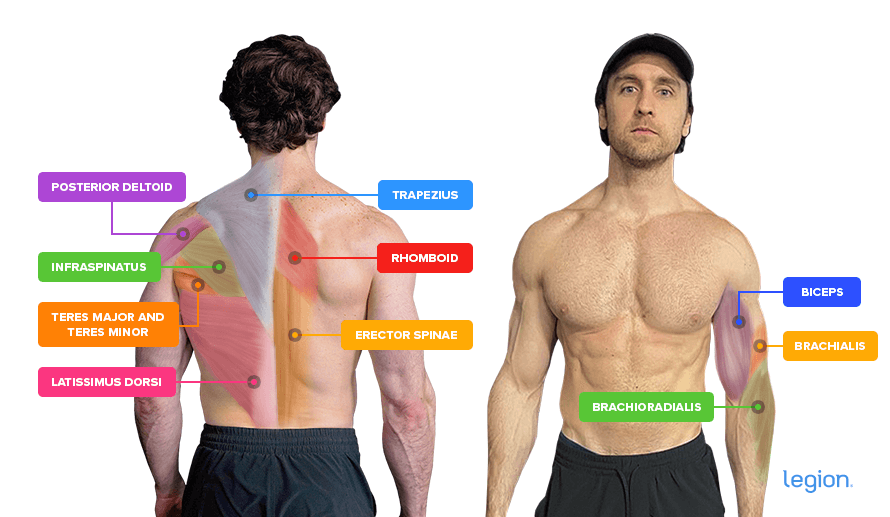
The underhand machine lat pulldown primarily trains your lats (latissimus dorsi), which bring your upper arms down toward your torso (shoulder extension), and your lower traps (trapezius), which pull your shoulder blades down (scapular depression).
Your biceps, brachialis, and brachioradialis help pull the handles down by bending your elbows. Your rear delts (posterior deltoids) help pull your upper arms back. Your forearms help you keep a firm grip on the handles, and your lower-back muscles keep your torso stable.
More Back Exercises
- The 13 Best Lat Exercises and 3 Lat Workouts
- The Best Way to Do the One-Arm Dumbbell Row
- Chest-Supported Row: Alternatives, Muscles Worked, and Form
Scientific References +
- ↩ Robinson ZP, Pelland JC, Remmert JF, et al. Exploring the dose–response relationship between estimated resistance training proximity to failure, strength gain, and muscle hypertrophy: a series of meta-regressions. Sports Med. 2024;54(9):2209-2231.
- ↩ Buonsenso A, Di Fonza D, Di Claudio G, et al. Electromyographic analysis of back muscle activation during lat pulldown exercise: effects of grip variations and forearm orientation. J Funct Morphol Kinesiol. 2025;10(3):345.
- ↩ Lusk SJ, Hale BD, Russell DM. Grip width and forearm orientation effects on muscle activity during the lat pull-down. J Strength Cond Res. 2010;24(7):1895-1900.