- Instructions
- Expert Tips
- Workout Programming
- Mike's Take
- Ab Crunch Machine Alternatives
- 3 Ab Crunch Machine Workouts
- Muscles Worked by the Ab Crunch Machine
- More Ab Exercises
Table of Contents
+Instructions
- Adjust the seat so the pivot point of the machine is at about the same height as the middle of your torso.
- Sit on the seat and place the back of your upper arms on the pads.
- Contract your abs to curl your ribs toward your pelvis.
- Pause for a brief moment, and reverse the movement and return to the starting position.
Expert Tips
- Focus on crunching your chest toward your waist, rather than bending forward at the hips. Your lower back should barely move, if at all.
- More range of motion isn’t always better with this exercise. Your abs can only contract a relatively short distance, so the range of motion on this exercise is much shorter than most others. That’s fine—it’s just how the abs are built.
- Try to adjust the seat so that you feel a slight stretch in your belly and your chest is extended toward the ceiling before you start your first rep. This ensures you’re training your abs through a full range of motion.
- Try to relax your grip on the handles and think about pulling your torso down with your abs instead of pushing the pads with your arms.
- There are many different kinds of ab crunch machines, so you may have to make small adjustments to get the most out of this exercise. The key is that you can get into a position that allows you to get a strong contraction in your abs and use a sufficient range of motion.
- If you feel like your hip flexors (the muscles inside your hips that pull your torso toward your thighs) are still being activated, try putting your feet on a raised platform to elevate your knees.
Workout Programming
Generally speaking, it’s best to do the ab crunch machine as one of the last exercises in your workouts. It’s not technically challenging, which means you can do it even when you’re sore or fatigued from other exercises.
Plus, abs aren’t most people’s first priority, so there’s no reason to do it first thing in your workout. You can tack this exercise onto the end of most any workout, whether it’s a push, pull, leg, upper-, lower-, or full-body workout.
A good default is 2–3 sets of 8–12 reps. Take each set 0–1 reps shy of failure—the point where you can’t move the weight with good form despite giving your maximum effort—and rest 2–3 minutes between sets. This is one exercise where it’s perfectly fine to take most of your sets all of the way to failure.
Mike’s Take
The ab crunch machine is one of my favorite ab exercises for building a stronger, more defined core. Here’s why:
- It lets you isolate your abs with minimal involvement from other muscles.
- It lets you focus entirely on contracting your abs as hard as possible without needing to balance your body or weights.
- It lets you add weight in small increments (some machines are better about this than others).
- It’s easy to learn and fast to set up and perform.
- It allows you to safely take your sets to complete muscular failure.
Now, as much as I like this exercise, not all ab crunch machines are created equal. Some of them don’t have arm pads and instead require you to pull the weight using handles. While these are still effective for training your abs if you’re strict about your technique, it’s easy to start pulling the weight with your arms rather than crunching the weight with your abs.
Some ab machines also have very limited options for adjustment, which can make it hard to move the seat into a position that allows you to fully contract your abs. For example, the weight might come to rest before you’ve fully extended your torso, or the machine might be designed in such a way that you can’t fully flex your abs.
Many people wonder how the ab crunch machine compares to the weighted sit-up and kneeling cable crunch. They’re all effective, and you can build a great six-pack with any of them. That said, here are the main differences:
The weighted sit-up generally activates your hip flexors more and can be more difficult to overload in small increments.1 For example, if you did 25 pounds last week and you want to add five pounds, you’ll have to hold both a 25-pound and 5-pound plate against your chest, which can get awkward quickly.
Another problem with the weighted sit-up is that the exercise is significantly easier at the top of each rep than at the bottom (in technical terms, it has a highly variable resistance curve).
The kneeling cable crunch mostly avoids these problems, but many people do it incorrectly. Specifically, they fold their torso over at the waist like a hip-hinge movement, rather than just contracting their abs.
And since you’re holding the rope in your hands, it’s easy to start pulling the weight down with your arms rather than your abs.
Most of these issues can be solved by simply paying close attention to your technique, but they’re generally less of an issue with the ab crunch machine, which is why it’s my favorite ab isolation exercise.
In other words, the ab crunch machine is basically all pros and no cons (depending on what machine you have access to), and it’s harder to mess up than most other ab exercises.
Ab Crunch Machine Alternatives
- Cable Crunch. The best substitute. This is essentially the same movement but using a cable machine instead. It’s easier to cheat on your form, though, so be mindful of this.
- Decline Weighted Sit-Up. This exercise also allows you to add weight in small increments, but it tends to rely more on the hip flexors and thus isn’t as effective at isolating the abs.
- Captain’s Chair Leg Raise. This is almost as challenging as the ab wheel rollout, which makes it a good alternative. That said, once you can do 15 or more reps, you’re better off graduating to a harder exercise, as adding weight becomes impractical.
- Captain’s Chair Knee Raise. The easier version of the captain’s chair leg raise. Use this until you can get 10 strict reps, then progress to the captain’s chair leg raise.
- Hanging Leg Raise. The same movement as the captain’s chair leg raise, but it also trains your grip at the same time. Downside: your grip will generally fail before your abs, making it a suboptimal ab exercise.
- Ab Wheel Rollout. Despite being a body weight exercise, this is challenging enough that it’s still very effective for training your abs.
- Reverse Crunch. No equipment required and easy to learn, but also impractical to progress past the beginner stage.
- Plank. One of the more challenging bodyweight ab exercises you can do. Once you can hold this position for 1–2 minutes, though, you’re better off progressing to a weighted ab exercise like the ab crunch machine.
- Bodyweight Crunch. This is fine when you’re new to weightlifting, but once you can do at least 20 bodyweight crunches, you’re better off switching to a weighted ab exercise like the ab crunch machine.
3 Ab Crunch Machine Workouts
Here are three sample workouts that show how to program the ab crunch machine, no matter what kind of workout routine you’re following.
Pull Workout with the Ab Crunch Machine
Barbell Deadlift: 3 sets | 4–6 reps | 2–3 min rest
Chest-Supported Machine Row: 3 sets | 6–8 reps | 2–3 min rest
Close-Grip Lat Pulldown: 3 sets | 4–6 reps | 2–3 min rest
Barbell Curl: 2 sets | 8–10 reps | 2–3 min rest
Ab Crunch Machine: 2 sets | 8–12 reps | 2–3 min rest
Leg Workout with the Ab Crunch Machine
Barbell Back Squat: 3 sets | 4–6 reps | 2–3 min rest
Barbell Romanian Deadlift: 3 sets | 6–8 reps | 2–3 min rest
Leg Extension: 3 sets | 6–8 reps | 2–3 min rest
Seated Leg Curl: 3 sets | 8–12 reps | 2–3 min rest
Ab Crunch Machine: 3 sets | 8–12 reps | 2–3 min rest
Upper Body Workout with the Ab Crunch Machine
Barbell Bench Press: 3 sets | 4–6 reps | 2–3 min rest
Chest-Supported Machine Row: 3 sets | 6–8 reps | 2–3 min rest
Cable Lateral Raise: 3 sets | 8–12 reps | 2–3 min rest
Bayesian Cable Curl: 3 sets | 8–10 reps/arm | 2–3 min rest
Cable Overhead Triceps Extension: 3 sets | 8–12 reps | 2–3 min rest
Ab Crunch Machine: 2 sets | 8–12 reps | 2–3 min rest
Do two warm-up sets before your first exercise in each workout. On the first set, do 5 reps with about 50% of the weight you plan to use for your first hard set, and rest for 1–2 minutes. On the second, do 5 reps with about 80% of your target weight, and rest for 1–2 minutes.
To progress these workouts, use double progression: use a weight that allows you to work within the given rep range, take each set 1–2 reps shy of failure (0–1 for the ab crunch machine), and once you hit the top of the range for your first set, add weight.
Muscles Worked by the Ab Crunch Machine
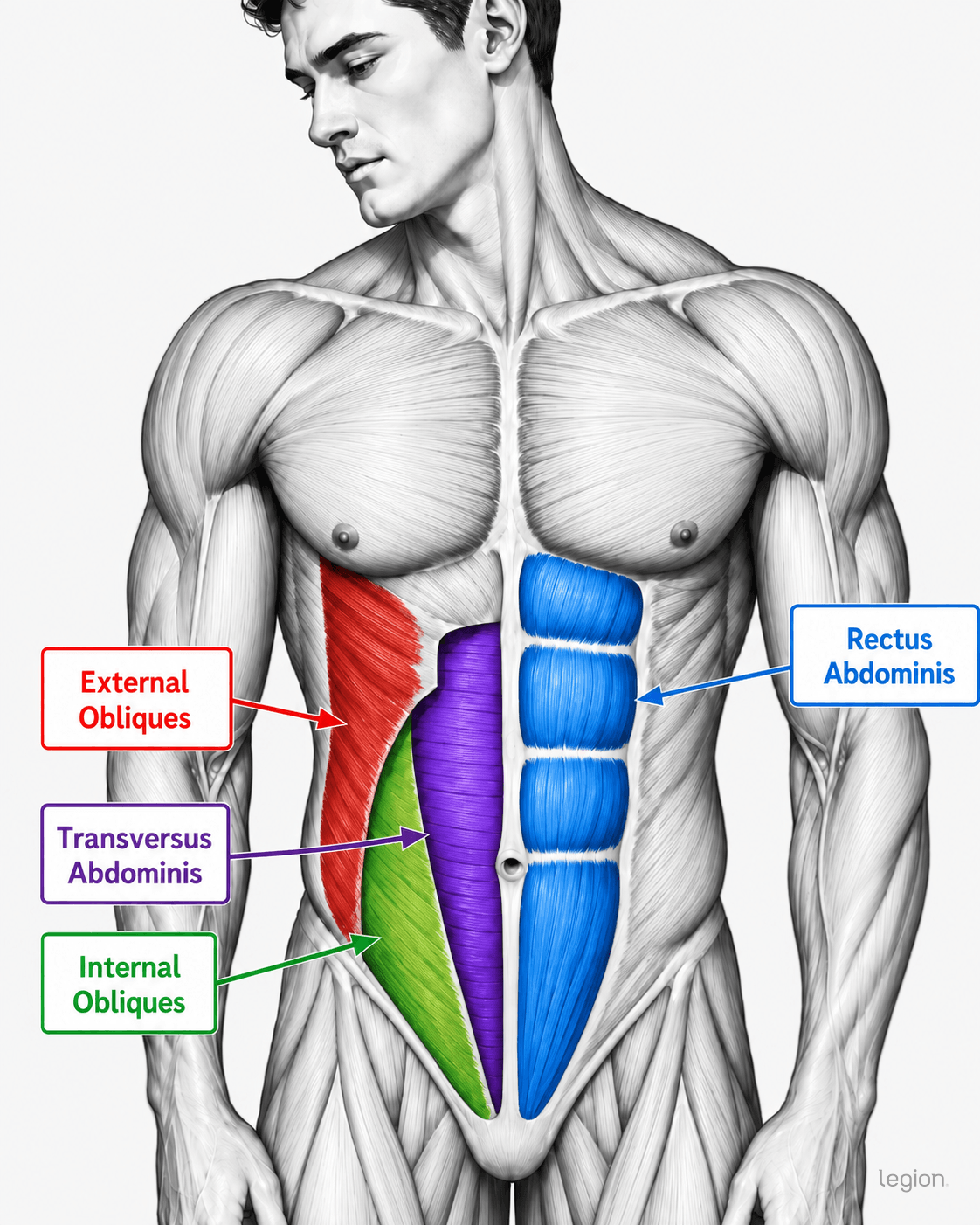
The ab crunch machine primarily trains your abs (rectus abdominis), which bring your rib cage toward your pelvis by bending your spine (spinal flexion).
Your internal and external obliques help bend your torso. Your transversus abdominis also helps keep your torso stable.
More Ab Exercises
- The Best Way to Do Cable Crunches for Stronger, More Defined Abs
- The Best Way to Do the Hanging Leg Raise for Six-Pack Abs
- The 8 Best Lower Ab Workouts & Exercises (Bodyweight + Weighted)
Scientific References +
- ↩ Juker D, McGill S, Kropf P, et al. Quantitative intramuscular myoelectric activity of lumbar portions of psoas and the abdominal wall during a wide variety of tasks. Med Sci Sports Exerc. 1998;30(2):301–310.