
Instructions
- Set a pulley to about chest height and attach a rope handle.
- Grab one end of the rope in each hand, turn away from the machine, and bring your hands behind your head so your biceps are next to your ears.
- Take a long step forward with one foot and keep your back foot close to the machine’s upright so you’re in a staggered stance, then lean forward at about a 45-degree angle.
- Let the cable pull your hands back behind your head until you feel a deep stretch in your triceps.
- Press the rope forward by straightening your arms, keeping your upper arms as stable as possible—some movement is fine, but they shouldn’t be shifting around much.
- Reverse the movement under control until you feel a stretch in your triceps again, then repeat.
Expert Tips
- Don’t force your elbows into an unnaturally narrow position or try to keep them perfectly in line with your torso—find a position that’s comfortable for you.
- Use the maximum range of motion you can—many people cut their reps short at top and bottom.
- If you find the rope handle uncomfortable, try the V-bar. You don’t get quite as much range of motion, but some people find it more stable and comfortable.
- Experiment with different cable heights to find what’s most comfortable for you. There’s no “right” answer here—just tinker.
- If you’re tired of the regular standing cable triceps extension and want to try something different, give the kneeling cable triceps extension a shot. Same exercise, but in the kneeling position.
Mike’s Take
The cable overhead triceps extension is my all-time favorite triceps accessory exercise. It trains all three portions of your triceps through a full range of motion, allows you to incrementally and safely add weight, and you can do it in basically any gym in the world (even most hotel gyms have a cable machine). I also like that you can tinker with different cable heights, handles, and positions to find a setup that’s comfortable for you. If I could pick just one triceps isolation exercise to do for the rest of my life, it would be this one.
I like to do these after my heavy pressing exercises on push or upper body days, usually for 2–3 sets of 8–12 reps with 2–3 minutes rest between sets, and I usually take each set either to failure or 1 rep shy of failure.
Muscles Worked
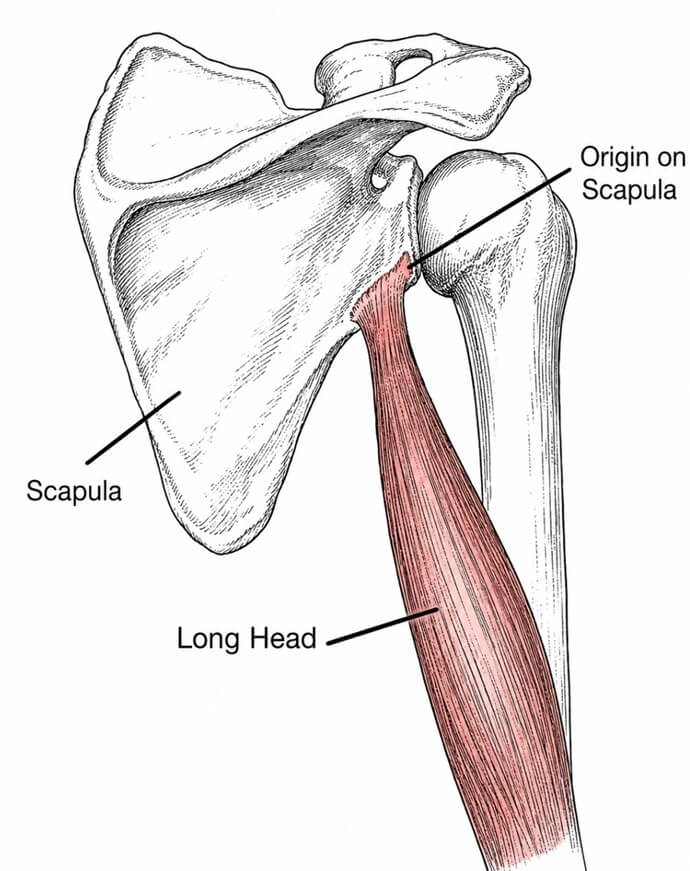
The cable overhead triceps extension trains all three heads of the triceps: the lateral head, the medial head, and the long head.
Here’s how these look:
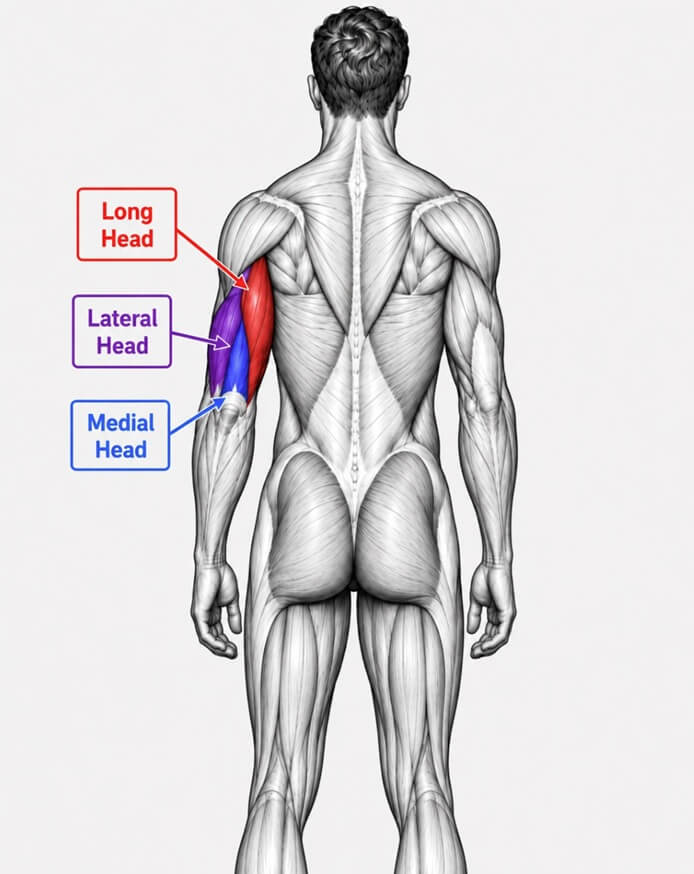
This is actually a unique feature of this exercise—most triceps exercises like the skullcrusher, triceps pressdown, triceps kickback, and so on—primarily train the triceps lateral and medial heads, but don’t thoroughly train the triceps long head.
The reason for this is that the triceps long head attaches to your scapula (shoulder blade), not your upper arm. The biomechanics are a little complicated, but the long and short of it (harhar) is that the triceps long head is best stimulated by triceps exercises that involve shoulder flexion—lifting your elbows above your head.
Here’s what this looks like:
For example, scientists at Ritsumeikan University had people perform cable overhead triceps extensions with one arm and cable triceps pushdowns with the other for 12 weeks.1 The arm that did overhead extensions experienced 50% more long-head triceps growth than the one doing pushdowns (28.5% vs. 19.6%), and about 25% more overall triceps growth (~20% vs. 14%).
This doesn’t mean you should only do overhead triceps extensions—other triceps isolation exercises have their merits—but it’s a good argument for including some overhead triceps training in your workout routine most of the time.
3 Cable Overhead Triceps Extension Workouts for Horseshoe Triceps
Here are three sample workouts incorporating the cable overhead triceps extension.
Chest Workout with Cable Overhead Triceps Extension
Barbell Bench Press: 3 sets of 4–6 reps
Incline Dumbbell Bench Press: 3 sets of 4–6 reps
Cable Overhead Triceps Extension: 3 sets of 8–12 reps
Lower Chest Cable Fly: 3 sets of 8–12 reps
Push Workout with Cable Overhead Triceps Extension
Incline Barbell Bench Press: 3 sets of 4–6 reps
Barbell Overhead Press: 3 sets of 4–6 reps
Cable Overhead Triceps Extension: 3 sets of 8–12 reps
Cable Fly: 3 sets of 8–12 reps
Upper Body Workout with Cable Overhead Triceps Extension
Dumbbell Bench Press: 3 sets of 4–6 reps
Pull-up: 3 sets of 4–6 reps
Cable Overhead Triceps Extension: 3 sets of 8–12 reps
Barbell Curl: 3 sets of 8–12 reps
Dumbbell Lateral Raise: 3 sets of 8–12 reps
The most common way to program the cable overhead triceps extension is toward the end of a push workout, chest day, or upper-body session after your compound pressing.
This works well because pressing already trains your triceps, but usually not enough to maximize hypertrophy on its own. Adding an overhead triceps extension on top ensures the triceps get the stimulus they need to grow—particularly the long head, which presses don’t train as effectively.
For most people, 2–3 sets of 8–12 reps works best, but you can also do sets with 6–8 reps of 12–15 reps depending on your preferences. (Some people claim the triceps respond best to lower reps because they’re a “fast-twitch” muscle, but the current body of evidence doesn’t support this idea.)
Here are a couple more workouts that incorporate the cable overhead triceps extension:
- The Best Back and Triceps Workout for Size & Strength
- The Best Chest and Triceps Workout for Building Muscle
What Height Should You Set the Cable?
You have two main options:
- Set the cable low (between hip height and the floor) and extend your arms upward toward the ceiling while standing upright.
- Set the cable higher (between hip and chest height), lean forward, and extend your arms out at about a 45-degree angle to the floor.
Here’s what each looks like:
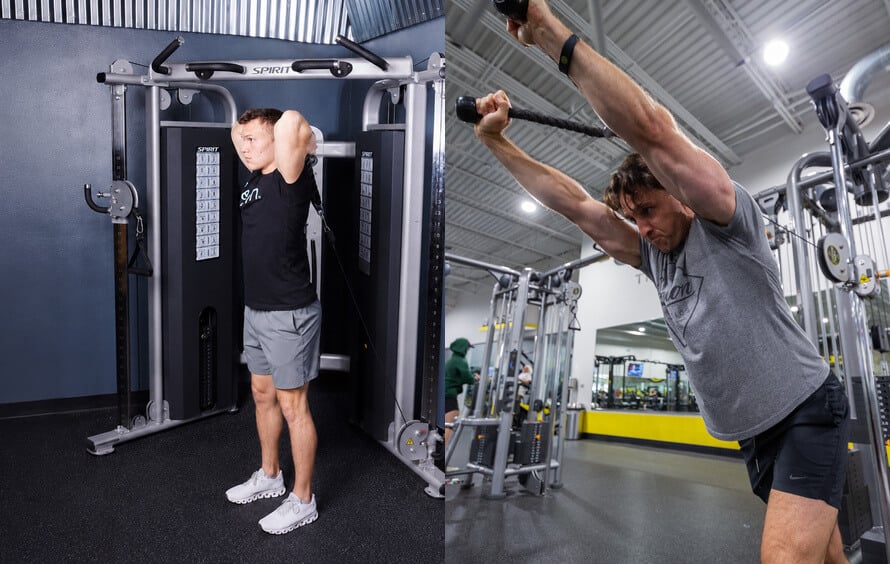
You’ll often see biomechanical shamans weightlifting gurus claim that one version is safer or more effective than the other, but this is hogwash. Your triceps don’t care whether the cable is 1–2 feet higher or lower whether you lean forward or stand more upright. Choose whichever position feels most comfortable and stable for you.
That said, most people find that as they get stronger and use heavier and heavier weights, they need to lean forward more to keep the weight from pulling them backwards. This isn’t because this position is inherently “better,” it just becomes necessary due to physics.
Personally, I now prefer the kneeling version of this exercise for precisely this reason. You set the cable at about waist height, put a pad on the floor, kneel facing away from the cable, lean forward against the weight, and otherwise perform the exercise in the same way. I find this makes it much easier to keep my torso stable when using heavy loads than the standing version, but your mileage may vary.
Which Handle Should You Use?
Most people prefer the rope handle and that’s what I typically use and recommend. It allows you to squeeze out a little more range of motion at the top of the rep, and doesn’t force your wrists or elbows into an unnatural position.
I also like the V-bar, as it makes the exercise a little more stable—the rope handle can sometimes shift a little and requires more grip strength, which can become awkward with heavier loads. Although some people find this bothers their wrists, I’ve never found that to be the case.
You can also use an EZ-bar or straight bar, but these tend to cause more wrist and elbow irritation than the rope or V-bar.
If you’d prefer to train each arm individually, you can also skip handles altogether and grab the cable. Some people find this more comfortable than training both arms simultaneously, but I don’t recommend it for most people for several reasons: it takes twice as long, it’s inherently less stable (which makes it harder to push heavy weights), and it can be very uncomfortable to grip the cable.
Overhead Cable Triceps Extension vs. Dumbbell Overhead Triceps Extension
The main advantage of the cable version over the dumbbell version is its resistance curve—which refers to how the difficulty of an exercise changes throughout the range of motion.
With a dumbbell, the tension is highest on your triceps at the bottom of the rep, when the dumbbell is behind your head. As you extend your arms to the upright position, the tension decreases, and for roughly the final quarter of each rep there’s almost no tension on your triceps. Instead, the weight is mostly being supported by your skeleton.
That’s not a huge deal—there’s still plenty of tension in your triceps when they’re stretched, which is arguably the most important part of the rep for muscle growth. With a cable, though, there’s consistent tension on your triceps throughout the entire rep. And in general, more tension on a muscle means more growth over time.
So while the dumbbell version is still a solid exercise that’s worth doing, the cable version will probably get you slightly better results over the long term.
The cable triceps extension also has a few practical advantages over the dumbbell version.
First, it’s much easier to get into position with a cable than with heavy dumbbells. While dumbbells are fine when you’re new to weightlifting, once you’re strong enough to lift ~25–50 lb. (lower end for women, higher end for men), it becomes awkward to maneuver the dumbbell into position. This is particularly true when taking your sets close to failure.
Second, the cable version is also generally easier on your wrists—with a dumbbell they’re forced into an awkward position that most people find uncomfortable when using heavy weights.
Plus, there’s no risk of dropping the dumbbell on your head when using a cable.
More Triceps Exercises
- How to Close-Grip Bench Press: Tips & Variations
- The 9 Best Exercises for Triceps Lateral Head Mass
- The 10 Best Dumbbell Exercises For Triceps Mass and Strength
- 7 Best Close-Grip Bench Press Alternatives for Triceps Mass
- The Best Workouts & Exercises for Building Horseshoe Triceps
Scientific References +
- ↩ Maeo S, Wu Y, Huang M, et al. Triceps brachii hypertrophy is substantially greater after elbow extension training performed in the overhead versus neutral arm position. Eur J Sport Sci. 2023;23(7):1240-1250.