- Instructions
- Expert Tips
- Workout Programming
- Mike's Take
- Low-to-High Cable Fly Alternatives
- 3 Low-to-High Cable Fly Workouts
- Muscles Worked by the Low-to-High Cable Fly
- More Chest Exercises
Table of Contents
+Instructions
- Adjust both pulleys on a dual cable machine to the lowest setting and attach the single-handle attachments.
- Grab a handle in each hand and stand between the pulleys so that the cables pull your arms out to your sides.
- Maintaining a slight bend in your elbows, take 1-to-2 steps forward so your arms are a little behind your torso with your palms facing forward and you feel a slight stretch in your pecs.
- Keeping your elbows slightly bent, bring your hands up and toward each other until they’re directly in front of your chest and a few inches apart.
- Hold this position for a brief moment, and then reverse the movement and return to the starting position.
Expert Tips
- The number one mistake people make with the low-to-high cable fly is excessively bending their elbows to make the exercise easier. This shortens the range of motion and increases activation of your triceps and front deltoids—essentially turning the fly into a sloppy chest press. If you have to bend your elbows more than about 30 degrees, you’re using too much weight.
- To check your form, record a video of your sets. Your elbows should hold the same slight bend from start to finish, and your hands should end up directly in front of your chest, a few inches apart. Some tutorials have you finish with your hands as high as your chin, but you don’t need to lift them that far.
- Keep your torso still throughout each rep. If you find yourself rocking your torso back and forth to finish each rep, the weight is too heavy. Drop it until you can complete every rep without shifting. Quality over quantity.
- Stand in a staggered stance (one foot in front of the other) and lean slightly forward over your front leg throughout each rep. This lowers your center of gravity and makes it much easier to stay stable through each rep.
- Before each set, lift your chest and pinch your shoulder blades together and down, and keep them there throughout each set.
- If you’re struggling to feel your pecs working, think about your pecs pulling your upper arms across your body rather than pushing the weight forward. Try the pec activation drill in my guide to setting up for the bench press, too.
Workout Programming
Program the low-to-high cable fly as part of a chest, push, or upper-body workout, usually after your main compound pressing exercises, such as the barbell bench press or incline barbell bench press.
A good default is 2–3 sets of 8–12 reps. Take each set 1–2 reps shy of failure—the point where you can’t move the weight with good form despite giving your maximum effort—and rest 2–3 minutes between sets.
This is one exercise that doesn’t play nicely with heavy weights and low-rep ranges—generally 8 is about the lowest I ever do or recommend. With heavy weights, it becomes difficult to maintain proper form, which makes the exercise less effective.
Mike’s Take
The low-to-high cable fly is a good chest exercise, especially if growing your upper chest is a priority. That said, I think there are better options for several reasons.
First, here’s what I like about this exercise:
-
It effectively isolates your pecs and isn’t limited by the strength of your triceps. With compound pressing exercises like the incline bench press, some people—especially those with long arms—find that their triceps fail before their chest is fully trained. Flyes rely far less on your triceps.
When researchers at Western Norway University of Applied Sciences compared barbell bench presses and dumbbell flyes in 17 trained men, average triceps activity was 75% higher during the press.1
-
It keeps constant tension on your pec muscles throughout the entire rep. That isn’t the case with the dumbbell fly, which feels hardest at the bottom of each rep, when your arms are spread wide, gets significantly easier as you raise the weights, and puts almost no tension on your pecs for roughly the last third of each rep.
-
It may emphasize your upper chest (more on this in a moment).
Now, here’s what I don’t like:
- The main downside is stability—you have to consciously focus on keeping your whole body as stable and stationary as possible during each rep. This becomes increasingly difficult as the weights get heavier, and it makes it harder to keep the focus on your pecs.
- Your front delts help lift your arms as you bring them together, and for some people, they give out before your chest does, ending the set before your pecs are fully trained.
- It takes more setup than a pec deck: you have to adjust both pulleys, attach the handles, step into position with a handle in each hand, and take up two towers of a cable station (which are often being used in most gyms).
- Some cable stations force you to add weight in large increments (5 pounds or more), which can make progressive overload more difficult.
Some people also argue that the low-to-high cable fly trains your pecs through a limited range of motion, but I don’t buy that argument. Your upper arms complete the same movement as they do in the bench press and pec deck. If anything, you can often get a bit more range of motion out of cable flyes.
The low-to-high cable fly is also probably better than the regular cable fly for training your upper chest (the clavicular head of your pecs). Pressing exercises that involve bringing your arms up and across your chest rather than straight across tend to better activate this portion of your pecs.2
For example, a study conducted by researchers at the Federal Institute of Sudeste of Minas Gerais had 30 untrained men train with flat presses, incline presses, or both on a Smith machine for eight weeks.3 The researchers then measured their chest muscle thickness at the top, middle, and bottom of their pecs.
The incline-only group gained about 6 mm more chest muscle thickness at the uppermost of three sites than the flat-only group, and about 5 mm more than the group that did both. Growth at the other two sites was similar.
The low-to-high cable fly trains your pecs with almost the same movement, so it’s reasonable to assume you’d see similar benefits. That said, another study found no increased upper chest activation when doing incline dumbbell flyes versus flat flyes, so it’s hard to say how much this really matters.4
Personally, I think it’s a generally good idea to include at least one exercise in your routine that specifically targets your upper pecs such as the incline barbell bench press, incline dumbbell bench press, low-to-high cable fly, or incline press machine.
Overall, I favor the pec deck over the cable fly. It’s easier to take your sets close or all of the way to failure, isn’t limited by your balance or the strength of other muscle groups, and is easy to set up and load in small increments over time.
That said, if you prefer low-to-high cable flyes, they’re a solid alternative if performed correctly.
And, of course, heavy flat and incline pressing should still make up the bulk of your chest training, regardless of what portion of the chest you’re trying to build.
You’ll also hear people call this exercise the low cable fly, the upper chest cable fly, or the low-to-high cable crossover.
Low-to-High Cable Fly Alternatives
- Pec Deck. This is my preferred alternative. The seat and back pad keep your body stable, so you can focus on contracting your pecs and safely take sets close to or all the way to failure.
- Incline Dumbbell Fly. A good option if your gym doesn’t have a cable station or it’s always busy.
- Cable Chest Fly. Basically the same exercise as the low-to-high cable fly, but you set the pulleys at shoulder height and bring your arms straight across your chest rather than up and across.
- Incline Bench Cable Fly. Lying on an incline bench between the pulleys makes it easier to keep your body stable and isolate your pecs, but it’s a pain in the butt to wheel a bench around the gym. I prefer the standing version.
- Incline Barbell Bench Press. Works just like the barbell bench press, except you set the bench on an incline, which helps emphasize your upper chest.
- High-to-Low Cable Fly. The one variation I tend not to recommend. While many say it’s the best fly for developing your lower pecs, the other cable fly variations work just as well, and it feels awkward for many people.
3 Low-to-High Cable Fly Workouts
Here are three sample workouts that show how to program the low-to-high cable fly.
Chest Workout with the Low-to-High Cable Fly
Barbell Bench Press: 3 sets | 4–6 reps | 2–3 min rest
Incline Dumbbell Bench Press: 3 sets | 6–8 reps | 2–3 min rest
Low-to-High Cable Fly: 3 sets | 8–12 reps | 2–3 min rest
Cable Lateral Raise: 3 sets | 8–10 reps | 2–3 min rest
Push Workout with the Low-to-High Cable Fly
Machine Chest Press: 3 sets | 6–8 reps | 2–3 min rest
Low-to-High Cable Fly: 3 sets | 8–12 reps | 2–3 min rest
Cable Lateral Raise: 3 sets | 8–10 reps | 2–3 min rest
Triceps Pushdown: 3 sets | 8–10 reps | 2–3 min rest
Upper-Body Workout with the Low-to-High Cable Fly
Dumbbell Bench Press: 3 sets | 6–8 reps | 2–3 min rest
Chest-Supported Machine Row: 3 sets | 6–8 reps | 2–3 min rest
Low-to-High Cable Fly: 3 sets | 8–12 reps | 2–3 min rest
Close-Grip Lat Pulldown: 3 sets | 6–8 reps | 2–3 min rest
Cable Lateral Raise: 3 sets | 8–10 reps | 2–3 min rest
Bayesian Curl: 3 sets | 8–10 reps | 2–3 min rest
Do two warm-up sets before your first exercise in each workout. On the first set, do 5 reps with about 50% of the weight you plan to use for your first hard set, and rest for 1–2 minutes. On the second, do 5 reps with about 80% of your target weight, and rest for 1–2 minutes.
To progress these workouts, use double progression: use a weight that allows you to work within the given rep range, take each set 1–2 reps shy of failure, and once you hit the top of the range for your first set, add weight.
Muscles Worked by the Low-to-High Cable Fly
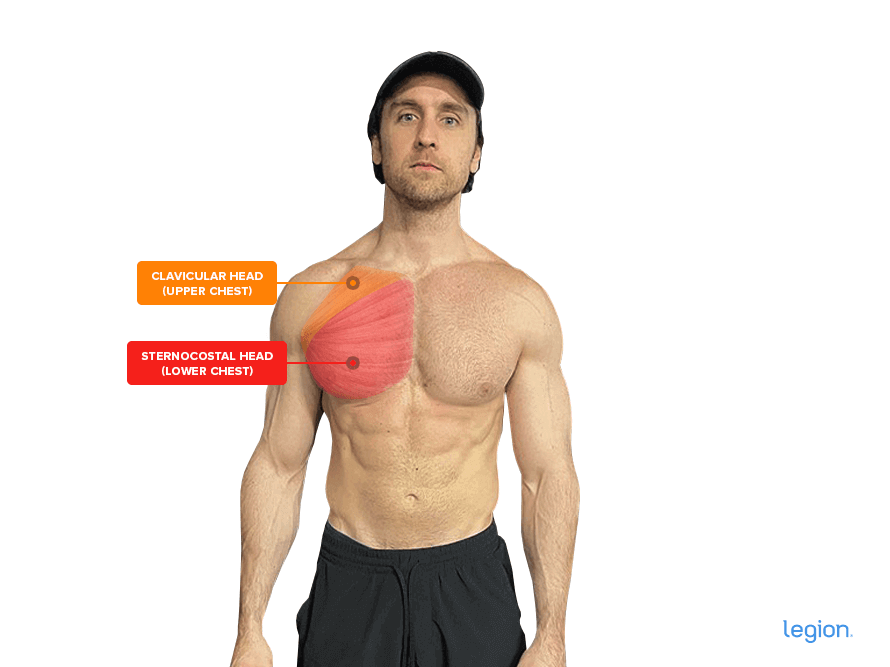
The low-to-high cable fly primarily trains your pecs (pectoralis major), which bring your upper arms toward the middle of your body (horizontal shoulder adduction). The upper portion of your pecs (the clavicular head) also helps raise your arms in front of you (shoulder flexion).
Your front delts (anterior deltoids) help raise your arms, while your traps and upper-back muscles stabilize your shoulder blades. Your forearms help you keep a firm grip on the handles, and your abs, lower-back muscles, hips, and legs keep your torso stable.
More Chest Exercises
- The Best Way to Do the Cable Chest Fly to Grow Your Pecs
- How to Do the Lower Chest Cable Fly (High-to-Low Cable Fly)
- How to Use the Pec Deck Machine (Machine Chest Fly)
- The Best Upper Chest Workouts & Exercises for Mass
Scientific References +
- ↩ Solstad TE, Andersen V, Shaw M, et al. A comparison of muscle activation between barbell bench press and dumbbell flyes in resistance-trained males. J Sports Sci Med. 2020;19(4):645-651.
- ↩ Rodríguez-Ridao D, Antequera-Vique JA, Martín-Fuentes I, et al. Effect of five bench inclinations on the electromyographic activity of the pectoralis major, anterior deltoid, and triceps brachii during the bench press exercise. Int J Environ Res Public Health. 2020;17(19):7339.
- ↩ Chaves SFN, Rocha-Júnior VA, Encarnação IGA, et al. Effects of horizontal and incline bench press on neuromuscular adaptations in untrained young men. Int J Exerc Sci. 2020;13(6):859-872.
- ↩ Reiser FC, de Moura JAR, Cardoso JMD, et al. Eletromiografia do exercício de crucifixo em diferentes planos e angulações de movimento. Rev Bras Prescr Fisiol Exerc. 2014;8(50):864-870.