- Instructions
- Expert Tips
- Workout Programming
- Mike's Take
- Reverse-Grip Lat Pulldown Alternatives
- 3 Reverse-Grip Lat Pulldown Workouts
- Muscles Worked by the Reverse-Grip Lat Pulldown
- More Back Exercises
Table of Contents
+Instructions
- Adjust the thigh pad so that it locks your legs in place and prevents your butt from rising off the seat when pulling the bar down.
- Grab the bar with your palms facing you and your hands about shoulder-width apart. Sit down, letting your body weight pull the bar down with you, and then wedge your legs underneath the thigh pad.
- Lift your chest upward and slightly arch your back, so that you’re leaning backward about 10–15 degrees.
- Relax your arms and shoulders, letting the weight pull your arms straight and your shoulders as high as possible (they should be almost touching your ears).
- Staring straight ahead, pull the bar down by bending your elbows and pulling your shoulder blades down and back simultaneously. Keep pulling until the bar touches your upper chest (or is at least 2–3 inches below your chin).
- Pause briefly, then reverse the movement to return to the starting position: straighten your arms and let the weight pull your shoulder blades as high as they’ll go.
Expert Tips
- If you struggle with pulling your shoulder blades down, practice this movement a few times during your warm-up (this is called a "shrug-down"). This may feel strange at first, but it’s the best way to ensure the lat pulldown effectively trains your traps.
- If your grip gives out before your lats do, use lifting straps. This prevents you from having to end your sets prematurely due to your grip giving out, allowing you to train your back, traps, and biceps more thoroughly.
- Avoid swinging your torso back and forth to finish your reps. It’s fine to lean back a little to help engage your lats and bring your chest closer to the bar, but avoid using momentum to make the exercise easier.
- Once you reach the point where you can’t pull the bar under your chin, don’t be afraid to do a few partial reps. These generally aren’t as effective for building muscle as full reps, but they’re better than cutting the set short, provided the reps stay controlled.
- If you can’t feel your lats working, don’t worry. Many people report the same thing. If you follow the steps above, your lats, traps, and biceps are all going to be thoroughly trained by this exercise.
Workout Programming
Use the reverse-grip lat pulldown as a vertical pulling exercise in a back, pull, or upper-body workout.
Most people do this as the second or third exercise in their workout, often after barbell exercises like the bench press, deadlift, or overhead press. If you’re specifically trying to develop your biceps and back, you can also do it as one of the first exercises in your workout.
Start with 2–3 sets of 6–8 reps, resting 2–3 minutes between sets, and finishing each set 1–2 reps shy of failure (the point where you can’t move the weight with good form despite giving your maximum effort).
Mike’s Take
The reverse-grip lat pulldown (aka underhand or supinated lat pulldown) is an outstanding but often underappreciated pulldown variation for training your lats, biceps, and traps. It’s basically a chin-up performed using a lat pulldown machine instead of your bodyweight. Or, put differently, a lat pulldown with a chin-up grip.
It allows you to effectively train your lats, biceps, lower traps, and mid-back simultaneously, add weight in small increments, and safely take your sets close or all of the way to failure. Almost every gym has one, too, so you can do it nearly anywhere.
Another benefit of this exercise is that it requires very little coordination or balance compared to exercises like pull-ups or chin-ups, so you can focus entirely on contracting your muscles as hard as possible. And, if you’re a beginner, you can start with relatively light weights (which isn’t possible with the chin-up or pull-up).
One downside of this exercise is that some cable machines force you to add weight in larger increments (often 10–20 pounds), whereas with a plate-loaded lat pulldown machine, you can add weight in much smaller increments (typically 2.5–5 pounds).
Now, why do the reverse-grip lat pulldown over the regular lat pulldown or the close-grip lat pulldown?
All three of these exercises are very similar and which one you choose largely depends on your anatomy and personal preferences.
That said, there are a few differences:
- The reverse-grip lat pulldown will generally involve your biceps a bit more than the close-grip or regular lat pulldown.
- The regular lat pulldown will generally involve your lats a bit more than the close-grip or reverse-grip lat pulldown.
- The close-grip lat pulldown will generally involve your brachialis (the muscle along the side of your upper arm) more than the regular lat pulldown or reverse-grip lat pulldown.
It’s worth noting that not all research agrees with this. For example, a study conducted by researchers at Pennsylvania State University compared wide and narrow overhand and underhand pulldowns in 12 men. They found greater lat muscle activity with an overhand grip and no significant difference in biceps or middle-trap activity between grips.1
That said, anecdotally and based on my experience working with tens of thousands of men and women through my books, coaching, and this website, and interviewing hundreds of experts on the Muscle for Life podcast, I think the above generalization is true for most.
The reverse-grip lat pulldown is also a good alternative if the regular lat pulldown irritates your shoulders. Plus, some people find they’re able to use a longer range of motion with the reverse-grip and close-grip lat pulldown than the regular version.
My usual advice is to try all three of these variations and see which one you prefer. Then, stick with it for at least 6–8 weeks, and then either continue with the one you like most or try a different one.
Reverse-Grip Lat Pulldown Alternatives
- Lat Pulldown. The same basic exercise, but performed with an overhand grip. Use a grip around shoulder-width or slightly wider.
- Close-Grip (V-Grip) Lat Pulldown. Almost identical to the reverse-grip lat pulldown, but with your hands facing each other instead of facing you.
- Single-Arm Lat Pulldown. This is a great variation of the regular lat pulldown that many people find more comfortable. It allows you to lift slightly more weight in total, but it also forces you to make larger relative jumps in weight, can feel awkward with heavier weights, and takes twice as long to finish each set.
- Lat Pulldown Machine. With a plate-loaded lat pulldown machine, you can add weight in much smaller increments (typically 2.5–5 pounds) than on many cable machines. It also requires even less coordination.
- Pull-Up. An outstanding alternative that trains all of the same muscles, but it’s harder to learn and perform and less convenient to load.
- Chin-Up. Almost identical to the pull-up, but it may emphasize your biceps slightly more. You can use these exercises interchangeably.
- Cable Pullover (Straight-Arm Lat Pulldown). This is basically a lat pulldown performed without bending your elbows. It’s one of the best lat isolation exercises you can do, but it doesn’t meaningfully train your biceps, traps, or grip strength.
3 Reverse-Grip Lat Pulldown Workouts
Here are three sample workouts that show you how to program the reverse-grip lat pulldown.
Back Workout with the Reverse-Grip Lat Pulldown
Chest-Supported Machine Row: 3 sets | 6–8 reps | 2–3 min rest
Reverse-Grip Lat Pulldown: 3 sets | 6–8 reps | 2–3 min rest
Machine Rear Delt Fly: 3 sets | 8–10 reps | 2–3 min rest
Barbell Shrug: 3 sets | 8–10 reps | 2–3 min rest
Pull Workout with the Reverse-Grip Lat Pulldown
Barbell Deadlift: 3 sets | 4–6 reps | 2–3 min rest
Chest-Supported Machine Row: 3 sets | 6–8 reps | 2–3 min rest
Reverse-Grip Lat Pulldown: 3 sets | 6–8 reps | 2–3 min rest
EZ-Bar Curl: 3 sets | 8–10 reps | 2–3 min rest
Upper-Body Workout with the Reverse-Grip Lat Pulldown
Barbell Bench Press: 3 sets | 4–6 reps | 2–3 min rest
Chest-Supported Machine Row: 3 sets | 6–8 reps | 2–3 min rest
Incline Dumbbell Bench Press: 3 sets | 6–8 reps | 2–3 min rest
Reverse-Grip Lat Pulldown: 3 sets | 6–8 reps | 2–3 min rest
To progress these workouts, use double progression: use a weight that allows you to work within the given rep range, take each set 1–2 reps shy of failure, and once you hit the top of the range for your first set, add weight.
Muscles Worked by the Reverse-Grip Lat Pulldown
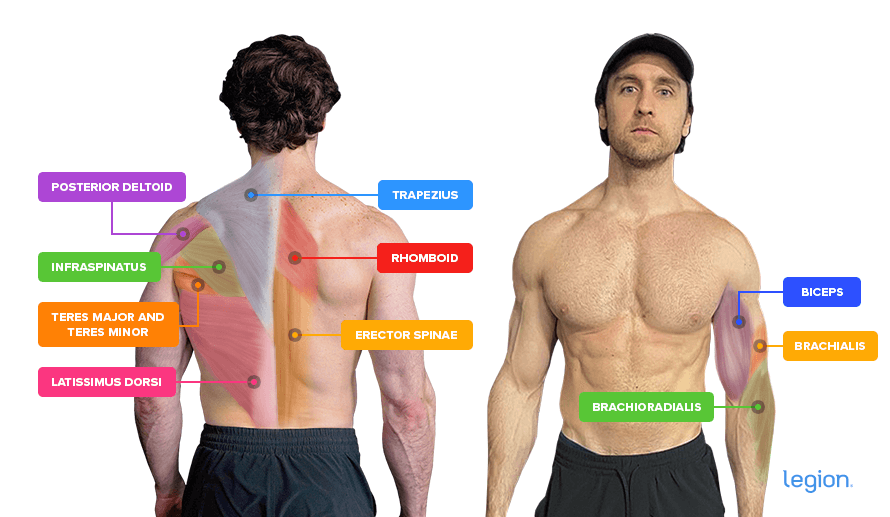
The reverse-grip lat pulldown primarily trains your lats (latissimus dorsi), which bring your upper arms down toward your torso (shoulder extension), and your lower traps (trapezius), which pull your shoulder blades down (scapular depression).
Your biceps, brachialis, and brachioradialis help pull the bar down by bending your elbows. Your rear delts (posterior deltoids) help pull your upper arms back. Your forearms help you keep a firm grip on the bar, and your lower-back muscles keep your torso stable.
More Back Exercises
- The 13 Best Lat Exercises and 3 Lat Workouts
- The Best Way to Do the One-Arm Dumbbell Row
- Chest-Supported Row: Alternatives, Muscles Worked, and Form
Scientific References +
- ↩ Lusk SJ, Hale BD, Russell DM. Grip width and forearm orientation effects on muscle activity during the lat pull-down. J Strength Cond Res. 2010;24(7):1895-1900.