
- Instructions
- Expert Tips
- Workout Programming
- Mike’s Take
- Standing Cable Curl Alternatives
- 3 Standing Cable Curl Workouts
- Muscles Worked by the Standing Cable Curl
- More Biceps Exercises
Table of Contents
+Instructions
- Attach a straight bar or EZ-bar to a cable machine in its lowest position, and hold it with your palms facing away from you.
- Face the cable machine and step back until your hands are supporting the weight.
- Curl the bar toward your chest as far as you can until your forearms run into your biceps, allowing your elbows to move forward slightly as the bar rises, so the bar ends up in front of your shoulders.
- Pause for a brief moment, and then lower the bar and return to the starting position.
Expert Tips
- Allow your elbows to move forward a few inches as the bar rises, but don’t force your elbows forward to increase the range of motion. While this lets you lift more weight, it’s because you’re relying more on your front delts, not because your biceps are working harder.
- Keep your torso as still as possible throughout the entire set. Don’t heave your body back and forth or shrug your shoulders to make your reps easier. Brace your abs and glutes throughout each rep and keep your shoulders pressed down.
- Use a full range of motion: lower the bar until your arms are straight and lift it to the same height you did on your first rep.
- Use a straight bar or EZ-bar, whichever is most comfortable for you.
Workout Programming
Generally, it’s best to do the standing cable curl after your heavier, more technical exercises in a pull or upper-body workout. Or, if you’re specifically trying to develop your biceps, you can also do it as one of the first exercises in your workout, as in the arm workout below.
A good default is 3 sets of 6–8 reps. Take each set 1–2 reps shy of failure—the point where you can’t move the weight with good form despite giving your maximum effort—and rest 2–3 minutes between sets.
Mike’s Take
The standing cable curl is one of my favorite biceps exercises because it’s effective at isolating the biceps, safe, simple, and easy to learn, and allows you to take your sets close or all of the way to failure.
How does the standing cable curl compare to the standing barbell curl? Both exercises are basically identical and you can program them interchangeably, with a few caveats.
Depending on the cable station at your gym, the barbell curl may allow you to add weight in smaller increments. For example, some cable stations force you to add weight in 10–20 pound increments, whereas most gyms have plates that allow you to add weight in 5–10 pound increments to a barbell (2.5–5 pounds per side).
One downside of the standing cable curl is that it probably doesn’t stimulate the long head of the biceps as effectively as exercises that position your elbow behind your torso (also true of the barbell curl and standing dumbbell curl). I say probably because the evidence on this is still a bit murky and it’s debatable how much this really matters, especially if you’re training close to failure with proper form.
Of course, you can always do both regular curls and curls with your elbows behind your torso, which is what I do and recommend. Practically, this could mean doing standing cable curls one day and Bayesian cable curls or incline dumbbell curls another.
Or, you could just focus on standing cable curls for 6–8 weeks and then focus on Bayesian cable curls or incline dumbbell curls for 6–8 weeks—it just depends on how often you’re training your biceps and your personal preferences.
Research also shows that curls are particularly effective at building your biceps, even if you’re already doing compound exercises that train your upper arms.
For example, a 2021 study conducted by researchers at the Federal University of Rio de Janeiro had 10 untrained men train one arm with dumbbell curls and the other with dumbbell rows for 8 weeks.1
The thickness of their elbow flexors—the muscles that bend the elbow like your biceps—increased by about 11% in the curl-trained arm and 5% in the row-trained arm. In other words, the dumbbell curl was simply more effective at building the biceps than the dumbbell row.
This study was on dumbbell curls, of course, but the standing cable curl is the same movement, so it’s fair to assume the same thing holds true.
You can program standing cable curls after pulling exercises like the dumbbell row, lat pulldown, machine row, and so on. This way, you get the best of both worlds: your biceps, lats, traps, and mid-back all get trained by the rows, and your biceps get additional volume from the curls to maximize arm development.
Standing Cable Curl Alternatives
- Barbell Curl. The barbell curl lets you use a barbell instead of a cable machine. Use whichever allows you to gradually add weight or better suits your preferences.
- Dumbbell Curl. Some people find this more comfortable, but it can also be more difficult to stabilize the weights and awkward to perform.
- Incline Dumbbell Curl. The incline dumbbell curl trains your biceps while your upper arms are behind your torso, which helps emphasize the long head of your biceps.
- Bayesian Cable Curl. The Bayesian curl is basically the same movement as an incline dumbbell curl, but performed standing, with a cable, and is almost always performed one arm at a time. It’s one of my favorite biceps exercises.
- Dumbbell Preacher Curl. In the dumbbell preacher curl, you place your upper arms against a preacher curl bench. This makes it hard to use momentum to cheat so your biceps do most of the work.
- Dumbbell Hammer Curl. The dumbbell hammer curl uses a neutral grip (palms facing each other), which many people find more comfortable than the traditional palms-up (supinated) grip and also helps emphasize the brachialis (the muscle beneath your biceps).
- Machine Biceps Curl. A machine curl supports your upper arms against a pad, making it harder to use momentum to lift the weight.
3 Standing Cable Curl Workouts
Here are three sample workouts that show how to program the standing cable curl as part of an arm, pull, or upper-body workout.
Arm Workout with the Standing Cable Curl
Standing Cable Curl: 3 sets | 6–8 reps | 2–3 min rest
Cable Overhead Triceps Extension: 3 sets | 6–8 reps | 2–3 min rest
Bayesian Cable Curl: 3 sets | 6–8 reps | 2–3 min rest
EZ-Bar Skullcrusher: 3 sets | 6–8 reps | 2–3 min rest
Pull Workout with the Standing Cable Curl
Barbell Deadlift: 3 sets | 4–6 reps | 2–4 min rest
Seated Cable Row: 3 sets | 6–8 reps | 2–4 min rest
Close-Grip Lat Pulldown: 3 sets | 6–8 reps | 2–3 min rest
Standing Cable Curl: 3 sets | 6–8 reps | 2–3 min rest
Upper-Body Workout with the Standing Cable Curl
Barbell Bench Press: 3 sets | 6–8 reps | 2–3 min rest
Seated Machine Row: 3 sets | 6–8 reps | 2–3 min rest
Incline Dumbbell Bench Press: 3 sets | 6–8 reps | 2–3 min rest
Standing Cable Curl: 3 sets | 6–8 reps | 2–3 min rest
Cable Lateral Raise: 3 sets | 8–10 reps | 1–2 min rest
To progress these workouts, use double progression: use a weight that allows you to work within the given rep range, take each set 1–2 reps shy of failure, and once you hit the top of the range for your first set, add weight.
Muscles Worked by the Standing Cable Curl
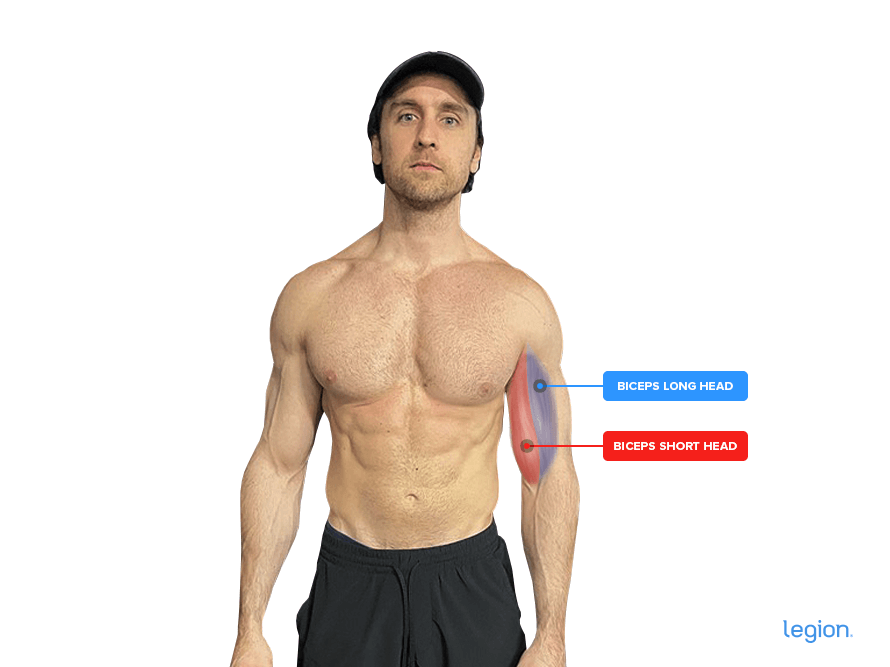
The standing cable curl primarily trains your biceps (biceps brachii), which bend your elbows (elbow flexion).
Your brachialis (the muscle beneath your biceps) and brachioradialis (a muscle on the thumb side of your forearm) also help bend your elbows. Your forearm muscles keep a firm grip on the bar, and your core, glutes, and rotator cuff muscles stabilize your torso and shoulders.
More Biceps Exercises
- The 4 Best Biceps Workouts and 12 Best Biceps Exercises
- How to Do Dumbbell Curls with Proper Form
- The Best Way to Do the Incline Dumbbell Curl
- The Best Way to Do the Preacher Curl for Stronger, More Defined Biceps
Scientific References +
- ↩ Mannarino P, Matta T, Lima J, et al. Single-joint exercise results in higher hypertrophy of elbow flexors than multijoint exercise. J Strength Cond Res. 2021;35(10):2677-2681.